Paper 2 Essay Skills
Know the official task
Paper 2 offers six questions in 150 minutes:
- three questions focusing mainly on microeconomics in Section A;
- three questions focusing mainly on macroeconomics in Section B;
- answer three questions, with at least one from each section;
- each question contains part (a), worth 10 marks, and part (b), worth 15 marks.
Question selection is a decision under scarcity. Choose three complete 25-mark questions, not three attractive sub-parts. A familiar keyword in part (a) is not enough if part (b) cannot be analysed and evaluated well.
In the audited corpus, 118 of 120 part (a) prompts used explain, while part (b) commonly used discuss, assess or consider. This supports an analysis-to-evaluation pattern, but the actual command and scope always control your answer.
Key essay terms
| Term | Meaning |
|---|---|
| thesis | your provisional answer or organising position, to be tested rather than merely asserted |
| scope | the agents, effects, policy, economy and time horizon the question requires |
| criterion | the common standard used to rank arguments or policies |
| causal paragraph | one developed line of reasoning from initiating change to relevant outcome |
| counterargument | a reason the initial claim may be incomplete, weaker or outweighed—not simply its grammatical opposite |
| evaluation | explanation of how a condition changes magnitude, direction, relevance or ranking |
| synthesis | combination of arguments into comparison, sequencing, complementarity or contingency |
| judgement | a reasoned final ranking that answers the exact question |
Select questions systematically
Create a quick grid for all plausible choices:
| Test | Question 1 | Question 2 | Question 3 |
|---|---|---|---|
| Can I define every controlling term? | |||
| Can I meet every requirement in part (a)? | |||
| Can I develop competing arguments in part (b)? | |||
| Do I know the relevant model or diagram? | |||
| Can I apply the context accurately? | |||
| Can I make a criterion-based judgement? |
Then verify the section rule. Do not spend so long choosing that writing time becomes scarce.
Deconstruct before planning
Convert the stem into a compact task line:
command + issue + outcome + agent + context + scope + criterion
Example:
Assess whether supply-side policy is the best way for a small open economy to achieve sustainable growth.
The answer must:
- analyse how supply-side policy affects sustainable growth;
- compare it with feasible alternatives because “best” is comparative;
- use conditions relevant to a small open economy;
- define sustainable growth rather than equate it with any rise in real GDP;
- use a common criterion such as durability, trade-offs and feasibility; and
- make a decision.
If one of these objects disappears from the plan, the answer has drifted from the question.
A flexible essay architecture
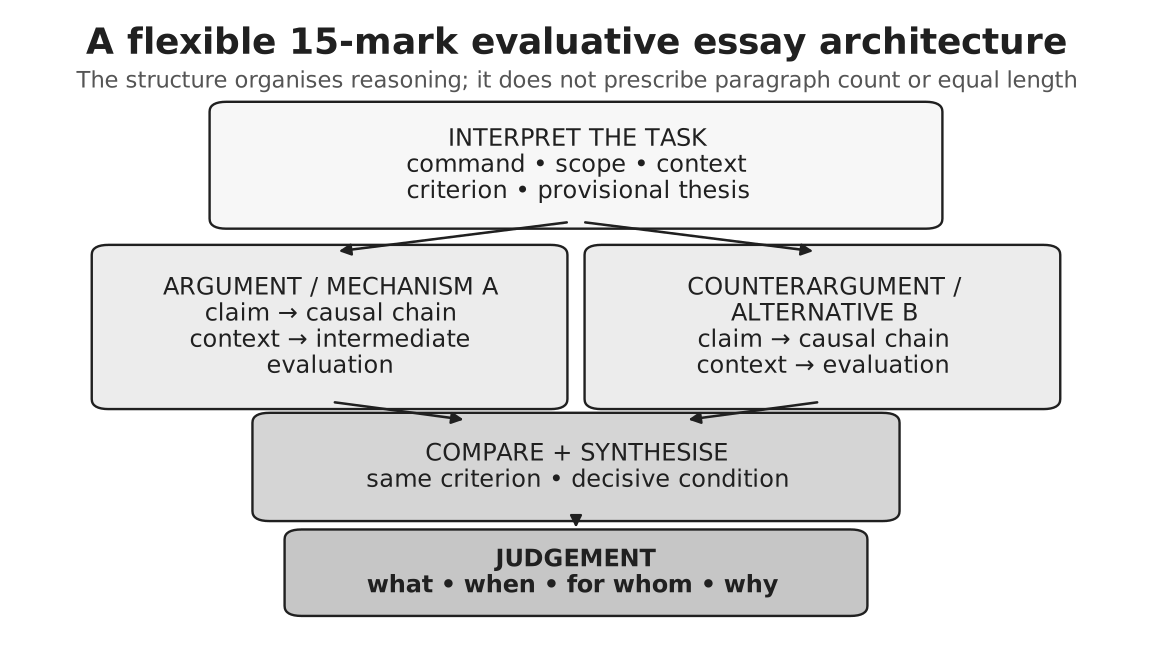
Caption: Begin at the top by interpreting the command, scope and decision criterion. The two main branches represent developed arguments or alternatives, each with its own mechanism, context and intermediate evaluation. They reconverge at comparison and synthesis before the final judgement. The two branches do not impose exactly two body paragraphs or equal treatment; they show that a 15-mark response needs more than one defensible perspective and must compare them.
Introduction
A functional introduction should:
- define terms that control the argument;
- clarify scope or a necessary assumption;
- identify the criterion for comparison;
- state a provisional thesis.
It should not become a history lesson or a list of everything known about the topic.
Analytical paragraph
Use the following as a diagnostic scaffold:
claim → economic mechanism/model → context → outcome → intermediate evaluation
Each paragraph should perform a distinct analytical job. Two complete mechanisms are often stronger than five named but truncated points.
Counterargument
A counterargument can show that:
- another cause is more important;
- the mechanism depends on a weak assumption;
- an effect changes over time;
- one stakeholder gains while another loses;
- a policy creates another objective conflict;
- an alternative instrument targets the root cause more closely.
It need not be the exact opposite of the first argument.
Synthesis and conclusion
Synthesis compares arguments rather than merely placing them side by side. A conclusion should state:
- which argument or policy ranks highest;
- according to which objective;
- under what condition;
- for whom;
- over what time horizon; and
- why the alternative ranks lower or acts as a complement.
Part (a): the 10-mark analytical task
A typical part (a) rewards accurate, sustained explanation and analysis. It may require more than one cause, effect or group, so underline every object in the stem.
Worked skeleton
Question type:
Explain how a depreciation of the exchange rate may affect real output and inflation.
A proportionate plan could be:
- Define depreciation and state the relevant ceteris-paribus condition.
- Export prices in foreign currency fall and import prices in domestic currency rise.
- If demand is sufficiently responsive and domestic supply can expand, net exports rise.
- Aggregate demand rises, increasing real output and demand-pull pressure depending on spare capacity.
- More expensive imported inputs raise firms’ costs, shifting SRAS left and adding cost-push inflation.
- Use an AD–AS diagram and explain both channels.
This is one coherent answer with two mechanisms. A long evaluation section is unnecessary unless the command asks for it, but material conditions belong in the analysis because they determine whether the mechanisms operate.
Part (b): the 15-mark evaluative task
A typical part (b) asks whether a proposition, policy or explanation is convincing. “Balanced” does not mean equal paragraph length or one advantage plus one disadvantage. It means the final judgement has survived serious testing.
Worked skeleton
Question type:
Assess whether exchange-rate appreciation is the best response to imported inflation in a small open economy.
Possible structure:
- Argument for: appreciation lowers domestic-currency prices of imports and may reduce cost-push pressure quickly.
- Contextual evaluation: effect is stronger when imports form a large share of consumption and production; weaker where contracts or pricing delay pass-through.
- Counterargument: appreciation reduces export competitiveness and may lower net exports, output and employment.
- Alternative: supply-side measures or targeted fiscal support may address domestic cost or distributional problems, but often with longer lags.
- Synthesis: appreciation may be the strongest short-run instrument when inflation is predominantly imported and external demand is resilient; a targeted complement can protect vulnerable households without broadly stimulating demand.
- Judgement: rank policies against inflation control, output cost, speed and feasibility.
The example demonstrates a reasoning structure, not a memorisable answer.
Related but independently answerable parts
Part (a) often establishes concepts useful for part (b), but part (b) must contain the reasoning needed to understand its own argument. Avoid writing:
As shown in part (a), the policy works.
Instead restate the relevant mechanism concisely in part (b), then evaluate or extend it. A marker assesses each part against its own demand.
Application: context must do analytical work
Weak:
Singapore is a small open economy.
Stronger:
In a highly import-dependent economy, exchange-rate appreciation can restrain imported inflation directly. Its output cost may nevertheless be significant where exports are price-sensitive and external demand is weak.
The context changes both transmission and evaluation.
Useful context can come from:
- a fact supplied in the stem;
- a carefully selected real-world example;
- structural characteristics such as openness, spare capacity or market dominance;
- a named stakeholder or policy constraint.
Do not invent statistics. A correct mechanism applied to a relevant characteristic is stronger than a precise-looking but uncertain number.
Diagram expectations
Few audited Paper 2 stems explicitly said “diagram”, yet school answer guides often used diagrams when the model was central. Ask whether a diagram would:
- establish equilibrium and the change being analysed;
- make a welfare, profit or macroeconomic effect precise;
- distinguish short-run from long-run adjustment; or
- make policy comparison clearer.
If yes, draw and explain it. If not, a generic graph adds no value. One accurate and integrated diagram is better than several familiar sketches.
Comparing policies fairly
Use common criteria:
| Criterion | Questions to ask |
|---|---|
| targeting | Does the instrument address the root cause or only a symptom? |
| speed | How quickly does transmission begin, and are there recognition or implementation lags? |
| magnitude and reliability | How responsive are agents, and how certain is the effect? |
| other objectives | What happens to growth, inflation, employment, equity or external balance? |
| distribution | Which groups gain, lose or bear adjustment cost? |
| fiscal/administrative cost | What resources and institutional capacity are required? |
| long-run capacity | Does the policy alter productive potential or only current demand? |
| government-failure risk | Are information, enforcement or unintended-response problems material? |
Do not compare policy A on speed with policy B on equity and then declare a winner. Rank both against the same priority.
Planning under time pressure
A compact plan should contain:
- thesis and scope;
- two or three complete causal chains;
- diagram choice and change;
- one contextual application per major argument;
- material evaluation conditions;
- a final ranking.
Avoid writing full prose in the plan. Its purpose is to prevent drift, repetition and missing requirements.
Suggested pacing
Equal-mark pacing gives about 50 minutes per complete 25-mark question. The paper also requires question selection, planning and checking. This is a baseline, not an official prescribed split; timed practice should determine how you divide time between parts (a) and (b).
Common essay problems
- Choosing a question because only one part looks familiar.
- Explaining the topic rather than answering the exact command.
- Ignoring one object in a compound part (a).
- Treating a named example as application without using it.
- Repeating one mechanism with different vocabulary.
- Adding a generic “however” paragraph unrelated to the criterion.
- Comparing policies on different objectives.
- Drawing several diagrams but explaining none.
- Claiming “a policy mix is best” without roles, sequencing or compatibility.
- Treating equal paragraph length as required balance.
- Introducing a new major argument in the conclusion.
- Ending with a different criterion from the body.
Final check
- Did I answer both parts independently?
- Did I satisfy every command, object and qualifier?
- Is each major claim supported by a complete causal chain?
- Does context alter the reasoning?
- Is every diagram accurate and explained?
- Did evaluation change the strength or ranking of an argument?
- Does the judgement identify a decisive criterion and condition?
Return to Case Study and Essay Skills.