Indicative essay-marking standard
Part (a): 10 marks
- Upper level: accurate, coherent and sufficiently developed explanation covering the full requirement; assumptions are made explicit; diagrams and context perform analytical work.
- Middle level: generally correct but incomplete, unevenly developed or weakly applied.
- Lower level: fragmented definitions, assertion, serious model error or failure to address a material part of the question.
Part (b): 15 marks
A strong response combines developed analysis with contextual evaluation. It compares arguments or policies using common criteria, identifies the conditions that change their relative importance, and reaches a supported judgement. Generic advantages/disadvantages or a bare “it depends” should not receive high evaluation credit.
These are formative descriptors derived from recurring corpus patterns, not official Cambridge or school-specific mark bands.
Paper 2 Practice: Integrative Economics Skills — Outlines
Indicative rather than exhaustive
Use these outlines to audit causal links, application, criteria and judgement—not as scripts to memorise.
Questions: Integrative Economics Skills.
Question 1(a) [10]
Define a binding minimum payment and specify the relevant labour-service market. Higher worker remuneration may increase labour supplied while platforms reduce quantity demanded, substitute technology, raise fees or accept lower profit. Some retained workers gain; displaced workers may lose; consumers may pay more or receive slower service. In a competitive benchmark, a binding floor can create excess labour supply. If a platform has wage-setting power, however, a moderate floor may raise both payment and employment over some range. Outcomes depend on elasticities, market power, worker status, enforcement and pass-through. Explain adjustment rather than asserting unemployment mechanically.
Question 1(b) [15]
Use explicit criteria: earnings adequacy, congestion external cost, employment, consumer access and administrative feasibility. A minimum payment targets low remuneration but may miss hours and expenses. A congestion charge internalises marginal external cost more directly, but requires measurement and may shift traffic. Alternatives include earned-income support, bargaining rights, zoning and differentiated peak charges.
The instruments address different failures and may complement one another, but their calibration matters. Recommend a monitored minimum earnings standard net of necessary costs plus location/time-differentiated congestion pricing where evidence supports it. Revise if labour-demand loss or diversion is large. A valid alternative must compare policies against the same concerns.
Question 2(a) [10]
Higher government purchases directly raise AD; tax reductions raise disposable income and consumption depending on MPC. Multiplier rounds can magnify the initial domestic injection. With spare capacity, firms raise output and derived demand for labour, while the GPL also tends to rise. Imports, saving, taxes, confidence, lags and crowding out affect magnitude. Distinguish an AD effect from any later productive-capacity effect of public investment.
Question 2(b) [15]
Expansion can reduce demand-deficient unemployment but risks intensifying inflation and import expenditure. Imported energy inflation is a supply shock, so broad demand stimulus is not a cure. Targeted income support protects vulnerable households; energy efficiency and diversification reduce exposure; retraining addresses structural mismatch. Monetary or exchange-rate restraint may lower imported inflation but weaken recovery.
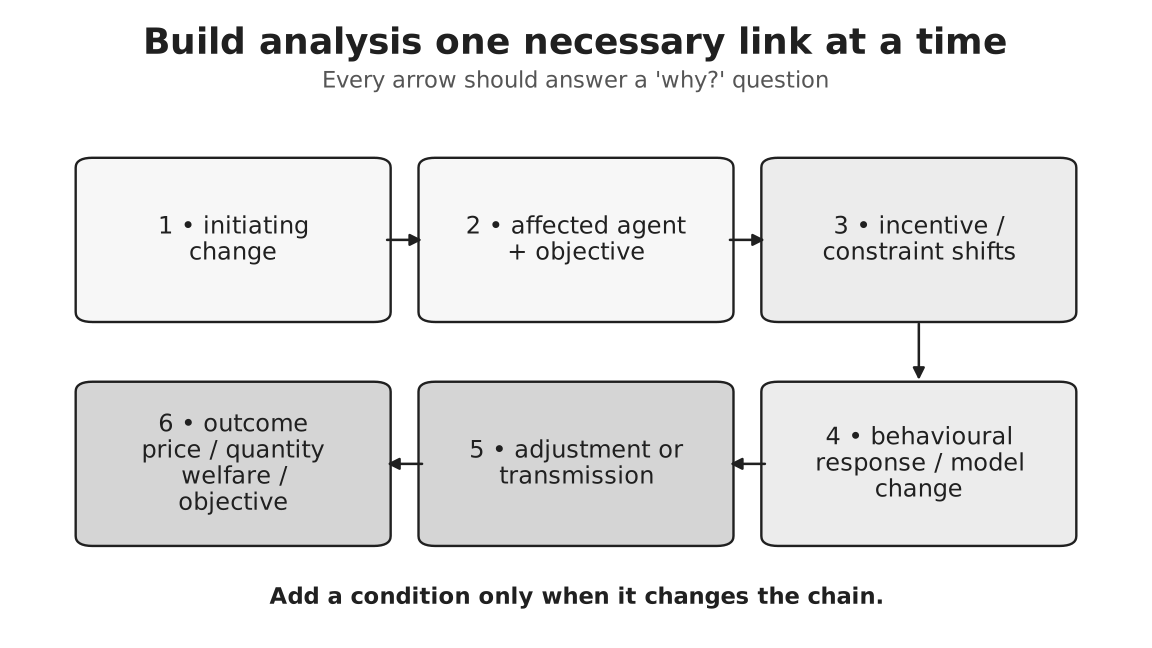
Caption: Test each proposed policy by tracing the instrument through agent incentives and intermediate changes to the final living-standard objective.
Prioritise targeted temporary fiscal support and high-readiness capacity-enhancing investment, with calibrated monetary restraint if expectations deteriorate. Evaluate domestic content, spare capacity, energy-price persistence, fiscal space, distribution and time lags. Conclude using material and non-material living standards, not GDP alone.
Question-specific formative marking framework
Use the working ranges in the shared Economics formative marking framework.
| Part | Requirements for the strongest working range | Diagnostic ceiling and alternatives |
|---|---|---|
| 1(a), 10 | Establish the competitive binding-minimum benchmark, trace worker/platform/consumer effects and qualify the result for labour-market power, productivity or platform responses. | Mechanical unemployment claims without assumptions should normally remain below 8. A monopsony route is valid when clearly contrasted with the benchmark. |
| 1(b), 15 | Diagnose labour-income and congestion concerns separately, analyse both instruments and alternatives, compare calibration, incidence and interaction, then judge the package. | Two isolated mini-essays without policy interaction or a common criterion should normally remain below 12. |
| 2(a), 10 | Trace expansionary fiscal policy through AD, multiplier, output and employment while explaining why GPL effects depend on spare capacity and imported inflation. | “Government spending increases GDP” without transmission should normally remain below 7. A diagram is useful only if its shift and equilibrium are explained. |
| 2(b), 15 | Build a policy mix that addresses demand weakness and imported cost pressure, comparing fiscal, monetary, supply and distributional measures across timing and objectives. | GDP growth alone is not a sufficient living-standard judgement. Different mixes are valid if the inflation–unemployment conflict is confronted. |
Common errors and self-check
Do not treat every wage floor, fiscal expansion or monetary response as having a context-free effect. Check that each essay states the model assumptions, traces a complete causal chain, compares alternatives on one criterion and gives a judgement that changes when material conditions change.