Paper 1 Practice: Asteria’s Resource Choices — Answers
How to use this guide
The points are indicative rather than an exhaustive official mark scheme. Credit other economically valid reasoning that answers the question and fits the case evidence. For the 8- and 10-mark responses, quality of analysis, use of evidence, evaluation and judgement matter more than reproducing every listed point.
Question 1(a)(i) [2]
Moving from C to D raises resilience projects from 2 to 3 and reduces household-service packages from 108,000 to 96,000:
The opportunity cost of the additional resilience project is 12,000 household-service packages.
Indicative allocation:
- correct change: 1 mark;
- correct answer with unit: 1 mark.
Question 1(a)(ii) [2]
From B to C, the opportunity cost is:
The C-to-D opportunity cost of 12,000 packages is 4,000 packages greater than the B-to-C opportunity cost of 8,000 packages. Equivalently, it is 1.5 times as large. Either explicit comparison is valid.
Indicative allocation:
- identifies the B-to-C cost as 8,000 packages: 1 mark;
- makes an explicit, accurate comparison: 1 mark.
Question 1(b) [4]
Scarcity exists because Asteria’s wants exceed the limited resources available to satisfy them, and those resources have alternative uses. Although some general construction labour is unemployed, the island still has limited land, engineering supervisors, specialised equipment and public revenue. Labour cannot produce the desired output without these complementary resources.
Using workers and equipment for coastal protection also means forgoing household services or another next-best use. Unemployment shows that actual output can lie inside the PPC; it does not make resources unlimited or remove choice and opportunity cost. The temporary bottled-water shortage is a distinct market or distribution problem, not the fundamental condition of scarcity.
Indicative credit may be awarded for four connected elements: an accurate definition; relevant limited resources or alternative uses; explanation of complementary constraints; and the distinction between unemployment, temporary shortage and scarcity. Other coherent routes should be credited.
Question 1(c) [4]
Initial output of two projects and 92,000 service packages lies inside the PPC because Table 1 shows that 108,000 packages are possible at two projects when resources are fully and efficiently employed.
The worker-matching programme raises service output to 104,000 while project output stays at two. This is a movement from an interior point toward the existing PPC: current resources are used more fully, so actual output rises without a demonstrated increase in productive capacity. The economy would still be inside the boundary because 104,000 is below 108,000.
The new construction system raises the maximum feasible resilience output. It therefore expands productive capacity and shifts the PPC outward, likely in a way biased toward resilience projects. This is potential growth; actual output rises only if the extra capacity is used.
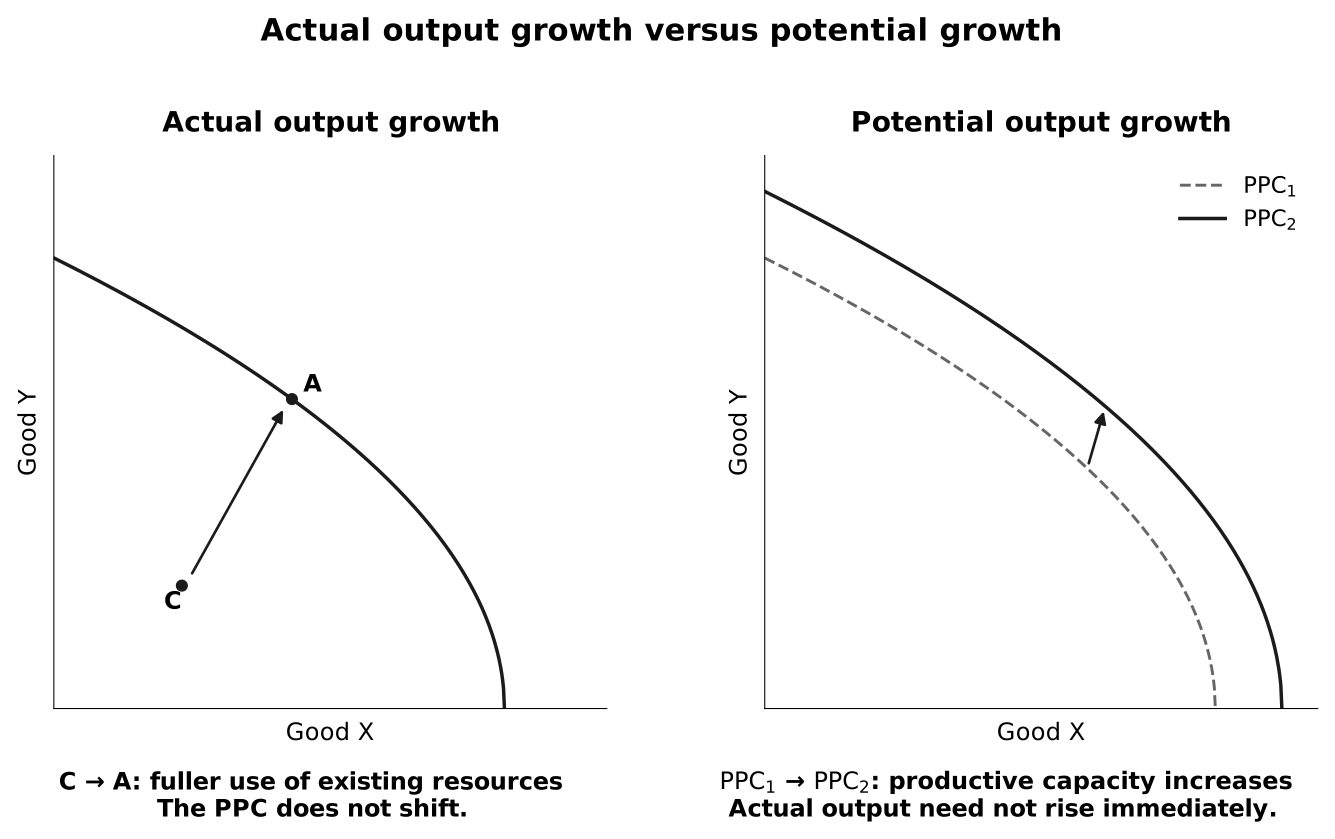
Caption: Better matching can move production toward the existing boundary, whereas productive technology can shift the boundary outward.
Indicative credit:
- identifies initial productive inefficiency from the table;
- explains movement toward the existing PPC and higher actual output;
- explains an outward, possibly biased, PPC shift and higher potential output;
- distinguishes productive capacity from realised production.
Question 1(d) [8]
Analysis using the estimates
For successive phases, Asteria should add a phase while its marginal social benefit exceeds its marginal social cost:
- phase 1: additional index points of estimated net benefit;
- phase 2: ;
- phase 3: ;
- phase 4: .
On the stated estimates, three phases maximise estimated net social benefit. Undertaking phases 1–3 gives a cumulative estimated net benefit of index points, while adding phase 4 would lower it to 25. The unrecoverable $6 million feasibility-study cost is sunk and should not affect the forward-looking decision; avoidable future construction and maintenance costs remain relevant.
Assessment and judgement
The recommendation depends on the accuracy and coverage of the estimates. The small positive margin for phase 3 is particularly sensitive to errors in storm probabilities, disruption avoided, construction costs and maintenance. Distribution may matter if benefits to highly vulnerable residents are not adequately represented. Phases may also be technically interdependent: a later phase could be necessary for an earlier one to function, or a binding budget or engineering constraint could make a phase infeasible.
A justified conclusion is to proceed provisionally with phases 1 and 2 and undertake phase 3 if sensitivity testing and engineering evidence support its small estimated advantage; phase 4 should normally be rejected on the supplied values. A different number can earn credit if the answer changes a stated assumption coherently and uses the case evidence.
Mark-quality guide
- Limited: reads values from the table or asserts a number with little marginal reasoning.
- Developing: applies the marginal rule and reaches a defensible number, but offers limited case-specific assessment.
- Strong: applies the figures accurately, treats the study cost as sunk, assesses relevant uncertainty or constraints, and reaches a conditional judgement.
Question 1(e) [10]
Reasons to allocate more to Plan K
Plan K creates physical and human capital. Effective drainage, equipment and technician training could raise resource quality or productivity and shift Asteria’s future PPC outward. It may also preserve existing capacity by reducing disruption. These gains could be persistent because coastal risk is repeated, and fewer emergencies could release future public resources for other uses.
Reasons to allocate more to Plan R, or to mix the plans
Plan K’s opportunity cost is lower present household assistance and services. Their marginal benefit may be especially high for low-income residents. Government objectives may include present security and distribution as well as future production.
Investment does not guarantee higher productive capacity or welfare. Weak project selection, poor maintenance, missing complementary supervisors or uncertain storm patterns could reduce Plan K’s return. Even an outward PPC shift does not ensure that output reaches the new boundary or that benefits are widely shared. Conversely, urgent support may protect health and human capital and therefore have some future productive benefit.
A mixed allocation can protect minimum current needs while retaining useful investment, although splitting scarce resources may delay both programmes or prevent either from reaching an effective scale.
Judgement
Asteria should allocate more—not necessarily all—resources to Plan K if its expected resilience and productivity gains remain high under sensitivity testing, complementary skills and maintenance are funded, and urgent household needs are protected. If immediate deprivation is severe or Plan K is poorly targeted, Plan R should receive more. The decision should compare the marginal expected benefits and opportunity costs of reallocating resources between the plans, taking account of time horizon, distribution and feasibility.
Alternative conclusions should be credited when supported by accurate PPC or decision-making analysis and specific case evidence.
Mark-quality guide
- Limited: describes the plans or gives a one-sided assertion.
- Developing: analyses present support and investment, with some application or qualification.
- Strong: develops the intertemporal trade-off, tests whether investment will translate into welfare, synthesises stakeholder and constraint evidence, and reaches a criterion-based judgement.
Return to the question paper.
Question-by-question formative marking framework
Use this with the shared Economics formative marking framework. The ranges are diagnostic, not official Cambridge boundaries.
| Part | Full-credit job | Acceptable alternatives and diagnostic ceiling |
|---|---|---|
| 1(a)(i), 2 | Calculate the fall in household-service packages and state the opportunity-cost unit. | Any transparent subtraction is acceptable. A bare 12,000 without identifying what is forgone should normally receive no more than 1. |
| 1(a)(ii), 2 | Calculate the B-to-C cost and make an explicit comparison with C-to-D. | “4,000 greater” or “1.5 times as large” is valid. Two isolated numbers without comparison should normally receive no more than 1. |
| 1(b), 4 | Define scarcity, apply limited complementary resources and explain why unemployment does not abolish alternative uses or opportunity cost. | A route through an interior PPC point is valid. Confusing scarcity with a temporary shortage prevents full credit. |
| 1(c), 4 | Distinguish movement toward the existing PPC from an outward, possibly biased, shift; distinguish actual from potential growth. | A correct labelled diagram may support the explanation. Treating both changes as PPC shifts should remain below full credit. |
| 1(d), 8 | Apply marginal benefits and costs accurately, identify the sunk cost, test the fragile third phase and reach a conditional recommendation. | A different phase choice is creditworthy if a stated assumption is changed coherently. Calculation without assessment should normally remain at 5 or below. |
| 1(e), 10 | Compare current support with investment, analyse the intertemporal opportunity cost, test whether capacity gains become welfare gains and give a criterion-based allocation judgement. | A Plan R, Plan K or mixed conclusion is valid. A one-sided PPC narrative without distribution, feasibility or judgement should normally remain below 8. |
Common misconceptions
- Unemployment does not mean resources are unlimited or have no alternative use.
- A point inside a PPC shows underused resources, not necessarily an inward shift of capacity.
- Investment can shift a future PPC only if it is productive and supported by complementary resources.
- A sunk cost is irrelevant to the forward-looking choice, but avoidable future costs are not.
Student self-check
Have I stated the unit of every opportunity cost, separated actual from potential output, used marginal rather than total reasoning in 1(d), and made the criterion behind my final allocation explicit?