Paper 2 Practice: The Central Economic Problem — Outlines
Indicative rather than exhaustive
These outlines identify the analytical jobs and illustrate possible lines of reasoning. They are not scripts or exhaustive mark schemes. Credit any coherent alternative that answers the set question, uses correct economics and supports its judgement.
Question 1(a) [10]
What the answer must do
Explain opportunity cost and marginal analysis as connected decision tools, and apply them to the variable-scale or combined uses of one scarce waterfront site.
Indicative analysis
- Because the site, budget and related resources are limited and have alternative uses, Meridia must choose among feasible projects and scales.
- The opportunity cost of a chosen allocation is the expected value or net benefit of the next-best feasible alternative forgone. It is not the sum of all rejected uses.
- The government needs an explicit objective and comparable evidence about monetary and non-monetary benefits and costs. Engineering, finance, land and information constraints determine feasibility.
- Since project scale can vary, the government can compare the marginal benefit and marginal cost of an extra housing block, college facility, park area or flood-protection stage. It should expand an activity while the additional expected benefit exceeds the additional expected opportunity cost.
- For a divisible interior choice, the benchmark is . If changes are indivisible, select the last increment with and reject the next with , subject to feasibility.
- Opportunity cost links the tools: resources assigned to the next increment of one use cannot provide the next-best increment of another use.
- Costs already incurred and unrecoverable are sunk; expected future avoidable costs remain relevant.
- Estimates should be revised when risk, preferences or constraints change.
Illustrative application
If an additional flood-protection stage has a larger expected net benefit than the best alternative use of the same land and funds, it should be undertaken. If the next stage would displace housing with greater expected net benefit, expansion should stop or the allocation should change.
Full credit does not require every bullet. A strong answer develops the two concepts, connects them and applies them to Meridia rather than listing definitions.
Question 1(b) [15]
Case for the decision rule
- Choosing the feasible allocation with the greatest expected net benefit is consistent with rational decision-making under a stated objective.
- A common framework can incorporate opportunity cost, stakeholder effects, non-monetary consequences and future effects.
- Marginal comparison can identify a better project scale or combination instead of treating every option as all-or-nothing.
- Explicit criteria make decisions more transparent and open to review.
Why the estimate may not identify the best allocation
- Future population and climate risk are uncertain, so expected benefits depend on forecasts and probabilities.
- Security, community ties, environmental quality and distribution are difficult to value on a common scale.
- An aggregate estimate can conceal concentrated losses. “Best” depends on Meridia’s objective and whether rights, equity or minimum provision constrain aggregate maximisation.
- Officials may have incomplete or biased information, while stakeholders may overstate benefits.
- Behavioural responses can create unintended effects such as displacement or land-price changes.
- Some uses may be complements, but combining them can also sacrifice economies of scale or engineering effectiveness.
- Irreversible choices strengthen the case for precaution or preserving flexibility.
Synthesis and judgement
The greatest estimated net benefit is a useful starting rule, not an automatic guarantee. It is most reliable when alternatives and constraints are correctly specified; important non-monetary and distributional effects are included; results remain robust under plausible assumptions; and the decision can be reviewed as information changes. Where uncertainty and irreversibility are large, a small estimated advantage may be outweighed by precaution, option value or minimum protection for affected groups.
Other valid frameworks may reach a different judgement. Reward explicit criteria and synthesis rather than the number of listed limitations.
Question 2(a) [10]
What the answer must do
Explain increasing opportunity cost along the current PPC and distinguish it from the possible future shift caused by successful investment.
Indicative analysis
- A PPC shows the maximum combinations of consumer and capital goods possible with current resources and technology when resources are fully and efficiently employed.
- Moving along the current PPC toward capital goods requires fewer consumer goods. The consumer goods forgone per additional unit of capital goods measure opportunity cost.
- Opportunity cost may rise because resources are imperfect substitutes. The most adaptable resources move first; later expansion transfers increasingly specialised resources from consumer-goods production, causing larger sacrifices.
- This gives a PPC bowed outward from the origin. If resources were equally adaptable, a straight PPC and constant opportunity cost would be possible.
- Effective capital formation, training and improved production technology can raise the quantity or quality of productive resources or productivity.
- Successful investment therefore shifts the future PPC outward. The shift may be biased if capacity rises mainly in one sector.
- An outward shift represents higher potential output, not a guarantee of higher actual output or welfare.
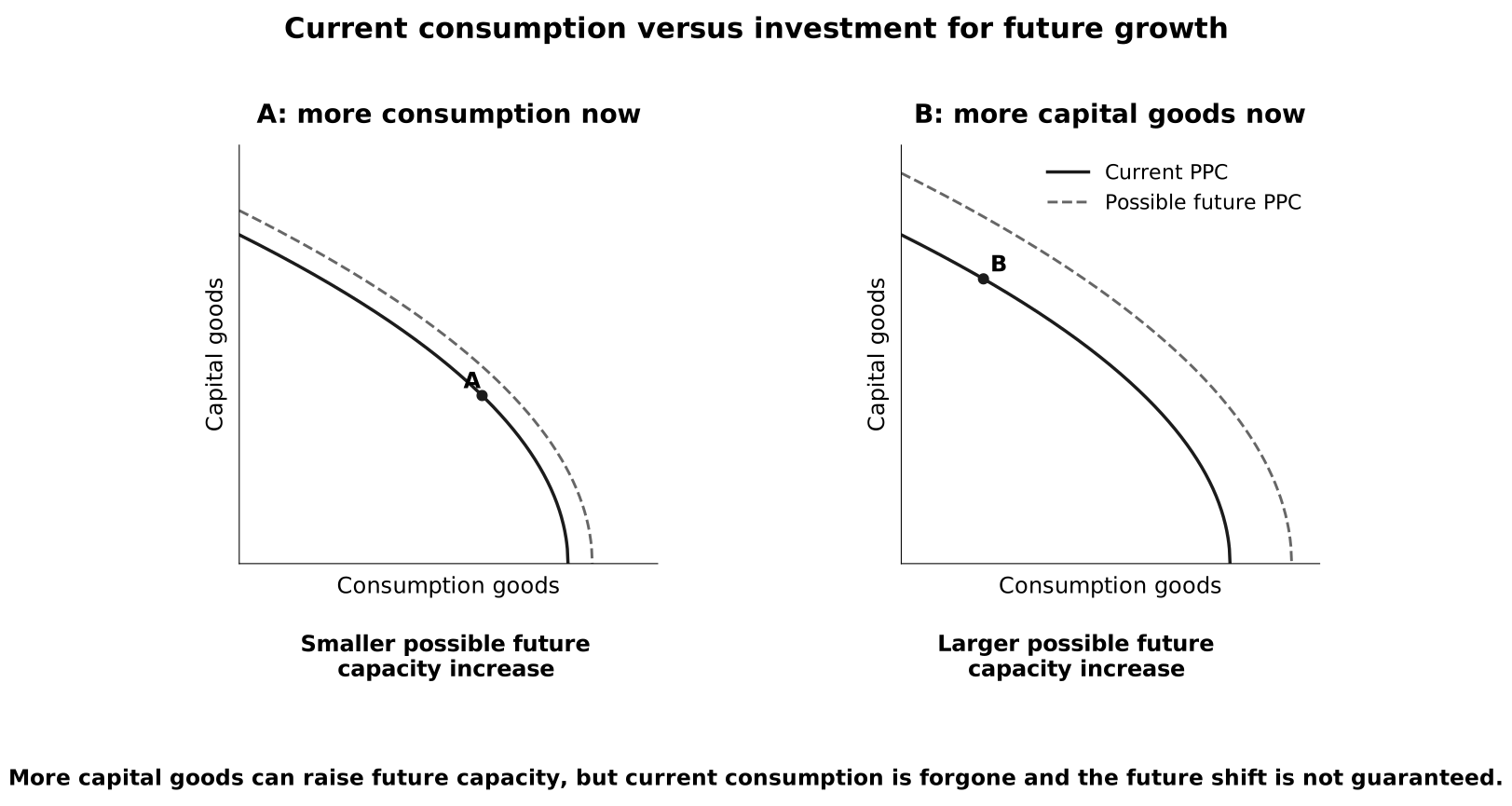
Caption: Producing more capital goods sacrifices some present consumption; if the investment is effective, it may permit a larger outward shift of future production possibilities.
A strong answer explains resource specialisation and clearly separates a movement along today’s PPC from a shift of a future PPC.
Question 2(b) [15]
Case for more investment
- Effective machinery, infrastructure, technology and human capital can raise productivity and productive capacity.
- A larger future PPC may permit more production and consumption, supporting higher future material living standards.
- Training and technology may improve quality and resilience as well as measured output.
- Present sacrifice may be worthwhile when expected returns are large, durable and widely shared.
Why more investment may not be best
- Forgone present consumption is an opportunity cost. Cuts to essential food, health, housing or leisure can reduce current welfare and may damage future health or productivity.
- Investment quality matters. Poor selection, weak maintenance, unsuitable technology or missing complementary skills may produce little capacity gain.
- A larger PPC does not ensure that actual output reaches the new boundary or that the additional output matches people’s preferences.
- Living standards also depend on distribution, health, leisure, environment and security.
- As investment expands, its marginal benefit may fall while the opportunity cost in consumer goods rises.
- The ten-year horizon, construction lags and uncertainty affect whether benefits arrive in time.
- The appropriate allocation depends on Lydora’s initial capital stock and unmet present needs.
Synthesis and judgement
More investment is justified where its expected marginal benefit exceeds the marginal opportunity cost, projects are productive and maintainable, complementary resources exist, and essential consumption is protected. The objective is not maximum investment but a context-sensitive balance.
For Lydora, decisive evidence includes project quality, current deprivation, time to benefit, distribution and complementarity among machinery, training and technology. A moderate reallocation may be best if these conditions are favourable; otherwise it can sacrifice present welfare without delivering the expected future gain.
Alternative judgements should receive credit when they are supported by accurate PPC analysis, relevant conditions and a reasoned comparison over time.
Return to the essay questions.
Question-specific formative marking framework
Use the working ranges in the shared Economics formative marking framework.
| Part | Requirements for the strongest working range | Diagnostic ceiling and alternatives |
|---|---|---|
| 1(a), 10 | Define opportunity cost correctly, connect it to marginal analysis, address divisible or incremental choices and apply both tools to the scarce waterfront site. | Definitions without a connected decision process should normally remain at 5 or below. A benefit-cost or PPC route is valid if opportunity cost remains explicit. |
| 1(b), 15 | Analyse the net-benefit rule, evaluate information, valuation, distribution, complementarity, uncertainty and irreversibility, then state when the rule is reliable. | A list of limitations without explaining how they alter the allocation should normally remain below 12. Rights- or precaution-based alternatives are valid when compared coherently. |
| 2(a), 10 | Explain increasing opportunity cost from resource specialisation, distinguish a movement along today’s PPC from a future outward shift and separate potential from actual output. | A diagram without the resource-specialisation mechanism should normally remain at 7 or below. Constant opportunity cost may be discussed as a contrast. |
| 2(b), 15 | Compare present consumption with future productive capacity, test investment quality and complementary resources, consider welfare and distribution, and judge the marginal allocation. | “Investment causes growth” without opportunity cost or implementation conditions should normally remain below 8. Pro-investment, pro-consumption or balanced conclusions are valid. |
Common errors and self-check
Do not define opportunity cost as all forgone alternatives or equate an outward PPC shift with guaranteed welfare. Each conclusion should state its criterion, decisive condition and opportunity cost.