Rational Decision-Making
The rational-choice benchmark
Economists model a rational agent as choosing the feasible option that gives the greatest expected net benefit according to the agent’s objective and available information.
The decision must be:
- rational: it maximises expected net benefit; and
- feasible: it lies within constraints such as income, time, information, skills, technology and law.
This is a benchmark, not a claim that people calculate perfectly or value only money. Family, fairness, leisure, safety and environmental quality can all enter benefits or costs.
Objectives differ across agents
| Agent | Standard objective | Possible benefit from one more unit | Possible cost from one more unit |
|---|---|---|---|
| Consumer | maximise utility | marginal utility | price, time and opportunity cost |
| Firm | maximise profit | marginal revenue | marginal production cost |
| Government | maximise social welfare | marginal social benefit | marginal social and budgetary cost |
The same option can therefore be ranked differently by different agents. A commuter may value shorter travel time, while government also considers ecological damage, public finance and effects on other residents.
The marginalist principle
Many decisions concern how much of an activity to undertake. Marginal means additional:
- MB: addition to total benefit from the next unit;
- MC: addition to total cost from the next unit.
The change in total net benefit from the next unit is:
Therefore:
- if , the next unit raises total net benefit;
- if , the next unit lowers total net benefit;
- if MB crosses MC from above for a divisible activity, the interior optimum occurs at .
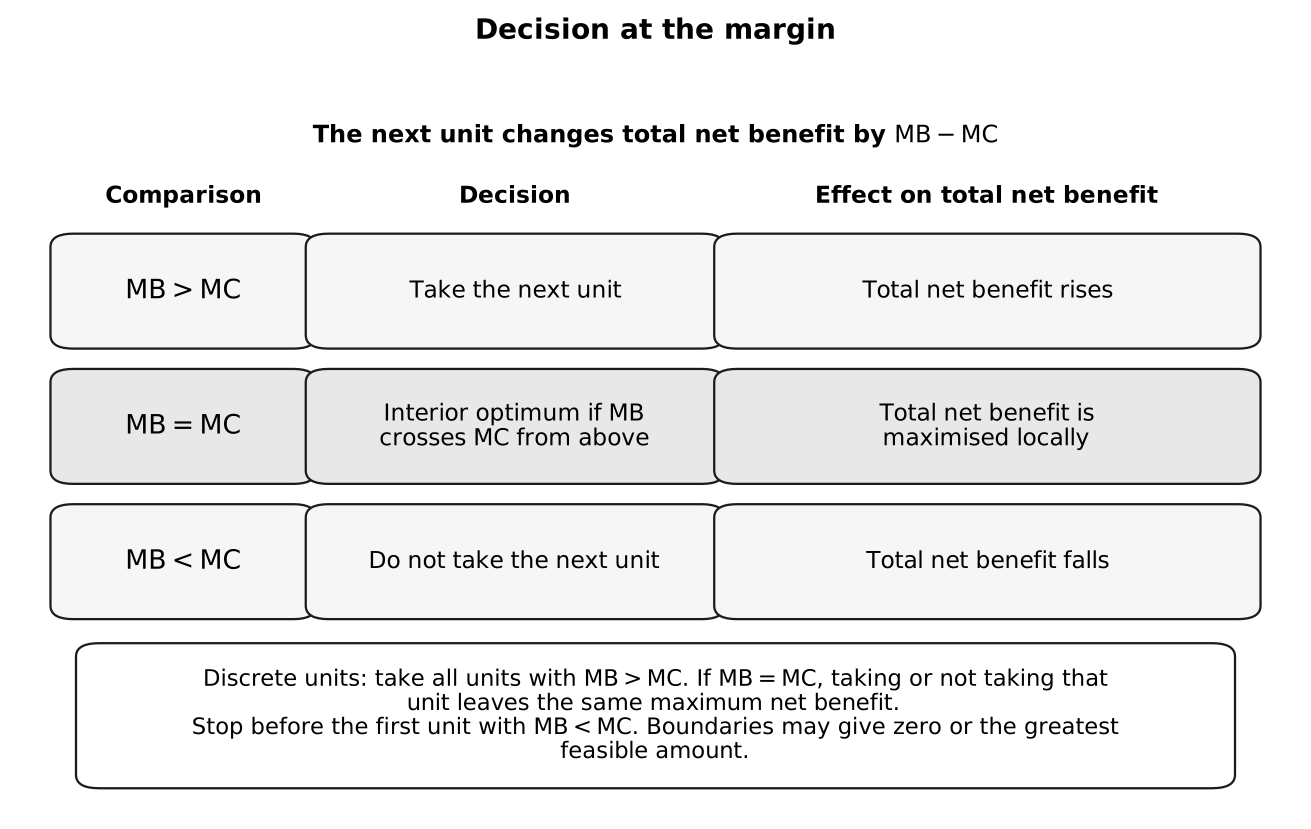
Caption: Read each row from comparison to decision to effect. The diagram derives the decision from , not from memorising an equality. The centre row is the standard interior crossing. For indivisible units, take all units with ; if one unit has , taking or not taking it gives the same maximum total net benefit. Stop before the first unit with . Boundary cases can still produce zero or the greatest feasible amount.
Worked discrete example
Suppose the MB and MC of successive revision hours are:
| Hour | MB | MC | Take the hour? | Effect on total net benefit |
|---|---|---|---|---|
| 1 | 12 | 4 | yes | |
| 2 | 9 | 5 | yes | |
| 3 | 6 | 6 | yes or indifferent at the margin | |
| 4 | 3 | 7 | no |
Two and three hours tie for the maximum total net benefit in this simplified example: the third hour adds zero net benefit. Taking it or not taking it leaves the maximum unchanged, while adding the fourth hour would reduce net benefit.
A complete decision cycle
1. Define the objective and decision-maker
A firm’s profit objective differs from a government’s social-welfare objective. Without a stated objective, “best” is undefined.
2. Identify feasible alternatives
Include the status quo where relevant. Eliminate options that violate binding constraints, but distinguish truly impossible options from merely costly ones.
3. Gather information
Relevant evidence can include prices, forecasts, surveys, engineering studies and stakeholder testimony. Assess accuracy, timeliness, source incentives and uncertainty.
Information is not free. Gather it while its expected marginal benefit exceeds its marginal cost; perfect information is rarely feasible.
4. Compare benefits and costs at the margin
Include monetary and non-monetary effects, opportunity cost and effects at different times. Avoid double-counting the same sacrifice under two labels.
5. Apply constraints
Constraints may include:
- income or government budget;
- time and administrative capacity;
- labour, land and technology;
- legal or political limits;
- incomplete information and uncertainty.
6. Consider perspectives and behavioural responses
A policy can benefit one group and harm another. Responses also matter: a subsidy may change production; a transport route may alter commuting and land use.
7. Anticipate consequences
- Intended consequences are outcomes the decision seeks to produce.
- Unintended consequences arise through missing information, behavioural responses or changing conditions. They may be harmful or beneficial.
8. Decide and review
Make the criterion explicit. Review the decision if preferences, technology, prices, constraints or new evidence change. A previously rational choice can cease to be optimal.
Linked public-decision example
For a rail alignment, government might seek the greatest expected net social benefit:
- compare a direct and skirting route;
- gather journey-time, construction, ecological and land evidence;
- apply engineering, budget and time constraints;
- consider commuters, taxpayers, residents, firms and future generations;
- anticipate intended connectivity gains and unintended ecological or land-use effects;
- choose using stated criteria and monitor outcomes.
This does not require formal CBA. It requires a transparent economic decision process.
Uncertainty and expected values
If outcomes are uncertain but plausible probabilities are available, an agent may compare expected values:
This is an enrichment expression, not a requirement to attach money values to every effect. Probabilities and valuations may themselves be disputed, so sensitivity to alternative assumptions should be acknowledged.
Cognitive biases
Syllabus connection
The biases illustrate departures from the rational benchmark. They are explicitly required later under firms’ use of consumer behaviour in Theme 2 rather than as a separate Theme 1.1 content item.
Sunk-cost fallacy
A sunk cost has already been incurred and cannot be recovered. It should not influence the current forward-looking marginal decision.
Example: a diner continues eating after becoming uncomfortable because the buffet fee has already been paid. The rational current comparison is the extra enjoyment versus the extra discomfort; the fee is unrecoverable.
Loss aversion
People may experience a loss more strongly than an equal-sized gain. A free trial can become difficult to cancel because losing access feels especially painful.
Salience bias
Vivid information may receive too much weight. A dramatic accident can influence travel decisions more than broader safety evidence.
Biases are systematic patterns, not random behaviour.
Strengths and limits of the model
The rational model is useful because it makes objectives, incentives, constraints and trade-offs explicit. It predicts how agents may respond when marginal benefits or costs change.
Its predictions weaken when:
- objectives conflict or change;
- information is inaccurate or costly;
- probabilities and non-monetary effects are hard to assess;
- cognitive biases are strong;
- other agents respond strategically;
- binding constraints prevent adjustment.
Syllabus boundary
Apply the decision process and marginalist reasoning. Formal utility-maximisation derivations and formal cost-benefit analysis as a project-appraisal tool are not required.
Common pitfalls
- Calling any self-interested action rational without comparing alternatives.
- Ignoring feasibility or the status quo.
- Comparing total benefit with marginal cost.
- Writing without explaining the crossing or boundary conditions.
- Including sunk costs in a current marginal decision.
- Treating government and private valuations as identical.
- Listing an unintended consequence without tracing why it arises.
- Assuming more information is always worth collecting regardless of cost.
Check your understanding
- Use to explain why total net benefit rises or falls with the next unit.
- Why is not a universal answer for every decision?
- Why can gathering additional information eventually reduce net benefit?
- A student keeps attending an unsuitable course because the fee was paid. Identify the bias and state the relevant current comparison.
- Apply the eight-step decision cycle to a government land-use choice.
Return to The Central Economic Problem.