Scarcity, Choice and Opportunity Cost
The conceptual chain
Economics begins with a mismatch:
- human wants are virtually unlimited;
- productive resources are limited and have alternative uses.
This is scarcity. It makes allocation and choice unavoidable. A choice creates a trade-off, and the value of the next-best feasible alternative forgone is the opportunity cost.
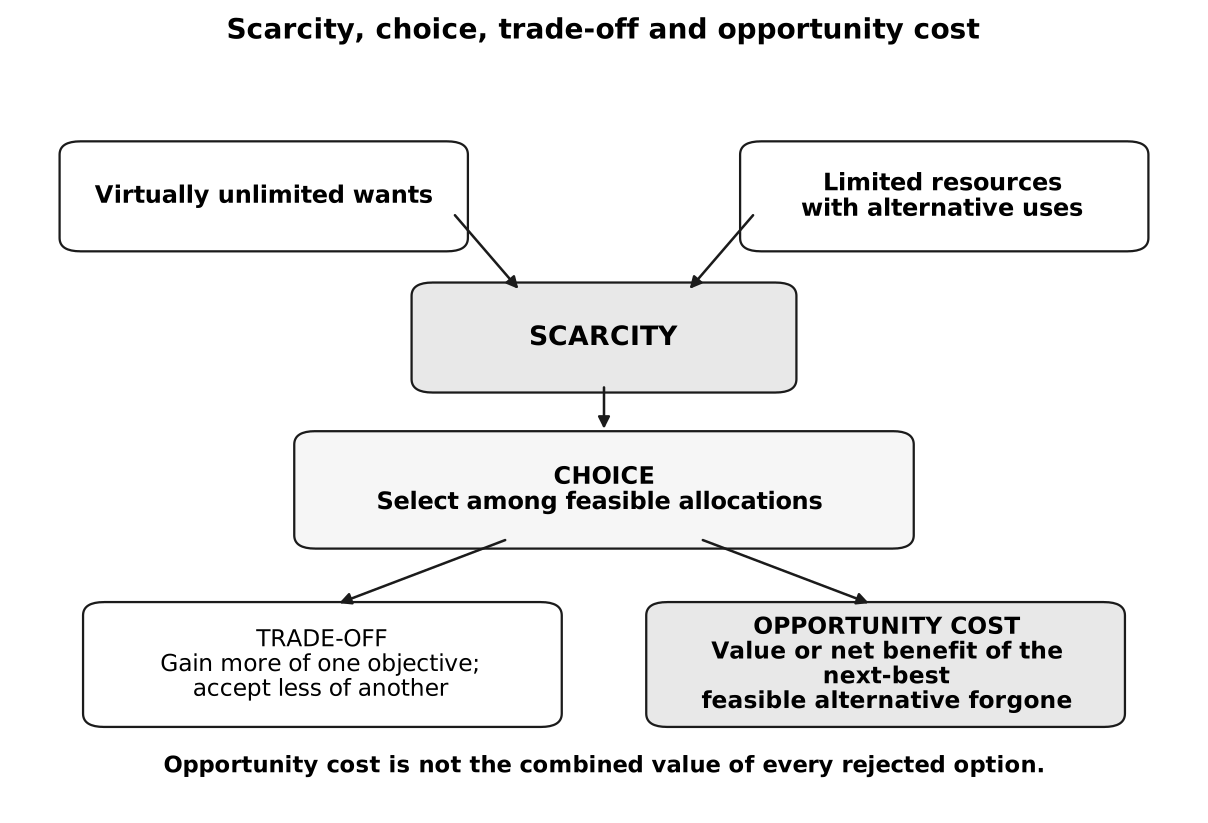
Caption: Read from the two top conditions downward. Wants and limited, alternatively usable resources create scarcity. Scarcity requires a choice among feasible uses. The trade-off is the exchange between objectives; opportunity cost is the value or net benefit of the next-best feasible option forgone. The final box therefore does not add together every rejected alternative.
What counts as a resource?
| Factor | Precise meaning | Examples | Common trap |
|---|---|---|---|
| Land | Natural resources used in production | land, water, forests, minerals | not only physical ground |
| Labour | Human physical and mental effort | nurses, engineers, drivers | a machine is not labour |
| Capital | Man-made physical resources used for further production | tools, factories, roads | money finances resources but is not itself productive machinery |
| Entrepreneurship | Organisation, innovation and bearing of business risk | starting and coordinating a firm | profit is a possible return, not a guarantee |
Human capital is the productive knowledge, skills and health embodied in people. Education and training can raise it.
Scarcity is not shortage or poverty
| Idea | Meaning | Can it disappear? |
|---|---|---|
| Scarcity | resources are insufficient to satisfy every want | not while wants and alternative uses remain |
| Shortage | at a particular price, quantity demanded exceeds quantity supplied | yes, through price or market changes |
| Poverty | a person lacks resources needed for an acceptable material standard | may be reduced even though scarcity remains |
Technological progress can relax a constraint and make more output possible, but it also creates new uses and wants. It therefore does not abolish scarcity.
Wants, effective demand and objectives
A want is a desire. Market demand normally requires both willingness and ability to purchase. Someone may want a sports car without possessing the purchasing power to create effective demand for it.
Different agents rank alternatives according to different objectives:
- consumers generally seek utility or satisfaction;
- firms may seek profit or another business objective;
- governments seek social welfare subject to public-resource and institutional constraints.
The objective determines what counts as benefit; constraints determine what is feasible.
What, how and for whom to produce
Suppose a government allocates a scarce site:
- What? Housing, a clinic or a park?
- How? Which construction method, design and resource combination?
- For whom? Which residents receive access, and how are costs financed?
If housing is chosen and the clinic is the next-best feasible use, the opportunity cost is the clinic’s expected net social benefit. A statement such as “the opportunity cost is the park and clinic” is wrong because only the best rejected alternative counts.
A reliable opportunity-cost method
- Identify the scarce resource and the decision-maker.
- State the objective and a consistent ranking criterion.
- List genuinely feasible alternatives, including the status quo where relevant.
- Rank alternatives after accounting for their relevant benefits and costs.
- Identify the chosen option.
- Select the highest-ranked rejected option.
- State the value or net benefit forgone, with a unit where possible.
Worked ranking
| Rank | Feasible use of an afternoon | Expected net benefit |
|---|---|---|
| 1 | Work at a café | 40 utility units |
| 2 | Meet friends | 32 utility units |
| 3 | Read in the library | 24 utility units |
If the student works, the opportunity cost is the utility units from meeting friends. The student’s net advantage over the next-best option is utility units. The units from reading are not added because reading is not the next-best alternative.
Different people can face the same menu but have different opportunity costs because their preferences, information and constraints differ.
Explicit cost and opportunity cost
An explicit cost is a direct payment. Opportunity cost concerns the best alternative use of all relevant scarce resources, including time and owned resources.
The two can overlap. If spending $20 means forgoing the best alternative purchase worth $20, do not count both the payment and the same forgone purchase as independent costs. The purpose is to identify the real sacrifice once, not attach several labels to it.
Examples:
- A free lecture has a zero ticket price but may have an opportunity cost in travel and the best alternative use of time.
- Using an owned building for a shop has an opportunity cost equal to the best alternative net benefit, such as rent that could have been earned.
- A construction payment is an explicit budget cost; the opportunity cost of public land is the next-best social use of that land.
Public choice and perspectives
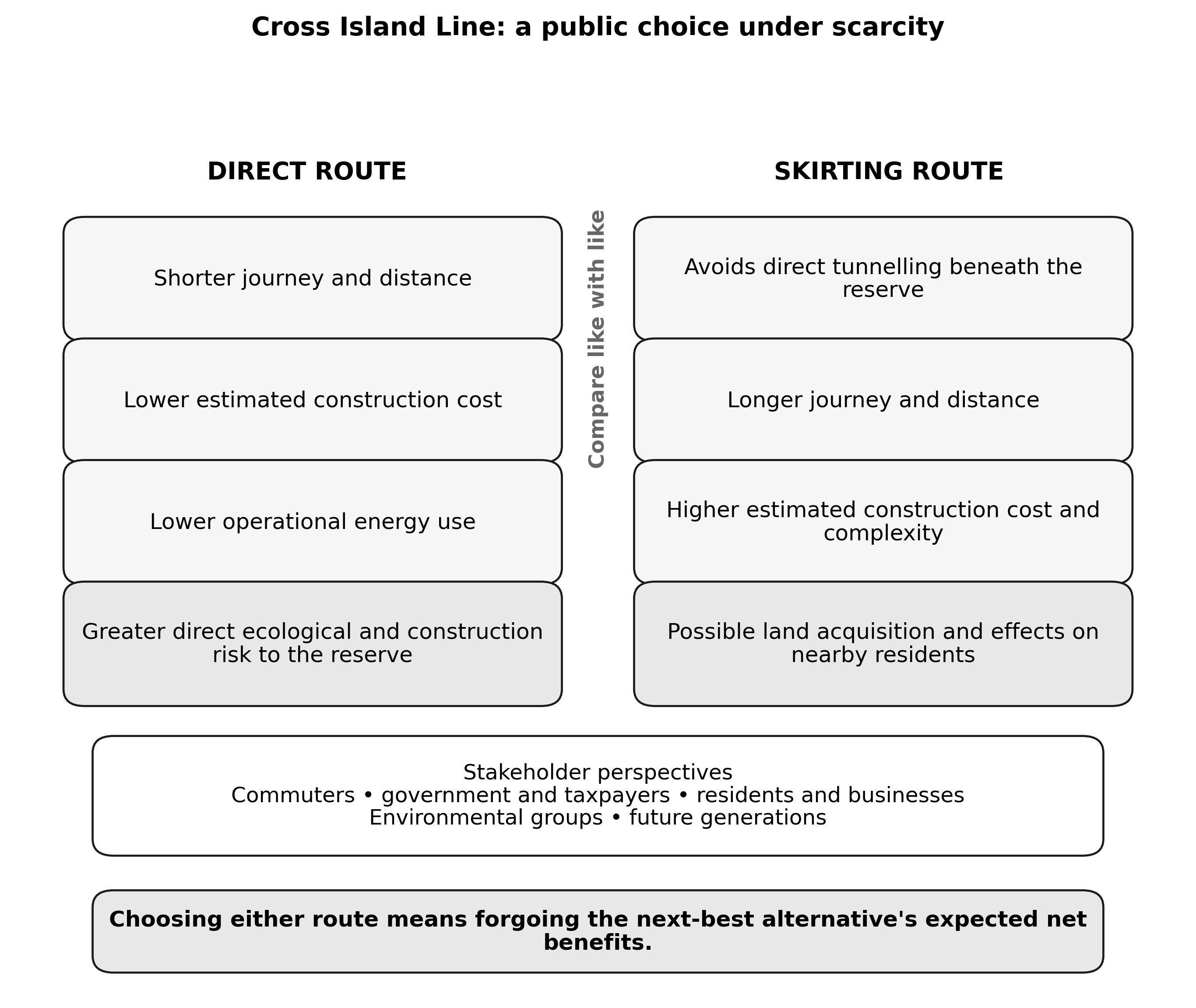
Caption: Compare the two route columns category by category. Shorter journey time and lower engineering complexity can favour the direct route, while reduced direct tunnelling beneath the reserve can favour the skirting route. Other residents, taxpayers, commuters, firms and future generations may value these effects differently. The figure organises relevant evidence; it does not calculate a unique answer or imply that every effect can be monetised exactly.
| Stakeholder | Possible objective | Possible constraint or concern |
|---|---|---|
| Commuters | reliable, accessible and shorter journeys | fares, disruption and connections |
| Government/taxpayers | high expected net social benefit | finance, engineering feasibility and uncertainty |
| Residents/businesses | accessibility and suitable land use | acquisition, noise and disruption |
| Environmental groups/future generations | preserve biodiversity and natural capital | irreversible or uncertain ecological harm |
Syllabus boundary
Theme 1.1 requires gathering information and weighing benefits, costs, constraints, perspectives and consequences. Formal cost-benefit analysis as a project-appraisal technique is not required.
Difficult distinctions
Trade-off versus opportunity cost
A trade-off describes the exchange: more of one objective, less of another. Opportunity cost values the next-best alternative forgone. Saying “more computers means fewer textiles” identifies a trade-off; stating “one extra computer costs four textiles” quantifies opportunity cost.
Opportunity cost versus sunk cost
- Opportunity cost is forward-looking and concerns an alternative still available at the decision point.
- A sunk cost has already been incurred and cannot be recovered, so it should not affect the current marginal choice.
Private versus social opportunity cost
An individual may consider personal effects, while government should consider effects on society, including third parties. This distinction becomes more important in Theme 2.
Exam-ready reasoning pattern
Because the resource is scarce and has alternative uses, choosing A means that B, the next-best feasible alternative, must be forgone. The opportunity cost of A is therefore the net benefit that would have been obtained from B.
Common pitfalls
- Describing scarcity without linking limited resources to virtually unlimited wants.
- Defining capital as money.
- Treating scarcity and shortage as synonyms.
- Naming every rejected option as opportunity cost.
- Giving the alternative’s name but not its value or benefit where explanation is possible.
- Assuming zero price means zero opportunity cost.
- Double-counting a money payment and the same forgone use of that money.
Check your understanding
- Why does innovation expand possibilities without eliminating scarcity?
- A school uses a room for a computer laboratory instead of its next-best use as a study room. State the opportunity cost precisely.
- Why might two people assign different opportunity costs to the same choice?
- Distinguish a trade-off from an opportunity cost using a PPC example.
- Apply “what, how and for whom” to one government allocation decision.
Return to The Central Economic Problem.