Economies of Scale and Long-Run Costs
What “long run” means here
In the long run the firm can vary every factor of production and choose its plant, technology and organisational scale. LRAC therefore answers a planning question: what is the lowest average cost attainable for each planned output when scale can be adjusted? It does not describe the cost of producing one more unit from a fixed plant; that is the role of short-run MC.
Internal economies and diseconomies
Internal economies are unit-cost savings caused by the firm’s own expansion. Sources include:
- technical indivisibilities and specialisation;
- managerial specialisation;
- purchasing and marketing economies;
- financial economies;
- risk-bearing economies.
Syllabus boundary
Know the distinction between internal and external economies/diseconomies and link them to LRAC. A detailed explanation of every named subtype is not required. Use a few well-explained causal examples instead of memorising a long catalogue.
Typical causal chains include:
- a larger plant makes specialised machinery viable → output rises more than operating cost → average cost falls;
- greater scale permits managerial or worker specialisation → productivity rises → unit cost falls;
- bulk purchasing strengthens bargaining power → input price per unit falls → average cost falls.
Internal diseconomies arise when coordination, communication, motivation and control become harder as the organisation grows.
For example, additional management layers can slow decisions and distort information. If monitoring and coordination costs rise faster than output, LRAC rises.
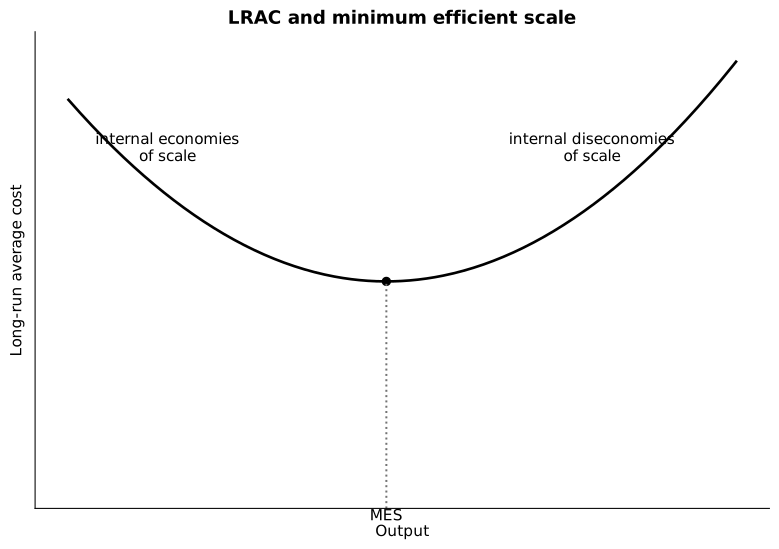
Caption: The horizontal axis is the firm’s planned output and the vertical axis is long-run average cost. Moving right along the same LRAC represents expansion by the firm. Before MES, internal economies make average cost fall; MES is the smallest output at which the minimum LRAC is achieved; beyond the minimum region, internal diseconomies may make average cost rise. A flatter minimum would mean several plant sizes are similarly efficient rather than one uniquely optimal output.
MES relative to market demand influences feasible market structure. If minimum cost requires 40% of total market demand, only a few MES-sized firms can coexist. If it requires 2%, many firms can operate efficiently. This is why MES is economically meaningful only when compared with the size of the relevant market.
Economies of scale versus returns to scale
- Economies of scale describe a fall in long-run average cost as output expands.
- Increasing returns to scale describe output rising more than proportionately when all inputs rise proportionately.
Increasing returns can contribute to economies of scale, but input prices, technology and organisation also matter. Do not use the two expressions as identical definitions.
Capital- and labour-intensive industries
Capital-intensive industries may have large indivisibilities and extensive economies, producing a long-falling LRAC. Labour-intensive activities may reach MES at a smaller output.
This is a tendency, not a rule: technology, management and product characteristics matter.
External economies and diseconomies
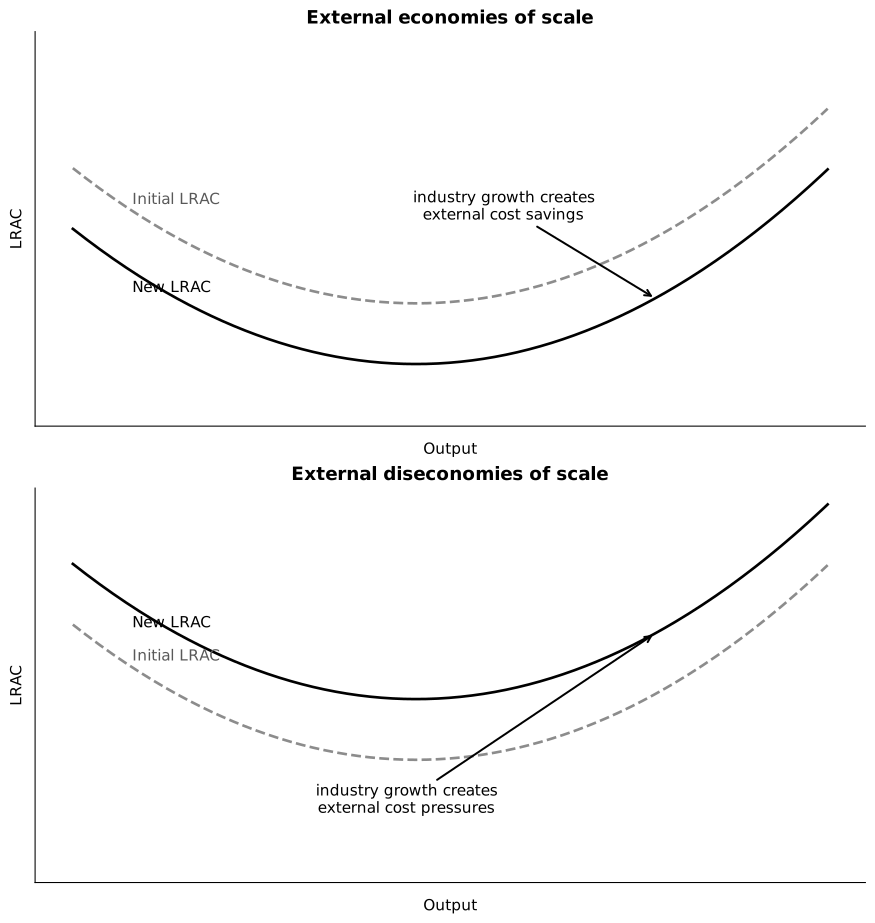
Caption: Each panel compares the representative firm’s LRAC before and after an industry-level change. Industry clustering may create shared suppliers, infrastructure, skills or knowledge and shift the whole LRAC downward; congestion or competition for scarce inputs may shift it upward. The shift affects attainable average cost at every shown output and is not a movement caused by the individual firm expanding along one LRAC.
External economies can arise from:
- specialised suppliers and labour pools;
- shared infrastructure;
- knowledge spillovers and research facilities.
External diseconomies can arise from congestion, higher land or labour prices, pollution and pressure on infrastructure.
The key test is the source. If the cost change results from the firm’s own expansion, it is internal. If it results from expansion or clustering of the wider industry and affects representative firms, it is external.
| Question | Internal scale effect | External scale effect |
|---|---|---|
| What changes? | the individual firm’s scale | the size, clustering or supporting environment of the industry |
| Diagram | movement along the firm’s LRAC | shift of the firm’s entire LRAC |
| Example | a larger firm justifies specialised machinery | industry growth attracts a specialised supplier available to many firms |
Do not classify an effect by whether it is “inside” or “outside” a factory building. The classification depends on whether the cost saving is generated by the firm’s own expansion or by the wider industry’s development.
Natural monopoly
Useful application
Natural monopoly is not separately named as a Theme 2.2 requirement, but it is a helpful application of LRAC, barriers to entry and monopoly welfare. Keep it secondary to the required cost concepts.
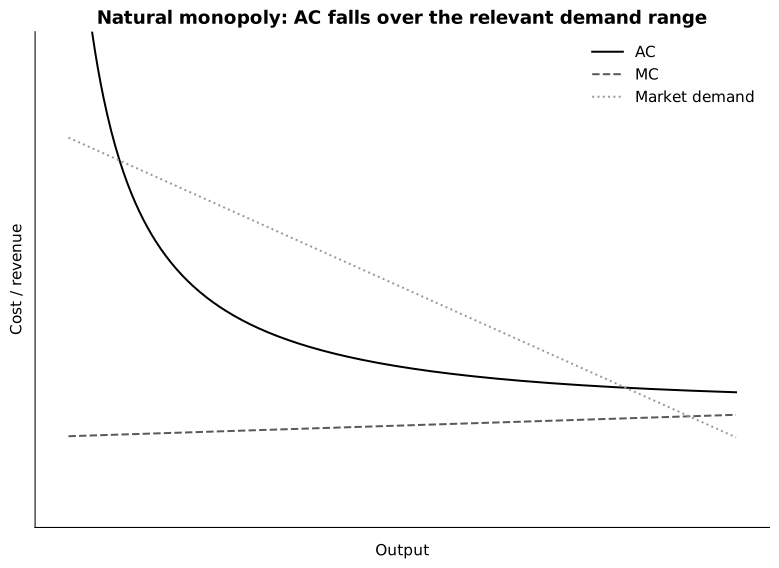
Caption: A natural monopoly exists when one firm can supply market demand at lower average cost than multiple smaller firms because AC continues falling across the relevant output range.
Natural monopoly is a cost condition, not merely the observation that one firm exists.
LRAC as a planning curve
In the long run all inputs are variable. Each plant size has its own short-run average-cost curve; the LRAC records the lowest attainable average cost for each planned output when the firm can choose scale. Moving down a given LRAC reflects internal economies from expanding the firm, while an external economy shifts the entire LRAC downward.
MES matters because it compares efficient plant scale with market demand. If MES is 5% of market output, many efficient firms can coexist. If MES is 80%, duplicating plants may raise industry cost and create a natural-monopoly tendency.
Enrichment: the SRAC-envelope interpretation
The LRAC may be viewed as the least-cost planning curve formed from available plant sizes. A firm on a particular SRAC has fixed plant in the short run; in the long run it can choose another scale. The syllabus does not require derivation of the curve, so focus on the economic choice and cost interpretation.
Scale, scope and firm strategy
Growth can be:
- internal/organic, through expanding the firm’s own capacity and sales;
- external, through merger or acquisition;
- horizontal, joining a firm at the same production stage;
- vertical, joining an upstream supplier or downstream distributor;
- conglomerate/diversified, entering unrelated markets.
Growth may lower unit cost through scale or scope economies, improve access to technology or distribution, and spread risk. It may also create integration cost, debt, culture clashes, weaker managerial control or reduced competitive pressure. Therefore, larger scale is neither costless nor automatically welfare-improving.
Evaluation
Lower average cost does not ensure lower consumer price. A large firm may retain cost savings as profit when rivalry and contestability are weak. Conversely, breaking up a network monopoly can sacrifice scale economies. Welfare analysis therefore combines cost structure with demand, pricing conduct, innovation, entry barriers and regulation.
Common pitfalls
- Calling lower input prices from industry growth an internal economy.
- Treating every LRAC as a symmetrical U.
- Equating firm growth with industry growth.
- Assuming a natural monopoly should never be regulated.
- Using AFC to explain LRAC.
Return to Firms and Decisions.