Market Structures and Market Power
Begin by defining the market
A statement such as “there are only three firms” is meaningful only after the relevant product market and geographical market have been defined. A railway operator may be a monopoly in intercity rail travel but face substitutes from coaches, cars or airlines in a broader transport market. Defining the market too narrowly exaggerates concentration; defining it too broadly can conceal market power.
Market structure summarises the conditions under which firms compete. Market power is the ability to influence price, output or other trading conditions without losing all customers. The two are related, but structure does not determine conduct mechanically.
Comparison
Syllabus boundary
9570 requires awareness of how economists classify perfect competition, monopolistic competition, oligopoly and monopoly using characteristics such as firm numbers and size, barriers and product nature. Diagrammatic comparison of the four structures is not required. Use the models as conceptual benchmarks, not rigid labels for every real industry.
| Feature | Perfect competition | Monopolistic competition | Oligopoly | Monopoly |
|---|---|---|---|---|
| Firms | many small | many | few large/interdependent | one firm in the pure model |
| Product | homogeneous | differentiated | homogeneous or differentiated | no close substitute |
| Entry barriers | negligible | low | high | very high |
| Firm demand | perfectly elastic model | downward, relatively elastic | downward and affected by rivals’ responses | market demand |
| Long-run profit | normal | normal | may remain supernormal | may remain supernormal |
| Strategic interdependence | negligible | limited | central | limited direct rivalry, but potential competition matters |
Real industries lie on a spectrum; the models are analytical benchmarks.
Price taking and price setting
- A price taker accepts the market price because its output is negligible relative to the market and buyers view rival products as identical substitutes. Its firm-level curve is horizontal.
- A price setter faces downward-sloping demand for its own product. It can choose a point on that curve, but it cannot independently choose any price and any quantity: a higher quantity normally requires accepting a lower price.
The demand facing a monopoly is market demand because the firm is the sole supplier in the pure model. The demand facing a differentiated firm is only its share of market demand and depends on rival prices, product characteristics and entry.
Barriers to entry
- legal: patents, licences and exclusive rights;
- cost: large MES, sunk cost and network infrastructure;
- strategic: limit pricing, predatory behaviour, exclusive contracts and advertising;
- brand loyalty and product ecosystems;
- control of essential inputs or distribution;
- information and technological know-how unavailable to entrants.
Barriers protect incumbents’ market power and long-run abnormal profit.
The causal chain is:
barrier raises an entrant’s expected cost or risk → entry becomes slower or less profitable → incumbents face weaker actual and potential competition → demand facing each incumbent may be less elastic → price-setting power and persistent supernormal profit become more feasible
This chain is conditional. A patent may protect one product yet leave close substitutes; a large incumbent may still face buyer power or disruptive technology.
A barrier matters when it raises the cost or risk of entry, delays entry, or prevents entrants from reaching a viable scale. A large fixed cost is not necessarily a sunk cost: it is sunk only when it cannot be recovered on exit.
Concentration
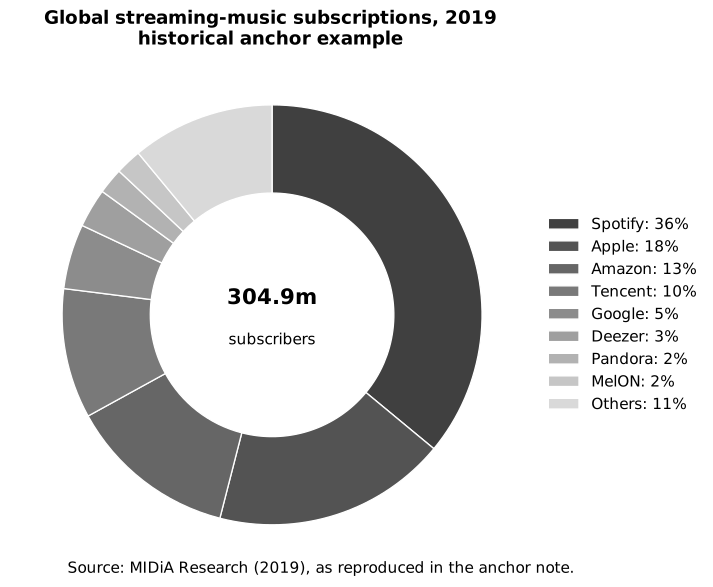
Caption: The donut records historical 2019 global streaming-music subscription shares, not current market shares. Adding Spotify 36%, Apple 18% and Amazon 13% gives . This indicates that a few suppliers held a large share of the stated market, but it does not show barriers, substitutability, regional variation, potential entry or whether the firms competed or colluded.
Concentration ratio:
Limitations include market-definition problems, foreign competition, potential entry and unequal size within the remaining firms.
For example, means the three largest firms together account for 67% of sales or subscribers under the dataset’s chosen measure. It does not mean each has 22.3%, that prices are 67% above cost, or that collusion exists. The numerator, denominator, market boundary, date and measurement unit must all be stated.
Oligopoly and interdependence
Each firm anticipates rivals’ reactions. Possible conduct includes:
- price leadership and price rigidity;
- non-price competition;
- tacit or explicit collusion;
- strategic capacity, advertising or innovation.
Collusion can raise joint profit but is unstable when members have incentives to cheat and when entry, detection or demand uncertainty is significant.
Collusion may be explicit, such as an agreement on price or output, or tacit, such as firms coordinating without a formal agreement. Price leadership is not by itself proof of collusion: similar costs or rapid observation may also produce parallel pricing.
Contestability
A market can behave competitively despite few firms if entry and exit are easy and sunk costs are low. Potential entrants can discipline incumbents through hit-and-run entry.
The mechanism is anticipatory: an incumbent that raises price substantially may attract entry, so the credible threat of entry can restrain its conduct even before an entrant appears. Hit-and-run entry is plausible only when entry is rapid and most committed cost can be recovered on exit. Where advertising, specialist equipment or customer acquisition spending is sunk, entry and exit are not costless.
Actual contestability depends on:
- legal and strategic barriers;
- access to distribution and technology;
- sunk cost;
- speed of incumbent response;
- consumer switching costs.
Natural monopoly
Useful application
Natural monopoly is an application of cost structure and barriers rather than a separately named Theme 2.2 requirement. Use it to deepen evaluation, not as a substitute for the four required market-structure benchmarks.
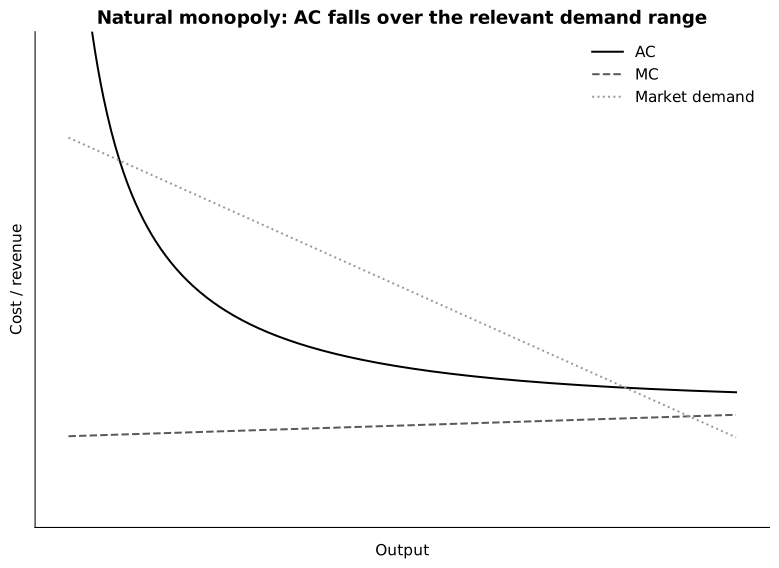
Caption: The downward market-demand curve covers the relevant range over which AC continues to fall. If total demand is divided among several smaller suppliers, each may operate at a lower output and higher AC; duplicating a network can therefore raise total industry cost. The figure establishes a cost argument for one-firm supply, not proof that an unregulated monopolist will charge a fair price or minimise cost.
Natural monopoly is defined by the cost structure over the relevant market demand, not simply by the existence of one current supplier. Technological change can shrink MES or create substitutes and thereby weaken a previously natural monopoly.
From structure to conduct and performance
Structure affects incentives but does not mechanically determine outcomes:
A concentrated market may show vigorous rivalry if products change quickly and entry is credible. A market with several firms may still have strong power when switching costs, data advantages or tacit coordination weaken competition.
Market power is better assessed through several indicators:
- ability to sustain price above marginal cost;
- profitability relative to risk and investment;
- barriers and sunk costs;
- buyer countervailing power;
- product substitutability;
- evidence of entry, innovation and switching.
Technological disruption
Technological change can alter structure rather than merely improve a firm’s product. It may:
- lower entry and distribution costs, increasing contestability;
- create platform or data network effects that raise barriers;
- make incumbent assets or skills obsolete;
- change market boundaries by creating new substitutes;
- intensify innovation races while increasing uncertainty.
The direction is therefore conditional. Digital technology can democratise entry in one stage of a market while concentrating power around data, standards or a dominant platform in another.
Model use
Perfect competition and monopoly provide limiting benchmarks. Monopolistic competition explains differentiated products with relatively easy entry. Oligopoly requires explicit interdependence: a firm’s best action depends on expected rival responses. Apply the model whose assumptions fit the market rather than classifying solely by firm count.
Reliable classification procedure
- Define the relevant product and geographical market.
- Examine actual and potential competitors, not firm count alone.
- Assess product substitutability and switching costs.
- Identify legal, cost, strategic and technological barriers.
- Explain likely conduct, including rivalry, differentiation or collusion.
- Draw a conditional conclusion about market power and consumer welfare.
Common pitfalls
- Defining monopoly as a firm with literally 100% in every context.
- Treating concentration as identical to market power.
- Assuming oligopoly always colludes.
- Equating product differentiation with absence of competition.
- Calling any large fixed cost a sunk cost.
- Ignoring potential competition.
Return to Firms and Decisions.