Paper 1 Practice: Velora’s Cloud-Gaming Market — Answers
Indicative guidance
Credit coherent alternatives. Longer responses are assessed through accurate mechanisms, application, evaluation and judgement.
Question 1(a)(i) [2]
One mark for method and one for the correct value with unit.
Question 1(a)(ii) [2]
The output interval is one million subscriptions, so total revenue rises by V$10 million over that block. Equivalently, marginal revenue averages V$10 per additional subscription across this discrete interval.
Question 1(b) [4]
Increasing output from 2 million to 3 million subscriptions raises revenue by V$14 million and cost by V$9 million, so that additional block adds V$5 million to profit. Increasing output from 3 million to 4 million subscriptions raises revenue by V$10 million but cost by V$11 million, so that additional block reduces profit by V$1 million. Profit therefore peaks at output 3 on the available schedule.
This is the discrete form of the marginal rule: expand while and stop before the first unit for which . It is also confirmed directly by profits of -V$2 million, V$3 million and V$2 million at outputs 2, 3 and 4 respectively.
Question 1(c) [4]
Any two developed reasons:
- Technical/indivisibility economies: fixed server capacity and software can support more users, spreading capital cost and improving utilisation.
- Purchasing economies: a larger platform may negotiate lower average licence or bandwidth prices.
- Marketing or managerial economies: advertising, specialised developers and security teams are spread over more subscriptions or used more efficiently.
The answer must link greater scale to lower cost per subscription. Congestion and coordination are diseconomies and do not answer why LRAC initially falls.
Question 1(d) [8]
Third-degree price discrimination can raise profit if PlayArc has market power, can identify and separate groups, prevents resale, and faces groups with different demand conditions. For the standard case with similar marginal costs across segments, profit maximisation allocates output so marginal revenue is equal across markets and equal to marginal cost. This normally implies a lower price in the segment with more elastic demand and a higher price in the less elastic segment. A student discount may also attract users when spare capacity keeps marginal cost low.
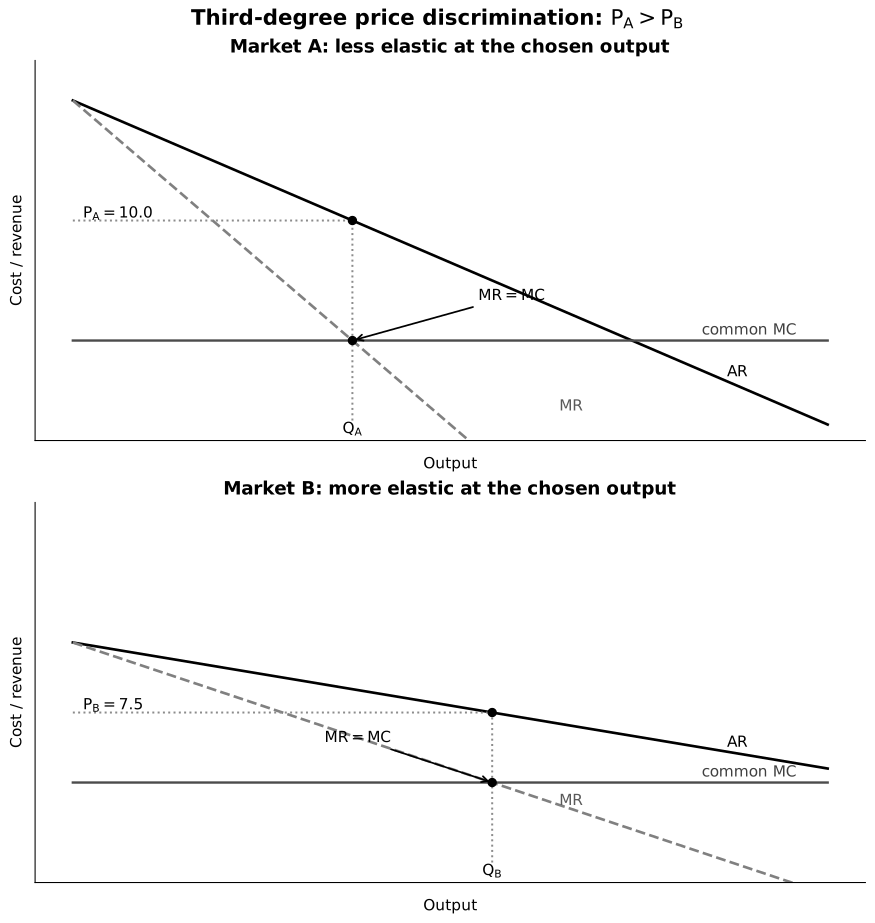
Caption: Profit-oriented discrimination charges a higher price in the segment with less elastic demand at its chosen output, provided markets can be separated.
Success is not assured. Verification and enforcement cost money; account sharing weakens separation; rivals may match discounts; and group elasticity estimates may be wrong. Extra users can cause congestion and higher marginal cost. A higher price may reduce goodwill or trigger regulation. Profit depends on the combined change in revenue and cost, not revenue alone.
The student-elasticity estimate comes from one promotion, so it may not persist. Spare capacity supports a low-marginal-cost argument off peak, whereas evening congestion may make additional subscribers more costly than the headline platform-cost structure suggests.
The strategy is most likely to increase profit where group differences are stable, resale is difficult, spare capacity exists and competitive retaliation is weak. Alternative conclusions should be credited when tied to the evidence.
Question 1(e) [10]
Ending long exclusive contracts can lower entry barriers, expand choice and strengthen pressure on price, quality and innovation. Its effect is limited if network effects, scale economies or other licences remain strong; exclusivity may sometimes finance game development.
A maximum price gives an immediate price constraint but can reduce service quality, create excess demand or weaken investment if set below sustainable average cost. The authority lacks complete cost information, increasing regulatory-error risk.
Regulated network access may reduce inefficient duplication and allow rivals to compete if the server network is an essential facility that cannot be economically replicated. The access charge must cover efficient capacity and investment costs: too high leaves entry ineffective, while too low causes congestion or underinvestment.
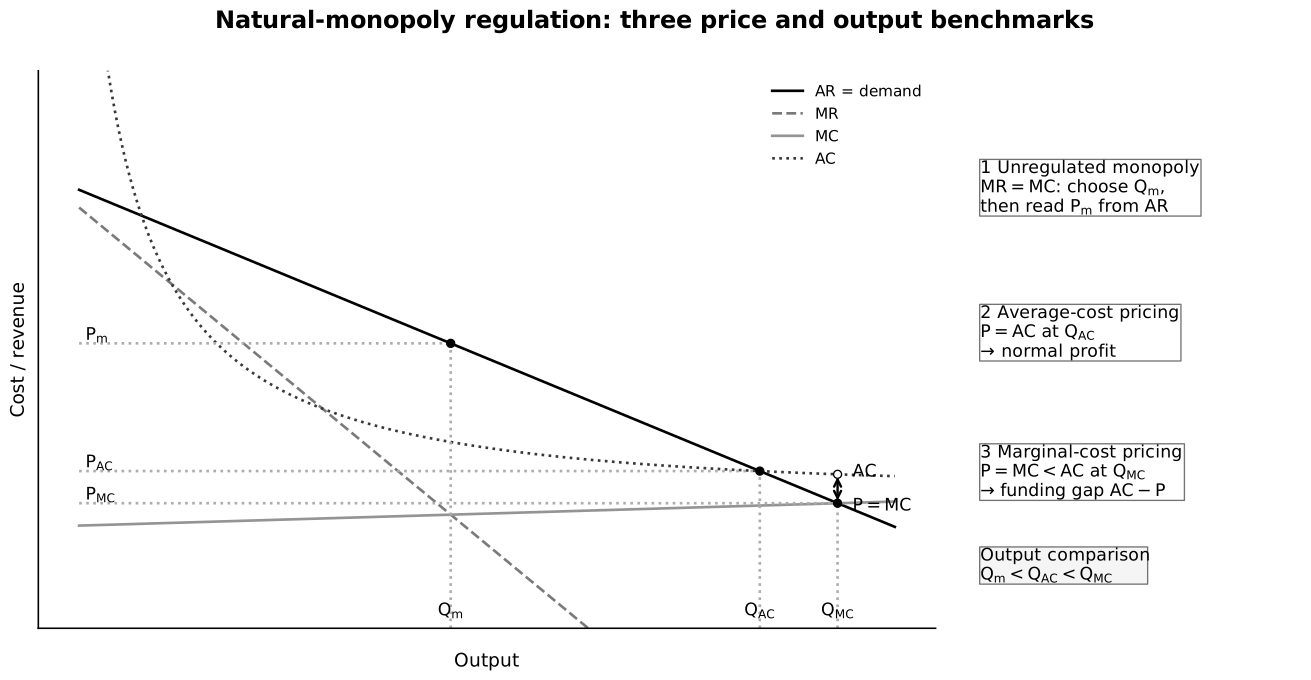
Caption: Price regulation involves a trade-off among a lower price, cost recovery and investment; the appropriate benchmark depends on the market’s cost conditions.
On the evidence supplied, a proportionate initial response is to limit unnecessarily restrictive exclusivity and monitor entry. Access regulation is justified if the server network is genuinely difficult to duplicate, with a reviewed cost-based charge. A broad maximum price is least suitable without reliable cost evidence. Judgement depends on the source of market power, entry feasibility, dynamic innovation and regulatory information.
PlayArc’s 46% subscription share and 52% share of popular exclusive titles indicate influence but do not prove monopoly or a natural-monopoly network. The casual-user entrant and availability of independent cloud capacity weaken the essential-facility claim; the developer-finance role of exclusivity creates a dynamic-efficiency counterweight.
Return to the question paper.
Question-by-question formative marking framework
Use this with the shared Economics formative marking framework.
| Part | Full-credit job | Acceptable alternatives and diagnostic ceiling |
|---|---|---|
| 1(a)(i), 2 | Apply at output 3 and retain the V$ million unit. | Correct method with arithmetic slip normally earns 1. |
| 1(a)(ii), 2 | Calculate the discrete change in total revenue and interpret the one-million-subscription interval. | V$10 million per block or V$10 per additional subscription is valid when clearly explained. |
| 1(b), 4 | Compare the incremental revenue and cost of the adjacent output blocks and show why profit peaks at output 3. | Directly comparing calculated profits is valid. Stating without using the discrete data is insufficient for full credit. |
| 1(c), 4 | Develop two distinct economies of scale and link each to falling cost per subscription. | Technical, purchasing, marketing or managerial routes are valid. Naming an economy without the cost link should receive limited credit. |
| 1(d), 8 | Establish market separation, resale control, market power and differing demand conditions; link allocation to and assess costs, capacity and rivalry. | Different prices need not be defended. Elasticity alone, without separation and cost conditions, should normally remain below 6. |
| 1(e), 10 | Compare exclusivity limits, maximum price and regulated access against consumer welfare, entry, investment and information constraints; select a proportionate response. | Any policy ranking is valid if tied to the source of market power. Assuming a natural monopoly from fixed costs or market share should normally remain below 8. |
Common misconceptions
- Total revenue changes measured in millions are not automatically revenue per subscription.
- Economies of scale concern long-run average cost, not simply a firm’s large size.
- Third-degree price discrimination does not raise profit merely because elasticities differ.
- Market share alone does not prove monopoly, abuse or an essential facility.
Student self-check
Have I reconciled all units, used marginal reasoning on the discrete schedule, explained rather than named economies of scale, and made regulatory judgement conditional on entry and cost evidence?