Indicative essay-marking standard
Part (a): 10 marks
- Upper level: accurate, coherent and sufficiently developed explanation covering the full requirement; assumptions are made explicit; diagrams and context perform analytical work.
- Middle level: generally correct but incomplete, unevenly developed or weakly applied.
- Lower level: fragmented definitions, assertion, serious model error or failure to address a material part of the question.
Part (b): 15 marks
A strong response combines developed analysis with contextual evaluation. It compares arguments or policies using common criteria, identifies the conditions that change their relative importance, and reaches a supported judgement. Generic advantages/disadvantages or a bare “it depends” should not receive high evaluation credit.
These are formative descriptors derived from recurring corpus patterns, not official Cambridge or school-specific mark bands.
Paper 2 Practice: Firms and Decisions — Outlines
Indicative rather than exhaustive
Reward accurate, applied reasoning and defensible alternative judgements.
Question 1(a) [10]
- Profit is ; the profit-maximising output is where for an interior solution with MC cutting MR from below.
- Unconstrained sales-revenue maximisation chooses the output where . If managers face a binding minimum-profit constraint, the chosen output may instead be the largest output consistent with that constraint.
- With a downward-sloping demand curve and conventional positive MC, occurs at a larger output than .
- The larger output requires a lower price read from AR/demand. Revenue is maximised, but profit is normally below its maximum because units beyond the profit-maximising output have .
- A diagram should distinguish the output decision from reading price off AR.
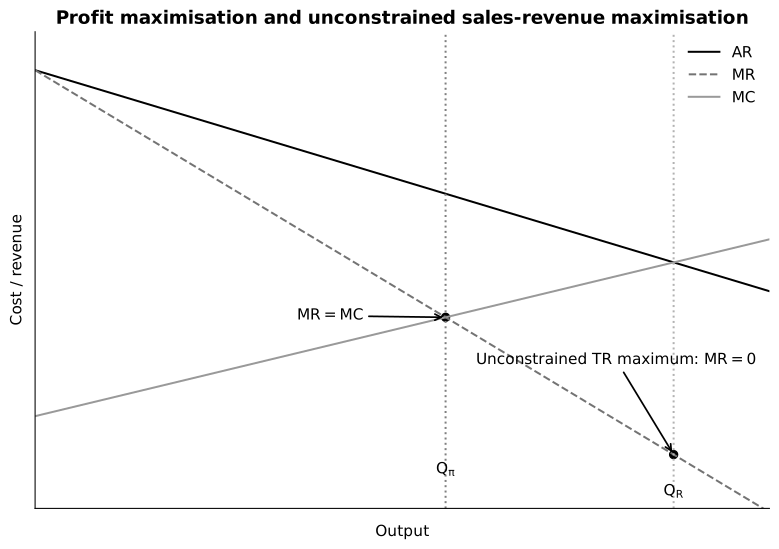
Caption: With positive marginal cost, unconstrained revenue maximisation occurs at a larger output and lower price than profit maximisation.
Question 1(b) [15]
Growth can build network effects, brand recognition, data and scale economies; deter entry; attract finance; and create future profit. Low prices may expand output and consumer access. However, promotion and below-sustainable prices consume cash, scale can cause diseconomies, demand may be less durable than expected, and investors may eventually require profit. Aggressive conduct may prompt retaliation or regulation. Managerial growth objectives can also diverge from owners’ interests.
The strategy is strongest where learning, network or scale benefits are large, finance is secure and there is a credible route to prices covering long-run cost. Long-run performance should be judged by sustainable profit, efficiency and resilience rather than market share alone.
Question 2(a) [10]
- High sunk aircraft, airport, safety and marketing costs increase the loss risk for entrants.
- Slots, licences, loyalty schemes, established routes and network effects can restrict entry or expansion.
- Internal economies reduce LRAC as an airline spreads fixed systems, buys inputs in bulk and uses specialised resources.
- A large minimum efficient scale means an entrant needs substantial demand before matching incumbent unit costs.
- With few effective rivals, each airline may face less price-elastic demand, giving scope to set price above marginal cost and sustain supernormal profit where entry barriers endure.
- Economies do not automatically prove abuse: lower cost may also support lower fares.
Question 2(b) [15]
Competition policy can remove exclusionary contracts, improve slot access, prevent anticompetitive mergers and strengthen rivalry, promoting lower prices and productive or allocative efficiency. Yet forced fragmentation may sacrifice route density, connectivity and scale economies. Thin routes may not support many efficient airlines, and safety or capacity constraints are genuine barriers.
Alternatives include price or service regulation, transparent slot auctions, open-access agreements and targeted support for contestable routes. Regulation faces information problems and may weaken investment or service quality. Dynamic efficiency matters alongside the static benchmark.
Policy should target conduct and bottlenecks rather than concentration alone. Stronger competition rules are best where exclusionary behaviour prevents an otherwise viable entrant; regulated access or service obligations may be better where infrastructure is a natural bottleneck. A mixed, evidence-based approach can preserve genuine scale benefits while disciplining market power.
Return to the essay questions.
Question-specific formative marking framework
Use the working ranges in the shared Economics formative marking framework.
| Part | Requirements for the strongest working range | Diagnostic ceiling and alternatives |
|---|---|---|
| 1(a), 10 | Derive profit maximisation at , unconstrained sales-revenue maximisation at , compare outputs/prices under a downward-sloping demand curve and recognise a possible profit constraint. | Naming the two rules without explaining why output differs should normally remain at 5 or below. A correct diagrammatic or verbal derivation is valid. |
| 1(b), 15 | Analyse routes from growth to long-run performance and countervailing finance, diseconomy, conduct and governance risks; define the performance criterion and judge the conditions for success. | Market share alone is not a welfare or profit criterion. Owner, consumer or dynamic-efficiency perspectives may be integrated. |
| 2(a), 10 | Explain how sunk costs, scale/MES, networks, licences or strategic conduct deter entry and connect persistent entry barriers to market power. | Concentration or large size without an entry mechanism should normally remain below 8. Lower-cost benefits should not be treated as proof of abuse. |
| 2(b), 15 | Compare competition enforcement with access, price/service regulation or targeted obligations; evaluate natural bottlenecks, information problems, scale benefits and dynamic efficiency; choose a proportionate policy. | An answer that equates more firms with greater efficiency should normally remain below 12. Mixed or conditional policies are valid. |
Common errors and self-check
Do not confuse revenue maximisation with maximum output, fixed costs with automatic natural monopoly, or concentration with proven market power. Check that diagrams are explained, market performance is judged against explicit efficiency or welfare criteria, and policy targets the identified source of power.