Economic Integration and Trade Agreements
Scope
Core Theme 3.3 requires reasons for, and broad benefits and costs of, international and regional cooperation. Detailed institutional forms, trade creation/diversion and diagrammatic analysis are enrichment.
Why countries cooperate
Cross-border exchange is affected by more than tariffs. Firms care about customs procedures, standards, data rules, investment protection, transport links and whether disputes can be resolved predictably. Cooperation can:
- reduce tariff and non-tariff barriers;
- standardise or mutually recognise rules;
- provide dispute-settlement procedures;
- enlarge effective market size;
- coordinate infrastructure or responses to shared problems;
- make policy commitments more credible.
The causal chain is not simply “agreement growth.” Lower trade cost changes relative prices and market access; consumers and firms respond; competition, scale and investment may change; only then may output, productivity and income rise. Implementation and domestic capacity are essential.
Enrichment: degrees of integration
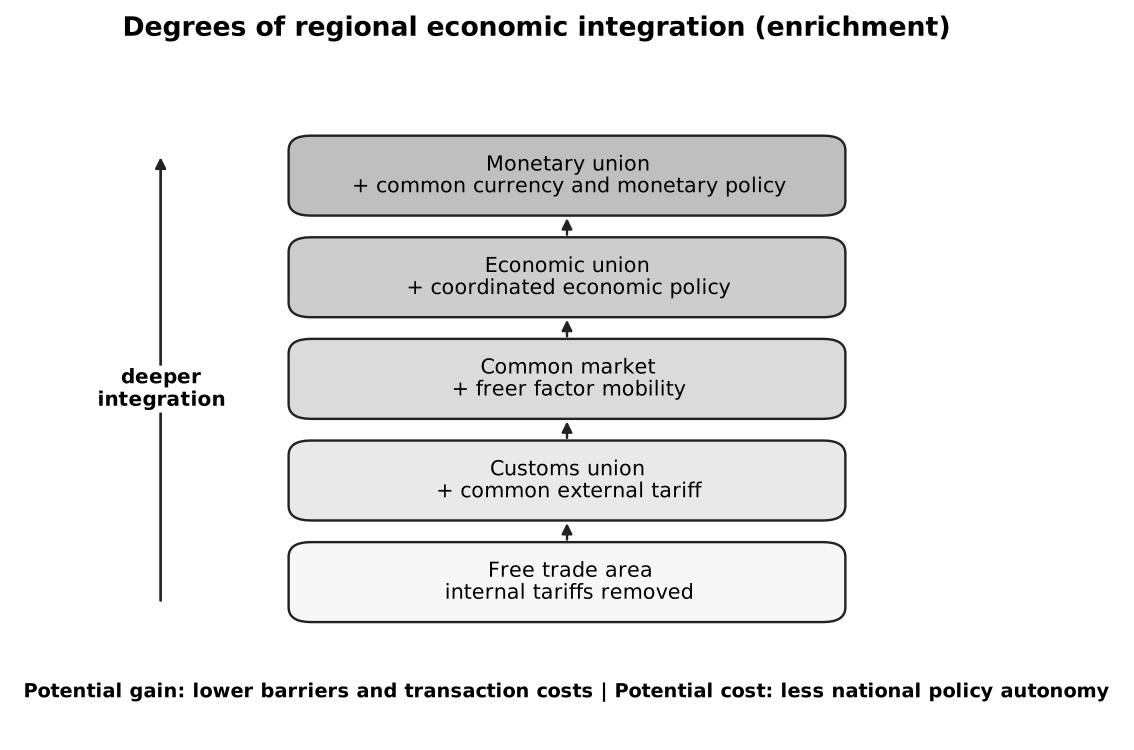
Caption: Each higher rung retains the main commitment below and adds another. An FTA removes internal tariffs while members retain separate external policies; a customs union adds a common external tariff; a common market adds freer labour and capital movement; an economic union adds major policy coordination; a monetary union adds a common currency and monetary policy. The upward arrow means deeper commitments and potentially lower transaction costs, not automatically higher welfare.
- FTA: rules of origin identify goods genuinely produced within members, preventing non-members from routing goods through the lowest-tariff member.
- Customs union: common external tariffs remove the need for most internal rules-of-origin checks but constrain national trade policy.
- Common market: freer factor movement can improve allocation but creates migration, regulatory and distributional challenges.
- Economic/monetary union: deeper coordination can reduce uncertainty but limits independent policy choices; a monetary union removes bilateral exchange-rate adjustment.
Benefits and their mechanisms
Trade, competition and scale
Lower barriers reduce landed prices and widen supplier choice. Consumers may gain; firms gain access to larger markets and inputs. Larger output can reduce average cost where economies of scale exist, while rivalry can reduce X-inefficiency.
Investment and production networks
Common rules can lower uncertainty and attract FDI. Firms may place different stages where skills, cost and logistics are best. Benefits to the host economy depend on local supplier links, training, technology transfer and whether value added remains domestically.
Macroeconomic and bargaining effects
Exports and investment can raise AD in the short run; capital and productivity can raise potential output later. A bloc may bargain more effectively, but large members can still possess disproportionate influence.
Enrichment: trade creation and diversion
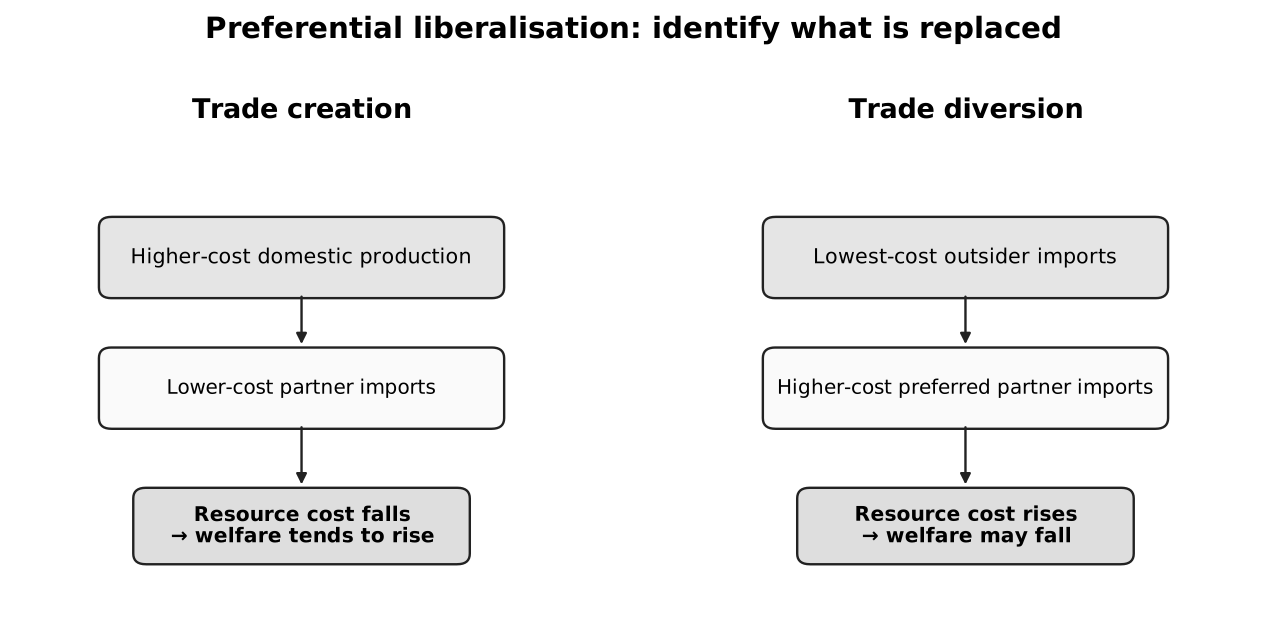
Caption: The two columns compare the source of imports, not merely trade volume. Trade creation replaces high-cost domestic production with lower-cost partner imports, releasing resources and tending to raise welfare. Trade diversion replaces the lowest-cost outsider with a higher-cost partner solely because the partner receives tariff-free preference, so tariff revenue and resource efficiency may be lost.
A numerical comparison
Suppose a good costs $12 to produce domestically, $8 from a partner and $6 from an outsider. Initially, a $4 tariff makes the partner cost $12 and the outsider $10, so the country imports from the outsider.
- If an FTA removes the tariff only on the partner, the partner price becomes $8 while the outsider remains $10: imports switch from the $6 resource-cost outsider to the $8 partner. This is trade diversion even though the consumer price falls from $10 to $8.
- If the country had originally produced domestically at $12 and the agreement enabled partner imports at $8, this would be trade creation.
Welfare assessment must include consumer gain, producer loss, tariff-revenue loss and the resource-cost difference. Greater intra-bloc trade is not sufficient evidence of a net gain.
Preferential versus wider liberalisation
An agreement discriminates in favour of members. This may encourage cooperation, but it can also exclude efficient outsiders. Multilateral liberalisation reduces barriers more broadly and avoids some diversion, though agreement among many countries can be slower and harder.
Costs and tensions
- import-competing firms and workers face adjustment;
- gains can be uneven across sectors and countries;
- common rules may not suit every economy;
- non-members face discrimination;
- administration and rules of origin create compliance cost;
- deeper integration constrains trade, migration, fiscal, regulatory or monetary autonomy;
- capital mobility can transmit financial shocks.
Enrichment application: ASEAN and Singapore
For a small, trade-dependent economy, regional cooperation can widen markets, improve production-network access, attract hub investment and support common customs, standards and digital rules. Yet development gaps, non-tariff barriers, slow implementation and competition among members can limit benefits. Gains are larger when domestic firms possess skills, finance and connectivity needed to use new market access.
Evaluation sequence
- Identify which barrier or coordination failure the agreement changes.
- Compare domestic, partner and outsider resource costs.
- Trace consumer prices, domestic output, import source and government revenue.
- Add dynamic effects from scale, competition, investment and productivity.
- Consider distribution across sectors, workers and members.
- Assess implementation, policy-autonomy cost and feasible alternatives.
Common pitfalls
- Calling every agreement a customs union.
- Assuming tariff removal guarantees trade creation.
- Ignoring rules of origin in an FTA.
- Using greater trade volume as proof of greater welfare.
- Discussing goods only when cooperation also affects services, capital and labour.
- Assuming every member gains equally or immediately.
Return to Globalisation and the International Economy.