Globalisation - Flows, Benefits and Costs
Scope
This branch follows the syllabus’s agent-based requirement: analyse free trade and capital/labour flows through consumers, producers and governments. Workers are treated separately where distribution and mobility matter, while recognising that they are also consumers, taxpayers and household members.
Meaning, drivers and measurement caution
Globalisation is increasing integration and interdependence through cross-border flows of goods, services, capital, labour, technology and information.
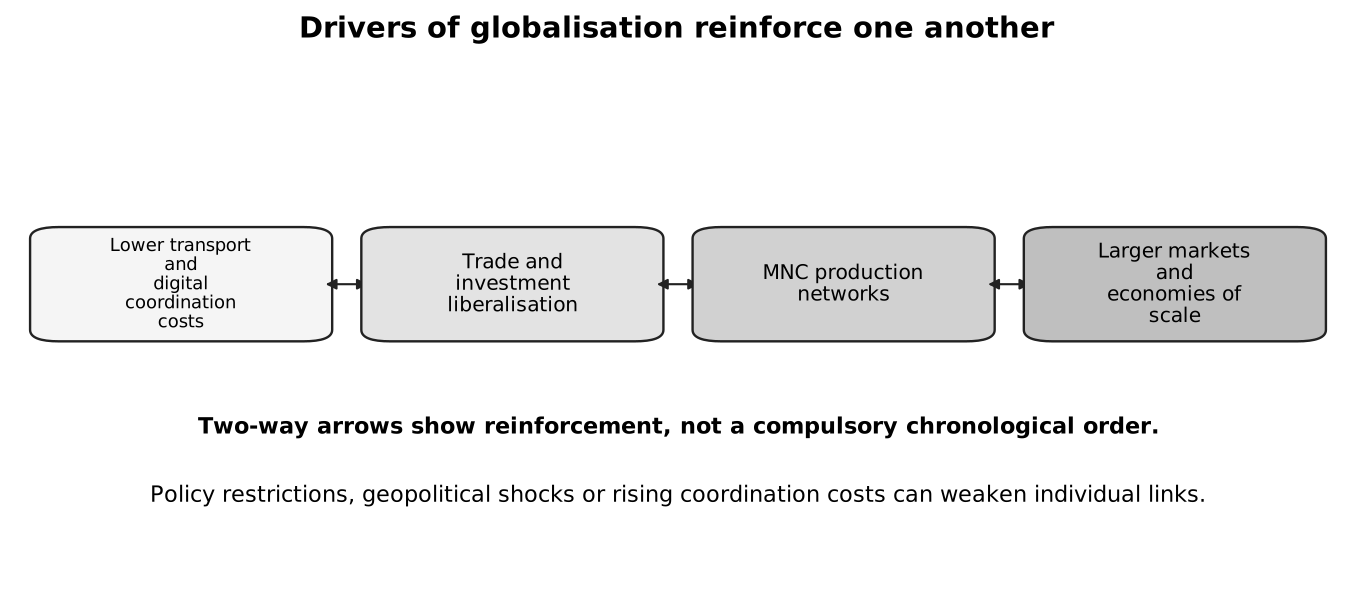
Caption: The boxes form a mutually reinforcing process rather than a guaranteed chronological sequence. Lower transport/digital costs and liberalisation make international production easier; MNC networks deepen cross-border sourcing; larger markets strengthen scale incentives. The two-way arrows indicate feedback. Policy, geopolitics and shocks can also slow or reverse individual links.
More gross flow is not automatically a better net outcome. A rise in capital inflows may finance productive factories or short-term asset speculation; more migration may fill shortages or intensify pressure on close substitutes; more trade may raise total income while concentrating losses.
Trade in goods and services
Consumers
Consumers may obtain lower prices, more variety, better quality and faster technology diffusion. A lower import price raises real purchasing power because the same nominal income buys more.
Possible costs include unsafe or weakly regulated products, market power by global firms, cultural homogenisation and environmental costs embodied in consumption. A consumer who loses employment in an import-competing sector may be worse off despite lower prices.
Producers
Exporters gain new markets; firms access cheaper or better intermediate inputs, larger scale and international knowledge. Competitive pressure can stimulate efficiency and innovation.
Import-competing firms may contract. Small firms may lack finance or managerial capacity to upgrade, and fragmented supply chains expose producers to foreign bottlenecks. Outsourcing can reduce cost while increasing concentration risk.
Labour mobility
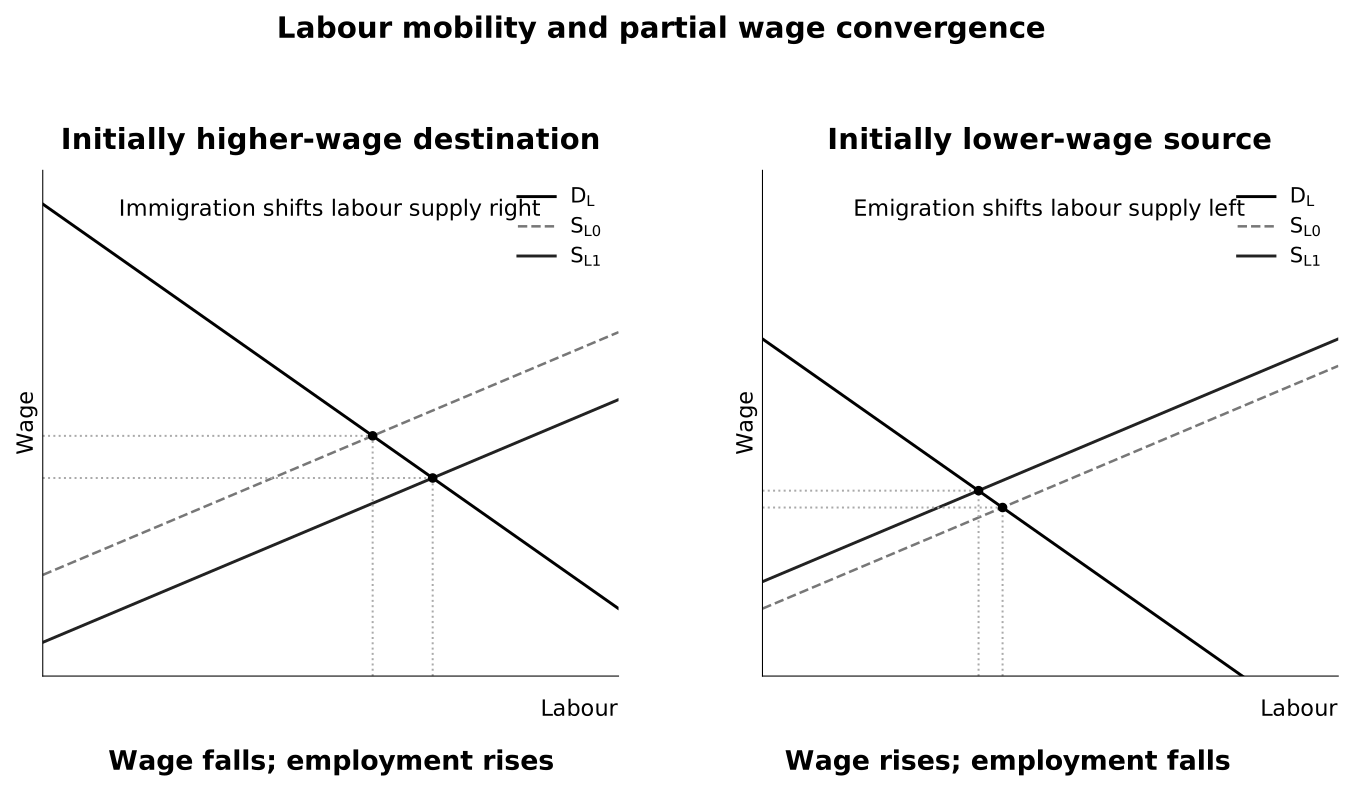
Caption: The left panel starts with a higher destination wage. Immigration shifts destination labour supply right, lowering the model wage and raising employment. The right panel starts with a lower source wage. Emigration shifts source labour supply left, raising the model wage and lowering employment. Dashed guides identify the old and new equilibria; the comparison suggests partial wage convergence, conditional on unchanged labour demand and comparable labour types.
Destination economy
Migrants can fill shortages, complement resident workers, start firms, enlarge demand and tax revenue, and bring scarce skills. Workers who are close substitutes may face wage or employment pressure; housing, transport and public services may face near-term congestion.
Source economy
Remittances support household income and foreign exchange; returning migrants may bring skills and networks; emigration may relieve unemployment. However, brain drain can weaken public services, innovation and future capacity.
Why the simple diagram is conditional
It holds labour demand and worker quality constant. In practice, migrants can be complements rather than substitutes, may raise demand for local output, can bring capital and entrepreneurship, and may differ in skill. The wage effect therefore depends on occupation, time horizon, capital adjustment and labour-market institutions.
Capital flows: distinguish FDI from portfolio finance
| Flow | Meaning | Potential gain | Main risk |
|---|---|---|---|
| FDI | lasting ownership/control of productive activity | capital, jobs, exports, technology, management and supplier links | profit repatriation, relocation, bargaining power, crowding out and environmental harm |
| Portfolio flow | purchase of financial assets without managerial control | liquidity, finance and risk sharing | rapid reversal, asset-price volatility and exchange-rate instability |
FDI raises productive capacity only when investment adds useful capital and is integrated into the economy. A factory assembled mainly from imports may raise gross investment yet generate limited local value added unless supplier, skill and knowledge links develop.
Governments
Governments may gain when openness raises output, employment and taxable income. Cooperation can improve rules and dispute settlement. Yet mobile firms and capital intensify tax competition and profit shifting; migration can enlarge the tax base while increasing near-term infrastructure demand; agreements exchange some policy discretion for predictable access.
The appropriate response is rarely “all openness” or “complete closure.” Preserve exchange gains while addressing specific externalities, distributional losses and concentration risks.
Macroeconomic effects
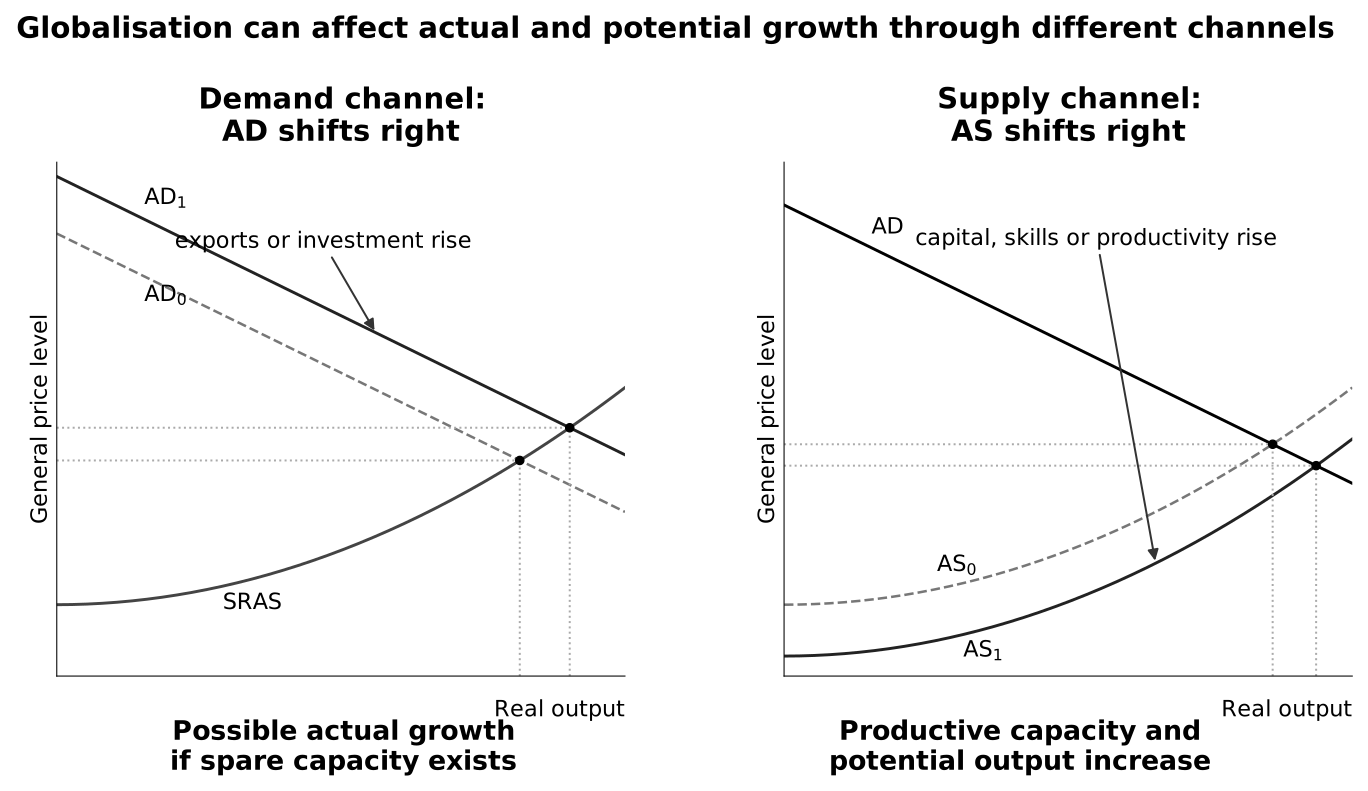
Caption: In the demand panel, higher exports or investment shifts AD from to ; actual output can rise when spare capacity exists. In the supply panel, capital, skills or productivity shifts AS from to , increasing productive capacity. The panels must not be combined into an automatic claim: inflows may not be productive, export growth may be offset by imports, and price outcomes depend on the relative AD and AS changes.
Possible benefits are actual and potential growth, employment, lower input costs, stronger export earnings and revenue. Possible costs are imported inflation, transmitted recessions, structural unemployment, volatile capital flows, supply shocks and external-financing vulnerability.
A trade deficit alone does not prove welfare loss. It may reflect strong investment imports or weak competitiveness; financing, composition and sustainability matter.
Distribution and inequality
Globalisation can reduce income gaps between countries when lower-income economies industrialise. It can widen inequality within a country if trade and technology raise demand for skills and capital while displacing routine labour.
Incidence depends on education, factor mobility, capital ownership, bargaining power, tax-transfer systems and access to infrastructure. State clearly which group and which income concept—wage, disposable income or real purchasing power—is changing.
Environment and sustainability
Higher production and transport can increase emissions and resource use; pollution-intensive activity may relocate to weak-regulation jurisdictions. Conversely, income growth and technology transfer can finance cleaner production. The direct response is to price or regulate the externality and coordinate internationally, not assume either autarky or unrestricted trade is environmentally optimal.
Resilience is not self-sufficiency
Resilience means reducing harmful concentration and improving recovery. Useful measures include diversified suppliers and markets, inventories for critical goods, interoperable infrastructure, emergency domestic capability and trusted agreements. Producing everything domestically sacrifices comparative advantage and can itself create single-country risks.
Managing adjustment
- Diagnose the loss: temporary demand shock, structural skill mismatch, market power, environmental externality or concentration risk.
- Support people through temporary income assistance and social insurance.
- Improve mobility through relevant training, matching, housing and transport.
- Improve firm adaptability through finance, technology, competition and connectivity.
- Address the externality or resilience problem directly.
- Review outcomes and withdraw support that preserves inefficient activity without adjustment.
Evaluation checklist
Separate short run from long run, aggregate gain from distribution, gross flow from net effect, temporary adjustment from permanent loss, FDI from portfolio capital, and complementary from substitute labour.
Return to Globalisation and the International Economy.