Paper 1 Practice: Calidora’s Solar-Panel Tariff — Answers
Indicative guidance
Credit accurate alternatives using the evidence and explicit conditions.
Questions: Calidora’s Solar-Panel Tariff.
Question 1(a)(i) [2]
Free-trade imports are thousand panels. Imports after the tariff are thousand panels.
Question 1(a)(ii) [2]
Question 1(b) [4]
The tariff raises the domestic price from C80 to C100. Consumer surplus falls as households pay more and consumption contracts from 110 000 to 90 000 panels, potentially slowing clean-energy adoption. Domestic producers receive the higher price and expand output from 20 000 to 40 000, increasing producer surplus, revenue and possibly employment. These are distributional changes. Tariff revenue is a transfer to government rather than a net social gain by itself. Under the standard small-country, competitive-market assumptions and with no other market failure, inefficient extra domestic production and forgone consumption create two deadweight losses.
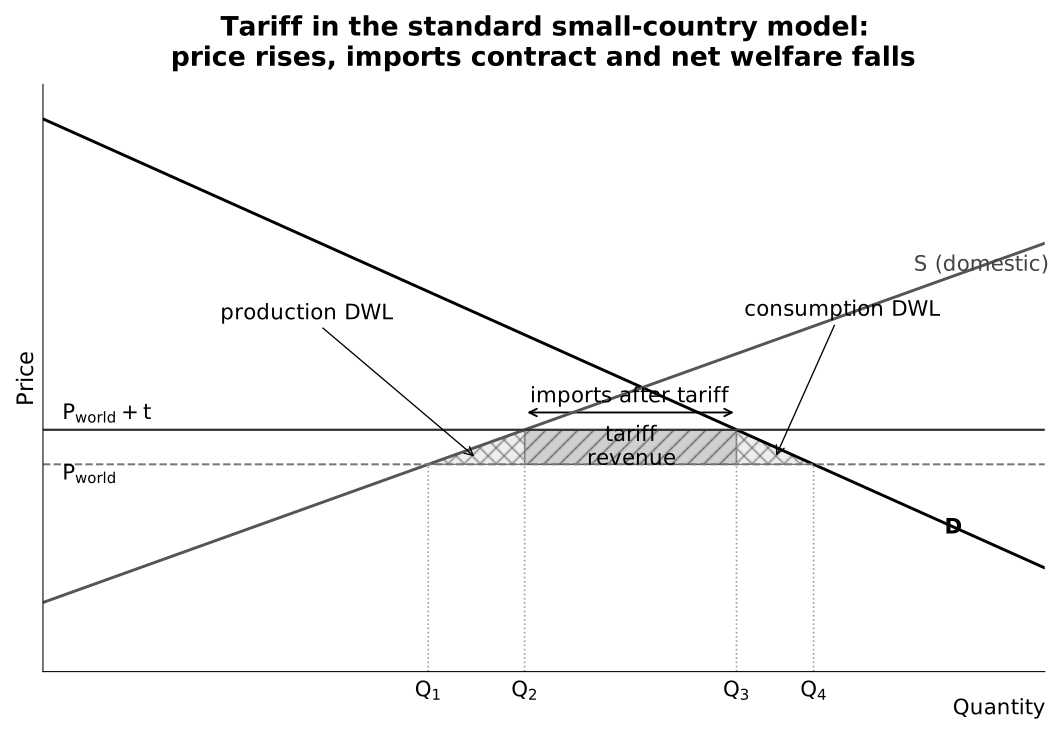
Caption: Apply the standard small-country tariff model by reading the higher domestic price, increased supply, reduced demand, smaller import gap, revenue transfer and two deadweight-loss areas.
Question 1(c) [4]
FDI can add capital and transfer engineering, management and distribution knowledge, raising labour productivity and productive capacity if local linkages and learning occur. Migrant technicians relieve seasonal skill shortages, enabling existing capital to be used and projects completed; knowledge may also diffuse to local workers. Gains are conditional on productive investment, local linkages and effective use of skills. Profit remittances do not by themselves reduce Calidora’s domestic productive capacity, but they reduce the share of FDI-generated income retained by residents. Migrants who closely substitute for local labour may create wage or employment pressures for some workers even while relieving aggregate skill shortages.
Question 1(d) [8]
Temporary protection may allow firms to expand output, learn, train workers and achieve scale economies until unit costs fall. If learning generates external benefits that firms cannot capture, intervention has an efficiency rationale. Calidora already possesses related mounting-system capabilities, which may improve prospects.
Yet the tariff raises downstream installers’ costs and reduces solar adoption. Imported cells remain important, so protection of final assembly may not create deep capability. Firms may lobby for extension, face weaker competitive pressure and never reach world cost. Retaliation threatens a competitive export industry. A tariff is poorly targeted if the failure is training or finance; conditional training grants or credit tied to measurable productivity may cost less.
Maintain protection only for a specified period with transparent productivity milestones and credible withdrawal. Without evidence of learning spillovers and eventual competitiveness, the infant-industry case is weak.
The scheduled three-year review is useful only if withdrawal is credible and firms disclose a cost-reduction path. Domestic supply remains below half of demand after protection, while installers employ more workers in total; these facts weaken a judgement based only on the two protected factories, although regional concentration makes adjustment support relevant.
Question 1(e) [10]
Resilience does not require self-sufficiency. Supplier diversification, strategic stocks for genuinely critical cells and regional standards reduce disruption risk while preserving scale and competition. Laboratories, skills and infrastructure improve non-price competitiveness. Portable support and retraining address concentrated worker losses without permanently raising consumer prices.
A larger tariff and local-content rules may expand domestic production but increase costs, invite retaliation and protect inefficient firms. FDI and migration can relieve capital and skill constraints, subject to competition, labour protections and knowledge-transfer incentives. Cooperation makes standards predictable and expands markets.
Calidora should phase out the broad tariff unless firms meet time-bound learning targets, while supporting the specific capabilities and adjustment failures directly. The precise mix depends on supply concentration, stockholding costs, likelihood of retaliation and measurable domestic spillovers. Competitiveness should mean sustainable productivity and real income, not simply fewer imports.
The 68% dependence on one cell supplier supports diversification, but six-month stocks risk obsolescence. Common standards and testing capability may improve switching and competitiveness across several industries, whereas domestic-content rules can raise downstream costs and retaliation risk. This is an indicative route only; credit coherent alternatives that use the evidence and answer the precise question.
Question-by-question formative marking framework
Use this with the shared Economics formative marking framework.
| Part | Full-credit job | Acceptable alternatives and diagnostic ceiling |
|---|---|---|
| 1(a)(i), 2 | Calculate imports before and after the tariff from demand minus domestic supply, with units. | One correct import figure normally earns 1. |
| 1(a)(ii), 2 | Multiply the per-panel tariff by post-tariff imports and express annual revenue in C million. | Correct method with unit error normally earns 1. |
| 1(b), 4 | Explain consumer loss and producer gain through the higher domestic price and changed quantities, while distinguishing transfers from net welfare effects. | Employment or revenue consequences can support the answer. Saying tariff revenue is automatically a welfare gain prevents full credit. |
| 1(c), 4 | Develop two productive-capacity channels from FDI, skills, migration or knowledge transfer, tied to the case. | Two variants of “more workers” without distinct mechanisms should not receive full credit. |
| 1(d), 8 | Explain learning/scale or spillover logic and test time limits, downstream costs, credibility, retaliation and targeting against the evidence. | Maintaining or withdrawing protection is defensible. Repeating “protect jobs” without an infant-industry mechanism should normally remain below 6. |
| 1(e), 10 | Compare diversification, stocks, domestic capability, standards, FDI/migration and adjustment support against resilience, competitiveness and opportunity cost; select a coherent mix. | Self-sufficiency may be defended only with strong evidence. Equating fewer imports with greater welfare should normally remain below 8. |
Common misconceptions
- Tariff revenue is a transfer to government, not automatically a net welfare gain.
- Profit remittances affect income retained by residents, not necessarily domestic productive capacity.
- Protection is not justified merely because an industry is new.
- Resilience can arise from diversified imports and switching capacity; it does not require self-sufficiency.
Student self-check
Have I reconciled domestic supply, demand and imports, separated distribution from net welfare, explained genuine capacity channels, and judged trade policy against both downstream costs and measurable learning or resilience benefits?