Indicative essay-marking standard
Part (a): 10 marks
- Upper level: accurate, coherent and sufficiently developed explanation covering the full requirement; assumptions are made explicit; diagrams and context perform analytical work.
- Middle level: generally correct but incomplete, unevenly developed or weakly applied.
- Lower level: fragmented definitions, assertion, serious model error or failure to address a material part of the question.
Part (b): 15 marks
A strong response combines developed analysis with contextual evaluation. It compares arguments or policies using common criteria, identifies the conditions that change their relative importance, and reaches a supported judgement. Generic advantages/disadvantages or a bare “it depends” should not receive high evaluation credit.
These are formative descriptors derived from recurring corpus patterns, not official Cambridge or school-specific mark bands.
Paper 2 Practice: Globalisation and the International Economy — Outlines
Indicative rather than exhaustive
Reward coherent alternatives, stakeholder analysis and conditional judgement.
Questions: Globalisation and the International Economy.
Question 1(a) [10]
Comparative advantage means lower opportunity cost, not greater absolute output. Reallocation toward comparative-advantage goods can raise combined production. At a mutually acceptable trading rate, each country obtains imports at a lower opportunity cost than domestic production, expanding consumption possibilities. Explain assumptions: resource mobility within economies, adjustment, low trade costs and a trading rate between opportunity costs.
Question 1(b) [15]
Consumers may gain lower prices and variety; exporters gain larger markets, scale and investment incentives. Competition can raise productivity. Import-competing owners and workers may suffer concentrated, persistent losses where skills and locations are specific. Externalities, market power, transport costs, volatile supply and unequal ownership qualify national gains.
Protection may be justified for security or a genuine infant-industry learning externality, but risks higher prices, inefficiency, lobbying and retaliation. Net national benefit is more likely with strong institutions, competition, mobility and targeted adjustment support. “Each economy benefits” need not mean every resident benefits.
Question 2(a) [10]
Inward FDI adds capital and may transfer technology, management and market access, shifting LRAS right if productive. Migrants expand labour quantity, fill shortages and may raise complementarity with capital. Outward direct investment can give resident firms scale, profits and access to technology, but if it substitutes for investment at home it may relocate some domestic capital formation or production. Profit repatriation affects national income; it should not be confused with the location of productive capacity. Effects depend on skills, domestic linkages and whether capital flows finance productive assets rather than short-term speculation.
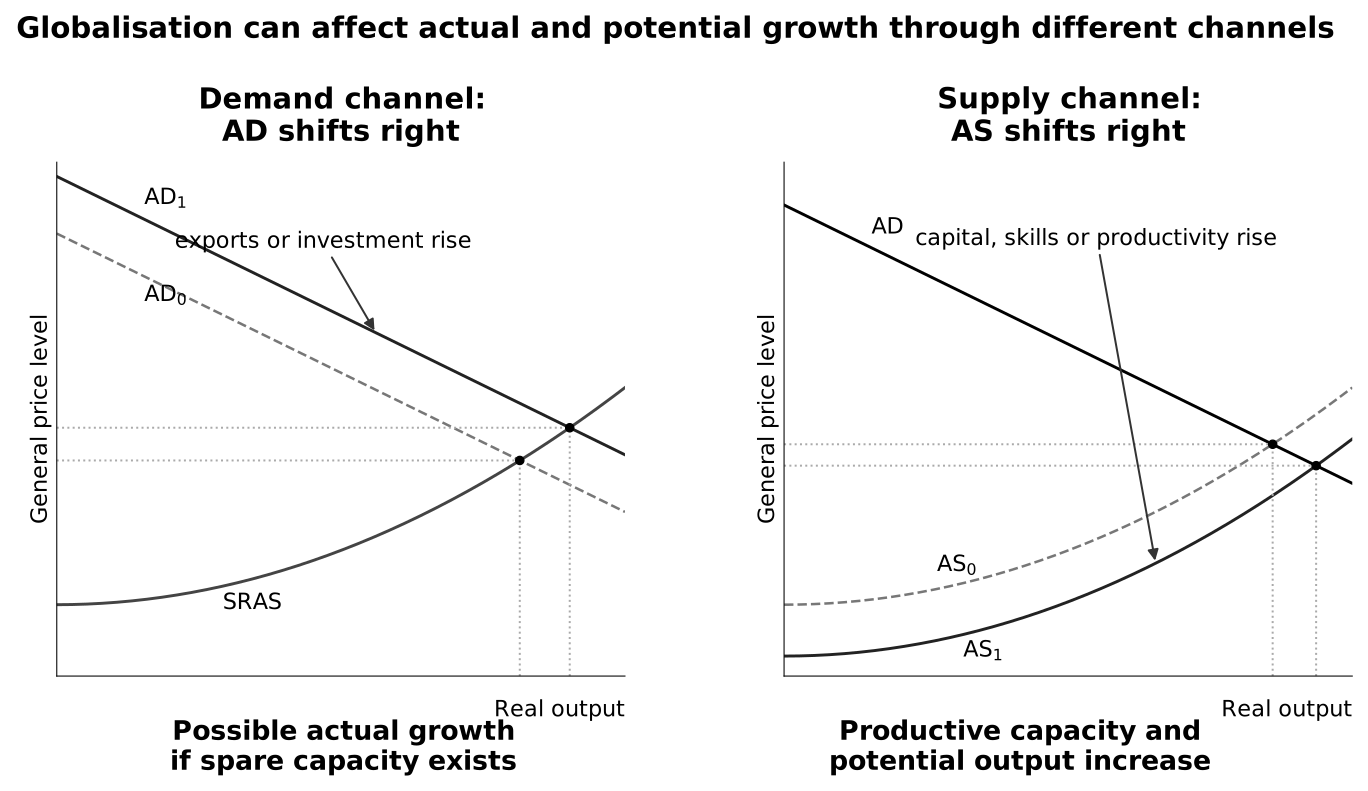
Caption: Separate a short-run expenditure effect on AD from genuine changes in productivity or factor quantity that shift productive capacity.
Question 2(b) [15]
Restrictions may protect close-substitute workers, reduce congestion, preserve strategic assets or limit volatile finance. But broad controls sacrifice investment, skills, competition, tax revenue and knowledge, and may provoke circumvention or retaliation. Domestic firms investing abroad may strengthen headquarters and supply chains even while some jobs relocate.
Target the identified problem: prudential rules for volatile finance, competition and security screening for sensitive acquisitions, labour standards and infrastructure for migration, and incentives for local training and supplier links. Restrict only where evidence of external cost or security risk exceeds lost gains. Capacity, distribution, reversibility and administrative effectiveness determine the judgement.
Question-specific formative marking framework
Use the working ranges in the shared Economics formative marking framework.
| Part | Requirements for the strongest working range | Diagnostic ceiling and alternatives |
|---|---|---|
| 1(a), 10 | Define comparative advantage through opportunity cost, derive mutually beneficial specialisation/trade and recognise the role of terms of trade and assumptions. | Absolute-advantage-only answers should normally remain below 6. A numerical or PPC explanation is valid. |
| 1(b), 15 | Compare consumer, producer, worker and dynamic gains with adjustment, market-failure, distribution and policy conditions; judge whether each economy benefits. | Aggregate gains alone do not prove every group or country benefits. Protection can be considered if its mechanism and opportunity cost are evaluated. |
| 2(a), 10 | Explain inward FDI, outward investment and migration through capital, skills, productivity, labour quantity/quality and knowledge channels; distinguish domestic capacity from resident income. | Treating every financial flow as physical investment should normally remain below 8. At least two distinct channels should be developed. |
| 2(b), 15 | Compare gains and costs of factor mobility, distinguish targeted regulation from broad restriction, and judge using externality, security, distribution, reversibility and administrative criteria. | A generic sovereignty or “jobs” assertion should normally remain below 8. Conditional screening, labour standards or prudential controls are valid alternatives. |
Common errors and self-check
Do not replace comparative advantage with productivity ranking, assume aggregate trade gains are evenly distributed, or conflate domestic production, national income and ownership. Check that restrictions target an identified problem and that forgone investment, skills or competition are included in the judgement.