Aggregate Demand: Components and Determinants
Definition, axes and movement
Aggregate demand (AD) is total planned expenditure on domestically produced final goods and services at each general price level (GPL), over a given period:
The horizontal axis of an AD-AS diagram is real national output demanded; the vertical axis is the GPL. Both are economy-wide aggregates.
The axes do not mean that the government first fixes the GPL and the economy then mechanically supplies an output. An AD curve is a schedule of conditional combinations: each point shows planned real expenditure at one hypothetical GPL while non-price determinants are held constant. Once AS is added, GPL and real output are jointly determined at the intersection.
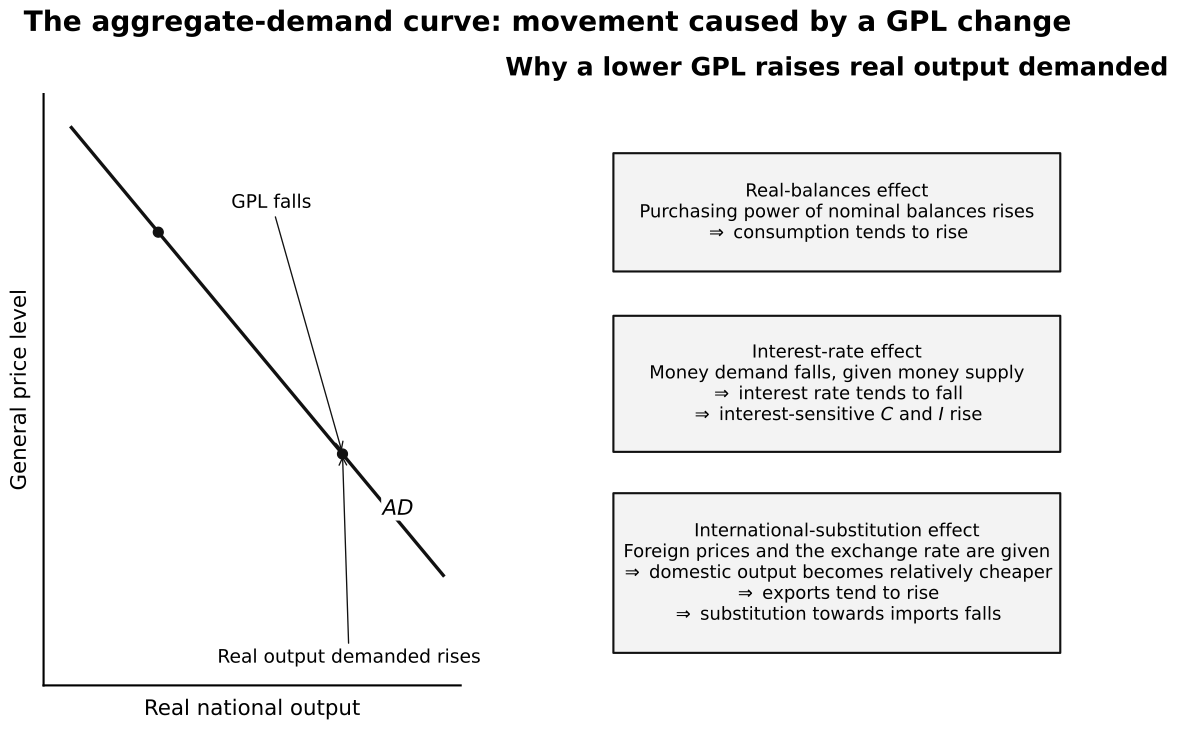
Caption: The downward-sloping line is one unchanged AD schedule. Moving from the upper point to the lower point means only the GPL has fallen. Real money balances rise, interest rates tend to fall and domestic output becomes relatively cheaper than foreign output, so planned real expenditure on domestic output increases. Because the cause is a GPL change, this is a movement along AD rather than a rightward shift.
The three mechanisms operate ceteris paribus:
- real-wealth or real-balances effect: a lower GPL raises the purchasing power of nominal money balances, supporting consumption;
- interest-rate effect: a lower GPL reduces transaction demand for money and can place downward pressure on interest rates, supporting interest-sensitive consumption and investment;
- international-substitution effect: a lower domestic GPL relative to foreign prices makes domestic output more competitive, raising exports and reducing substitution toward imports.
A GPL change causes a movement along AD. A non-price determinant changes planned spending at every GPL and shifts AD. The AD curve is not a market-demand curve: substitution between different domestic goods does not explain its slope.
Movement or shift? Use this test
| Starting information | Diagram operation | Example |
|---|---|---|
| GPL itself changes | movement along the existing AD curve | a fall in GPL raises the real value of money balances |
| a determinant of , , , or domestic import substitution changes | shift of the entire AD curve | greater business confidence raises planned investment at every GPL |
Do not infer the direction from the wording “demand rises.” First identify whether the statement refers to aggregate quantity demanded because GPL changed or to aggregate demand because a non-price determinant changed.
Components of AD
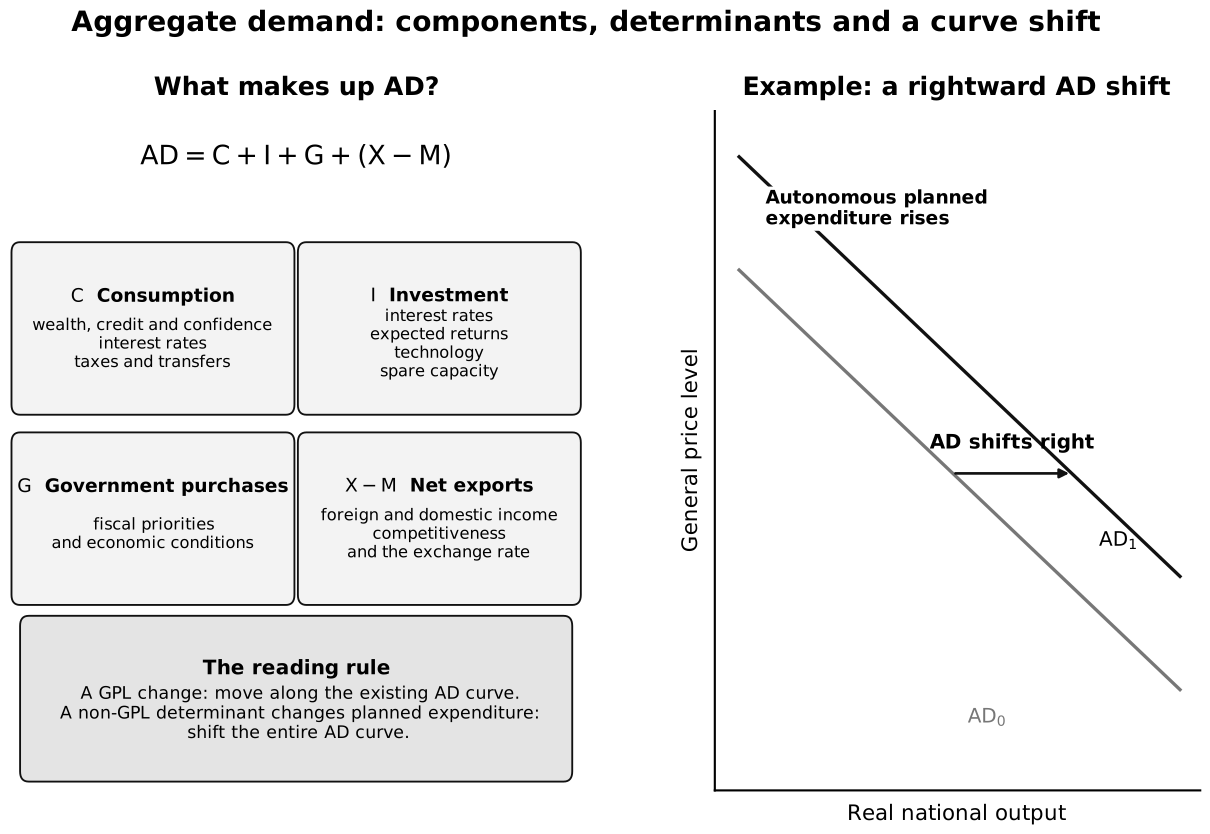
Caption: The left side defines and separates the four expenditure sources. The right side shows a shift: at every GPL, planned expenditure on domestic output is now greater. For imports, trace the domestic-spending counterpart rather than treating the minus sign mechanically—a switch from domestic goods toward imports shifts AD left, while an equal rise in gross expenditure and imports may leave domestic demand unchanged.
Consumption,
Consumption is household expenditure on final goods and services. A simple consumption function is:
where is autonomous consumption, is disposable income and is the marginal propensity to consume.
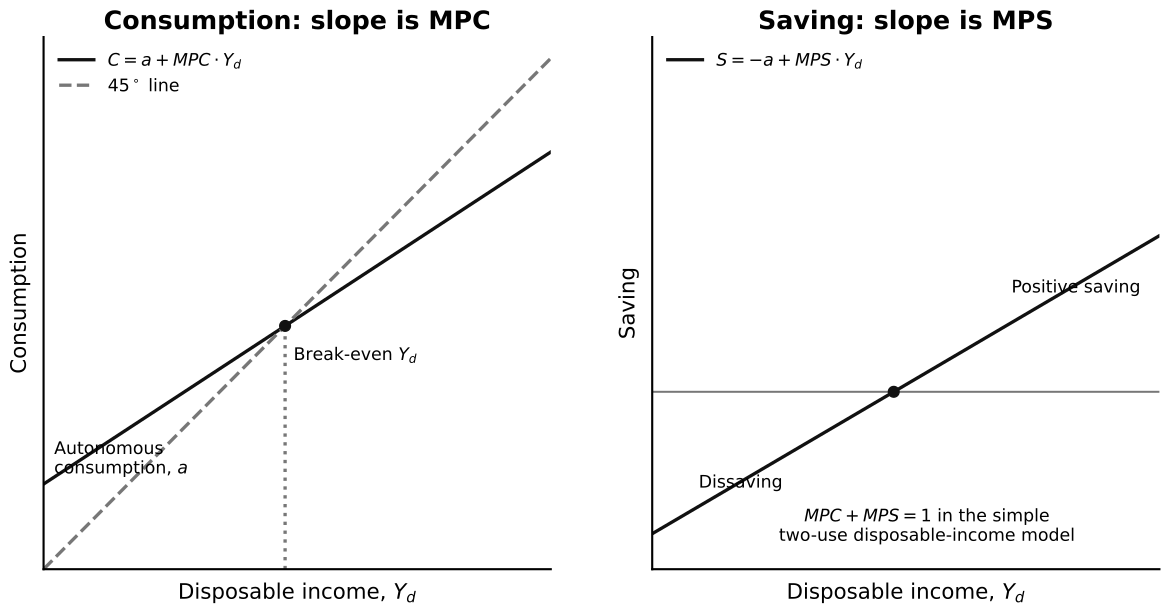
Caption: In the consumption panel, the vertical intercept is autonomous consumption and the slope is ; moving right raises induced consumption. In the saving panel, dissaving occurs where saving is negative, break-even income occurs where , and the slope is the MPS. Under the simple two-use model, the two marginal propensities sum to one.
In the simple two-use disposable-income model, .
Important non-income determinants include:
- interest rates and access to credit;
- consumer confidence and expectations of future income, employment and prices;
- household net wealth and indebtedness;
- direct taxes and transfers through disposable income;
- income distribution, because groups may have different MPCs;
- demographics, tastes and attitudes toward saving.
Income is a flow; wealth is a stock. A household can experience rising asset wealth while its current real income falls.
Investment,
Macroeconomic investment is expenditure on newly produced capital and inventories. It includes gross fixed capital formation, new residential construction and changes in inventories. It does not include the mere purchase of existing shares, bonds, land or second-hand assets.
Gross investment includes replacement of depreciated capital:
Only positive net investment necessarily enlarges the capital stock.
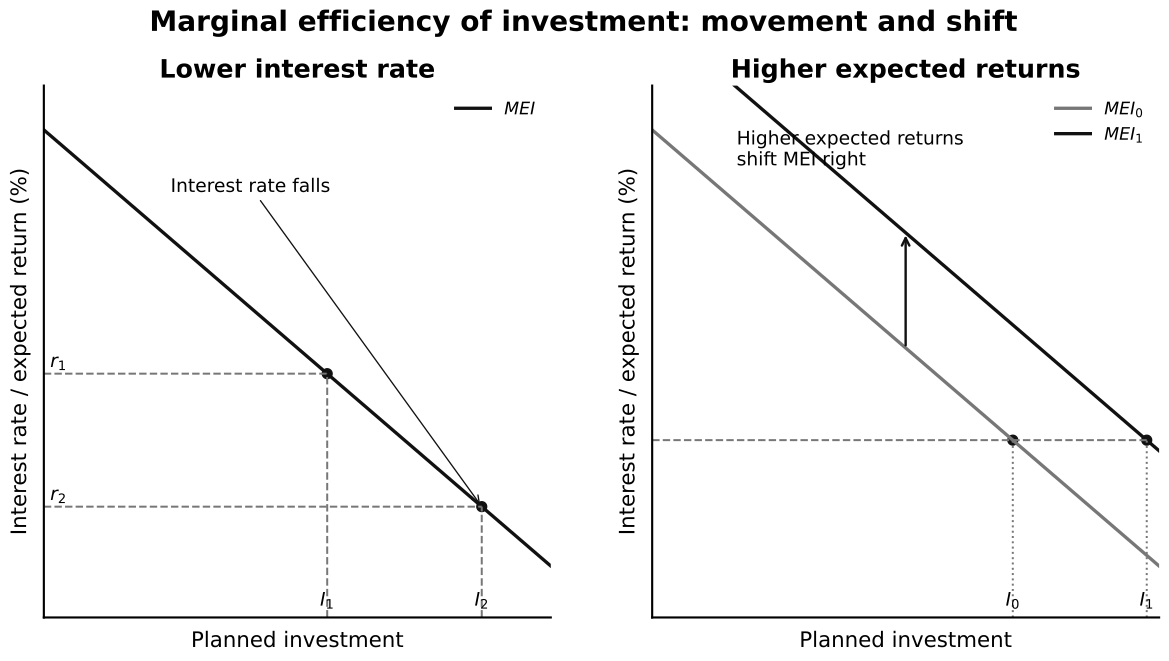
Caption: In the movement panel, the MEI schedule is unchanged and a lower interest rate makes more projects’ expected returns exceed their financing or opportunity cost, increasing planned investment. In the shift panel, improved expected profitability moves the entire MEI schedule right, so planned investment is greater at each interest rate. The schedule concerns newly produced capital, not purchases of existing financial assets.
Component, determinant and induced response
| Component | What is counted | Example non-income determinant | Induced response to higher domestic income |
|---|---|---|---|
| household purchases of final goods and services | confidence, wealth, interest rates | consumption usually rises | |
| new capital, new housing and inventory change | expected profitability, financing cost, technology | may rise through accelerator or expectations effects, but is not automatically induced in the simple model | |
| government purchases of current output | fiscal priorities and policy decisions | treated as autonomous in the simple model | |
| foreign purchases of domestic output | foreign income and competitiveness | mainly linked to foreign, not domestic, income | |
| domestic purchases of foreign output | relative prices and preferences | imports usually rise, creating an induced withdrawal |
The distinction is analytical rather than permanent: a component can contain both autonomous and induced parts. State which part changes in the scenario.
Investment depends on:
- interest rates and other financing costs;
- current capacity utilisation and expected demand;
- expected profitability, confidence and political or regulatory risk;
- technology and the relative cost of capital and labour;
- corporate taxes, grants and investment allowances.
Foreign direct investment can finance domestic capital formation, but a cross-border financial transaction is not automatically equal to current investment expenditure. The key question is whether new capital is produced in the domestic economy.
Government expenditure,
is government expenditure on currently produced final goods and services, including public-sector consumption and public investment. It is driven mainly by fiscal priorities, economic conditions and political or social objectives.
Transfer payments such as cash benefits do not directly purchase current output and therefore do not enter . They may raise AD indirectly if recipients increase consumption.
Net exports,
is foreign expenditure on domestic output. is subtracted because gross , and can include imported output.
To see the accounting logic, split gross expenditure into domestic and imported parts:
and:
Then:
Therefore, a rise in import expenditure alone does not mechanically reduce AD: the corresponding change in gross expenditure is also present. AD falls when expenditure is substituted away from domestic output, or when another change lowers domestic planned spending.
Net exports depend on:
- foreign real income, affecting demand for exports;
- domestic real income, affecting induced import expenditure;
- exchange rates and relative inflation;
- relative quality, reliability and non-price competitiveness;
- trade barriers and foreign or domestic preferences.
A depreciation usually improves the price competitiveness of domestic exports and imported substitutes. The eventual change in export revenue, import expenditure and AD depends on pass-through, quantities, elasticities, contracts, capacity and time. Do not infer the magnitude from the exchange-rate change alone.
Autonomous and induced expenditure
An autonomous expenditure change is independent of current national income and shifts AD. An induced expenditure change follows from changing income.
Examples:
- improved business expectations autonomously raise investment;
- higher foreign income autonomously raises exports from the domestic economy’s perspective;
- the resulting increase in domestic income induces additional household consumption and imports.
This distinction is explicitly required by the syllabus and is essential for the multiplier.
Building a complete AD explanation
For a rise in foreign income:
- overseas households and firms demand more goods and services, including domestic exports;
- domestic export volume and export revenue tend to rise, ceteris paribus;
- and planned expenditure on domestic output increase at each GPL;
- AD shifts right;
- unintended inventory depletion encourages firms to expand output;
- equilibrium real output and GPL rise, with the output response larger when spare capacity is substantial.
Common pitfalls
- Labelling the axes “price” and “quantity” rather than GPL and real national output.
- Using substitution between individual domestic goods to explain AD’s slope.
- Treating a GPL fall as a rightward shift of AD.
- Treating transfer payments as .
- Counting purchases of existing financial assets as .
- Saying all gross investment expands productive capacity.
- Saying a rise in automatically reduces AD without tracing the domestic-spending counterpart.
- Confusing income with wealth or MPC with the average propensity to consume.
- Predicting an exchange-rate effect without stating the relevant price, volume, revenue, expenditure and time assumptions.
Return to Introduction to Macroeconomics.