Paper 1 Practice: Norvale’s Port-Retooling Programme — Answers
Indicative guidance
Credit any accurate route using the evidence. Longer answers require analysis, evaluation and a supported policy judgement.
Questions: Norvale Port-Retooling Programme.
Question 1(a)(i) [2]
The marginal propensity to withdraw is 0.60.
Question 1(a)(ii) [2]
The maximum modelled increase is N400 million.
Question 1(b) [4]
Lower planned investment reduces injections and aggregate expenditure. At the previous output, planned withdrawals now exceed injections and firms experience unintended inventory accumulation. Firms cut production and demand for factor services, reducing household income and induced consumption. As income falls, saving, tax payments and import expenditure fall. Adjustment continues until planned withdrawals again equal planned injections at a lower equilibrium national income. The ex-post identity between output, income and expenditure still holds; it does not prevent this planned disequilibrium and adjustment.
Question 1(c) [4]
Bringing forward domestically directed government purchases raises , planned expenditure and AD in the short run. Successive induced-consumption rounds may magnify the initial injection. Once the port and software become productive, faster turnaround, lower logistics costs, better information and trained labour may reduce unit costs and/or expand productive capacity, shifting SRAS and possibly LRAS right. The supply shift is delayed and uncertain because construction and training take time; imported control units also reduce the initial demand for domestic output.
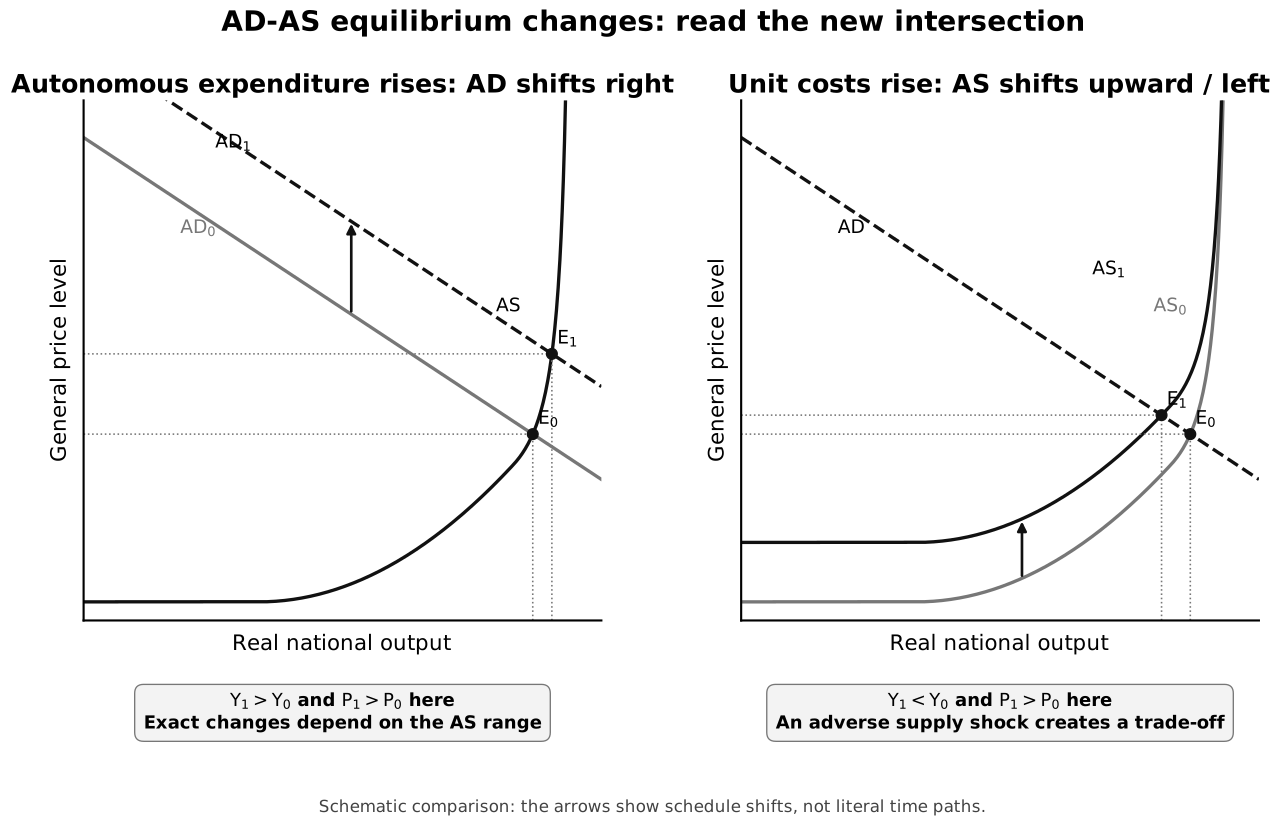
Caption: The relevant analytical distinction is timing: expenditure can shift AD before infrastructure and training improve economy-wide productive capacity. A complete answer labels the axes and identifies the appropriate rightward shifts rather than assuming that all spending instantly raises LRAS.
Question 1(d) [8]
The estimate provides a transparent benchmark: with , each income round passes only 0.40 into further domestic consumption, so the geometric process converges to a multiplier of 1.67 and N240 million could generate an N400 million increase in equilibrium national income. With the price level fixed, this is also an N400 million increase in real output measured at constant prices under the model assumptions.
Its predictive value is limited. Imported control units mean the initial autonomous demand for domestic output is below N240 million. If indebted households save more, MPW rises and the multiplier falls. Taxes and import propensities may change with income, and project delays weaken the timing link. Crowding out may occur through higher interest rates, displaced maintenance or scarce engineers. If confidence improves, complementary private investment could instead crowd in.
The case estimates only N170 million of first-year payments to domestic firms and workers. Applying the simple multiplier to the full N240 million therefore overstates the direct domestic injection even before imported inputs purchased by local contractors are considered.
Most importantly, the simple calculation assumes fixed prices and spare capacity. Idle general construction resources make some real-output response plausible, but scarce electrical engineers create bottlenecks. Part of the expenditure may therefore raise wages and the GPL rather than real output. The multiplier is useful as a conditional benchmark and, given the case evidence, plausibly an upper-bound scenario rather than a point forecast. Sensitivity estimates using the domestic content, spare capacity and alternative MPWs would be more informative.
Question 1(e) [10]
The port programme directly supports AD when private investment and consumption are weak. It is targeted at domestic productive activity, can employ idle resources and may later lower exporters’ costs and raise productive capacity. These supply benefits distinguish it from a purely temporary demand stimulus. Yet imported equipment leaks abroad, engineers are scarce, implementation is slow and higher debt interest creates an opportunity cost.
Lower-income tax relief may act faster and have a relatively high MPC, but recipients may repay debt, purchase imports or save amid uncertainty. It does not directly repair logistics constraints, and temporary relief can be politically difficult to withdraw. Taking no action avoids fiscal and information costs and may be appropriate if foreign demand recovers soon, but it risks a deeper multiplied contraction and persistent loss of skills.
The choice depends on the output gap, domestic content, readiness of the project, fiscal space and the expected duration of weak demand. Norvale should proceed with the demonstrably high-return, ready components, phase work around the engineering bottleneck and use narrowly targeted temporary relief only if household demand is deteriorating rapidly. If the downturn is brief or the project fails cost-benefit appraisal, postponement is preferable. Credit coherent alternative judgements tied to the evidence.
The estimated 2% output gap and idle general construction resources favour some stimulus, but the four-month procurement lag reduces immediate stabilisation. The predicted 12% turnaround improvement is conditional on software compatibility and training, so it should enter a cost-benefit appraisal rather than be treated as certain.
Question-by-question formative marking framework
Use this with the shared Economics formative marking framework.
| Part | Full-credit job | Acceptable alternatives and diagnostic ceiling |
|---|---|---|
| 1(a)(i), 2 | Sum the marginal withdrawal propensities accurately and identify . | Correct sum without label normally earns 1. |
| 1(a)(ii), 2 | Apply and multiply by the stated injection under the model assumptions. | Minor rounding is acceptable. Omitting the N million unit or conditional nature loses interpretation credit. |
| 1(b), 4 | Trace lower planned investment through injections, unintended inventories, output/income adjustment and a new equilibrium. | An AD route can support the answer if the circular-flow adjustment is explicit. Merely stating “investment falls, GDP falls” is insufficient. |
| 1(c), 4 | Distinguish the near-term AD injection from delayed productivity/capacity effects on AS. | A rightward SRAS or LRAS shift can be defended with timing. Treating supply capacity as an immediate multiplier round prevents full credit. |
| 1(d), 8 | Use the multiplier as a benchmark, then test domestic content, changing withdrawals, spare capacity, lags and AD-AS price adjustment against the evidence. | A useful-but-overstated or useful-under-conditions conclusion is valid. Reporting N400 million as a forecast should normally remain below 6. |
| 1(e), 10 | Compare port spending, targeted tax relief and no action using timing, domestic content, output gap, fiscal cost, distribution and supply effects; reach a sequenced judgement. | A different policy mix is valid. A multiplier-only ranking without implementation or capacity evidence should normally remain below 8. |
Common misconceptions
- The multiplier is a conditional equilibrium model, not a guaranteed forecast.
- Imported spending is a withdrawal from the domestic circular flow.
- A rise in the general price level is an outcome of AD-AS adjustment, not the cause of an AD shift.
- An outward AS shift raises potential output; it does not guarantee that actual output immediately rises.
Student self-check
Have I shown the adjustment process rather than only its endpoint, separated demand timing from supply timing, identified domestic content and withdrawals, and compared all three policy options using a common objective?