Indicative essay-marking standard
Part (a): 10 marks
- Upper level: accurate, coherent and sufficiently developed explanation covering the full requirement; assumptions are made explicit; diagrams and context perform analytical work.
- Middle level: generally correct but incomplete, unevenly developed or weakly applied.
- Lower level: fragmented definitions, assertion, serious model error or failure to address a material part of the question.
Part (b): 15 marks
A strong response combines developed analysis with contextual evaluation. It compares arguments or policies using common criteria, identifies the conditions that change their relative importance, and reaches a supported judgement. Generic advantages/disadvantages or a bare “it depends” should not receive high evaluation credit.
These are formative descriptors derived from recurring corpus patterns, not official Cambridge or school-specific mark bands.
Paper 2 Practice: Introduction to Macroeconomics — Outlines
Indicative rather than exhaustive
Reward coherent alternatives with accurate diagrams, causal reasoning and contextual judgement.
Questions: Paper 2 Introduction to Macroeconomics.
Question 1(a) [10]
- Define and distinguish a shift from a movement along AD.
- Higher exports directly raise planned demand for domestic output. Confidence can raise expected returns and planned investment.
- The combined autonomous increase shifts AD right. Inventory depletion induces firms to raise output and employment; induced consumption can reinforce the increase.
- At the new AD-AS intersection, real output and the GPL generally rise. Their relative changes depend on the starting AS range.
- Avoid treating a higher GPL as the cause of the AD shift.
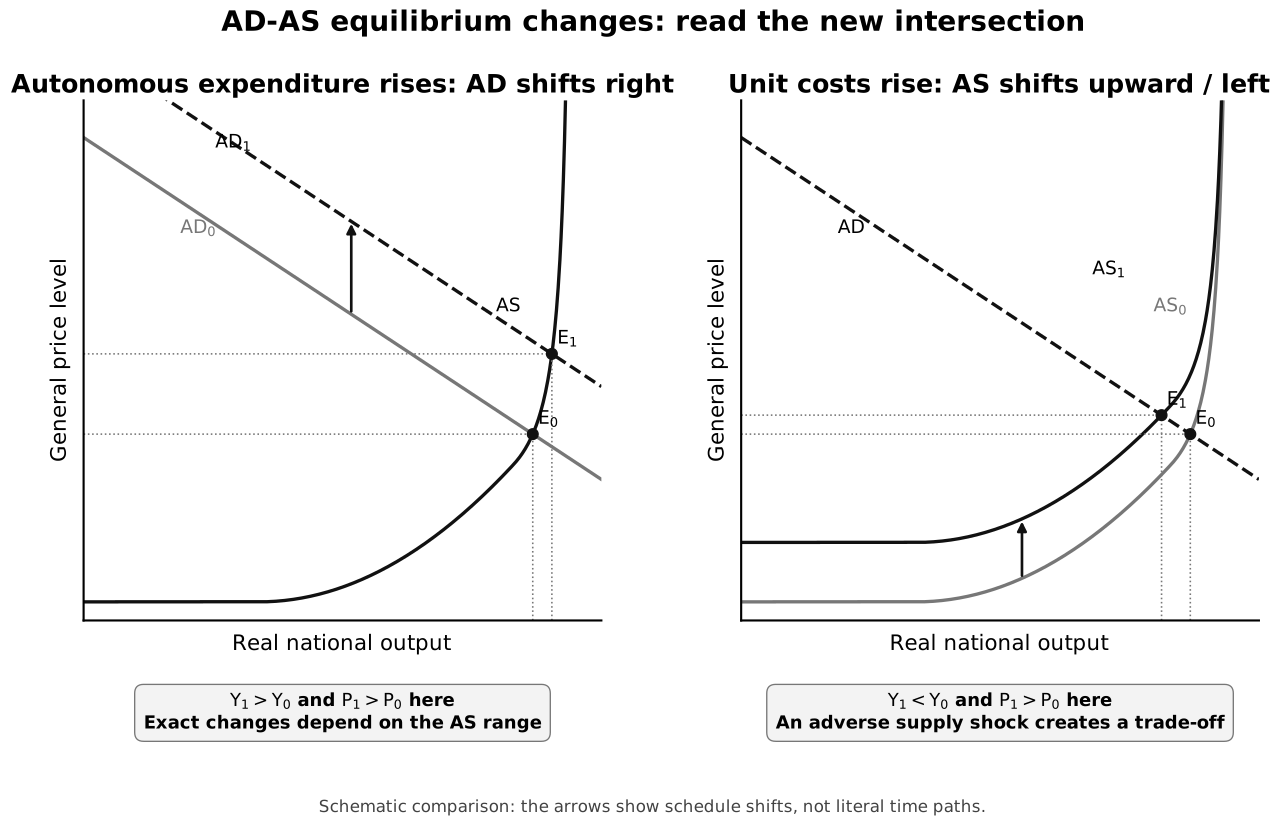
Caption: A rightward AD shift normally raises both equilibrium real output and GPL, but the proportions depend on spare capacity and the shape of AS.
Question 1(b) [15]
Sustainability requires productive capacity and competitiveness to keep pace with demand. Relevant conditions include spare labour and capital, occupational mobility, infrastructure, skills, investment quality, technology, access to imported inputs and whether export demand persists. Near capacity, further AD growth produces inflation, wage pressure, congestion and import growth rather than much real output.
Private investment may expand LRAS, especially if it embodies technology and complements training. Yet weak finance, long gestation, policy uncertainty or investment concentrated in property may limit capacity gains. An adverse imported-cost shock could shift SRAS left even while AD rises.
A strong judgement distinguishes short-run cyclical expansion from long-run potential growth. The rise is most sustainable when spare capacity permits the initial response and productive investment removes emerging bottlenecks. Its magnitude cannot be inferred from AD alone; the composition, timing and supply response are decisive.
Question 2(a) [10]
An autonomous rise in government purchases becomes income for firms and factor owners. Recipients spend an induced fraction on domestic output, creating another person’s income. Saving, taxes and imports withdraw part of every round, so rounds diminish.
For example, an MPW of 0.50 gives : an initial autonomous increase in expenditure on domestic output of 100 produces an eventual modelled equilibrium-income rise of 200 under fixed-price, spare-capacity and constant-propensity assumptions. Equilibrium is restored when the cumulative rise in withdrawals equals the initial injection.
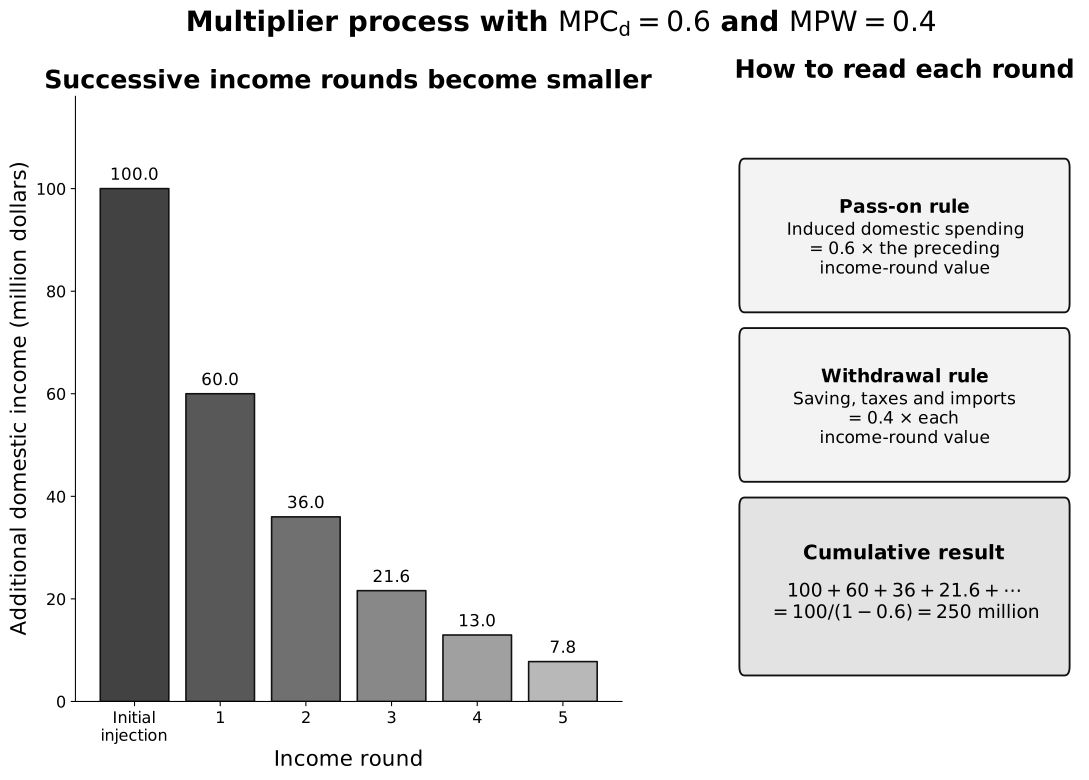
Caption: Successive induced-spending rounds become smaller because a share of each income increment is withdrawn through saving, taxes and imports.
Question 2(b) [15]
High saving and import propensities raise MPW and reduce the first economy’s multiplier. The domestic content of government purchases also matters: imported procurement is not an initial injection into domestic output. Confidence may alter saving and investment, while interest-rate or resource crowding out can offset demand.
The other economy may have a larger arithmetic multiplier but little spare capacity. The simple multiplier may suggest a substantial money-value increase in expenditure, while in an AD-AS setting more of the adjustment may occur through a higher GPL and less through real output. Bottlenecks, labour immobility and the duration of the programme matter. If purchases improve capacity, a later rightward AS shift may permit more real growth; poorly selected projects may not.
The economy with lower withdrawals is not automatically the one with the larger real-output gain. Compare both the demand-side multiplier and the AS setting. The best conclusion is conditional on domestic content, MPW, spare capacity, implementation speed, monetary response and any supply benefit.
Question-specific formative marking framework
Use the working ranges in the shared Economics formative marking framework.
| Part | Requirements for the strongest working range | Diagnostic ceiling and alternatives |
|---|---|---|
| 1(a), 10 | Trace export and investment increases into AD, distinguish shifts from movements, and explain the equilibrium output/GPL result using the economy’s capacity position. | Component definitions without an AD-AS adjustment should normally remain below 8. A circular-flow route may support but not replace economy-wide equilibrium analysis. |
| 1(b), 15 | Evaluate spare capacity, productive investment, labour/skills, bottlenecks, confidence, inflation and longer-run AS; distinguish cyclical expansion from sustainable potential growth. | AD analysis alone should normally remain below 12. A strong conclusion states what must happen to capacity and productivity. |
| 2(a), 10 | Explain repeated income-spending rounds, withdrawals, convergence and , while identifying the assumptions behind the multiplied equilibrium change. | Formula-only treatment should normally remain below 6. A numerical illustration is valid but not compulsory. |
| 2(b), 15 | Compare MPW and domestic content with spare capacity, crowding out, lags, monetary response and possible supply effects; distinguish nominal expenditure from real-output effects. | Ranking the economies solely by arithmetic multiplier should normally remain below 12. Either economy can have the larger real-output gain under defensible conditions. |
Common errors and self-check
Do not make the GPL cause the AD shift, count imported procurement as domestic output, or treat the multiplier as independent of withdrawals and capacity. Check that every claimed real-output effect is reconciled with the AS setting and time horizon.