Balance of Trade and External Stability
Balance of trade and the wider balance of payments
The balance of trade is export revenue minus import expenditure for goods and services:
- : trade surplus.
- : trade deficit.
The balance of trade is part of the current account, not the whole balance of payments (BOP).
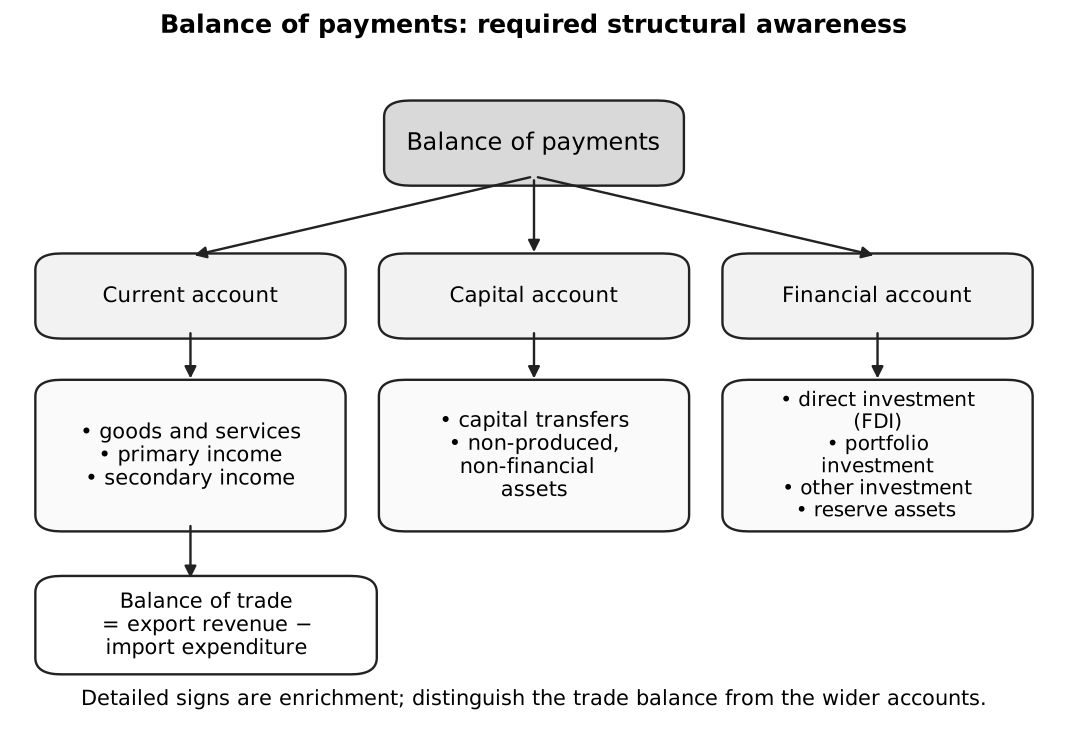
Caption: Read the hierarchy from the top. The balance of trade records export revenue minus import expenditure for goods and services and is nested inside the current account; primary and secondary income are also current-account items. Capital and financial transactions belong to separate accounts, so a trade deficit is not the same as a BOP deficit.
At H2 level, awareness of the main components is required, but detailed BOP accounting and sign conventions are not.
| Account | Main content |
|---|---|
| Current account | Trade in goods and services, primary income and secondary income |
| Capital account | Capital transfers and transactions in non-produced, non-financial assets |
| Financial account | Cross-border investment and financial-asset transactions, including direct and portfolio investment |
Do not assume that a current-account deficit means transactions cannot be financed. It is associated with net financial inflows, reserve changes or other offsetting entries. The quality and reversibility of financing matter for stability.
Use the nesting rule:
The symbols show conceptual inclusion, not that the numerical balance of one account is simply added twice inside another.
What determines export revenue and import expenditure
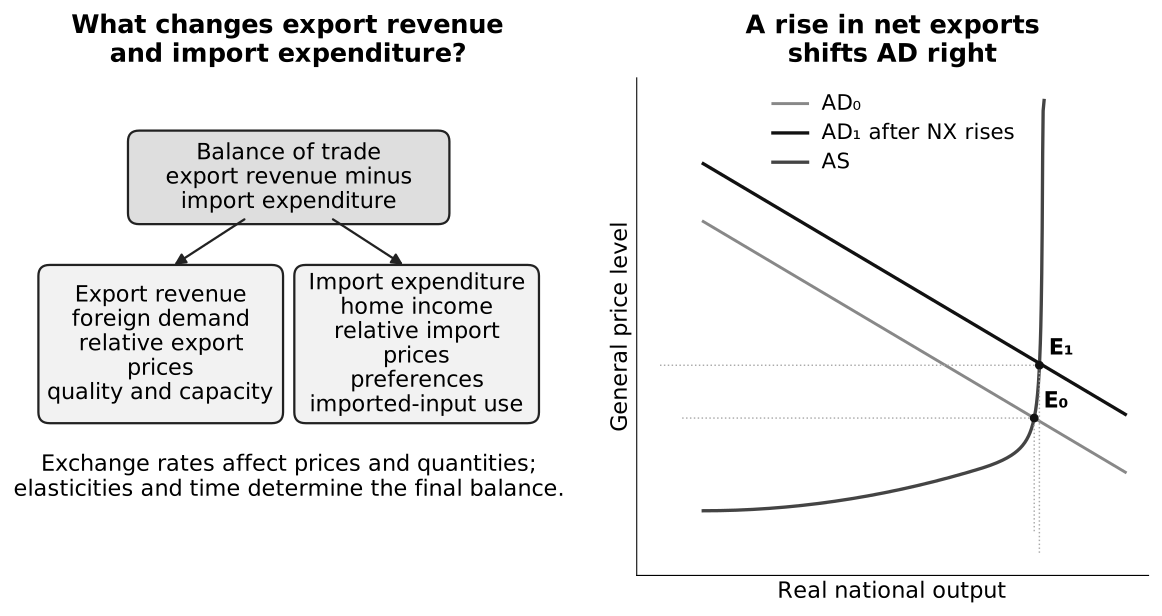
Caption: The left branch collects determinants of export revenue; the right branch collects determinants of import expenditure. Each side is price multiplied by quantity, so income, relative prices, exchange rates and non-price competitiveness can affect the total through different routes. The AD-AS panel then shows one possible macroeconomic consequence of a rise in net exports, holding other AD components constant.
Export revenue
Export revenue tends to rise when:
- foreign real income increases;
- domestic goods become more price-competitive;
- quality, reliability, branding or after-sales service improves;
- domestic firms have sufficient capacity to meet foreign demand;
- access to foreign markets improves.
Import expenditure
Import expenditure tends to rise when:
- domestic real income increases;
- imported goods become cheaper relative to domestic substitutes;
- domestic capacity is constrained;
- preferences shift towards foreign products;
- firms demand more imported capital goods or intermediate inputs.
Hence a surplus can reflect high competitiveness, but can also result from weak domestic demand. A deficit can reflect a competitiveness problem, but can also accompany strong growth or productive capital imports.
Exchange rates and the trade balance
State the quotation before reading any currency graph. In the local diagram, the vertical axis is foreign currency per SGD. A rise therefore means one SGD buys more foreign currency—an appreciation of SGD—while a fall means depreciation. A quotation written in the reciprocal form would move numerically in the opposite direction for the same economic event. The S$NEER is a trade-weighted index rather than one bilateral quotation.
A depreciation lowers the foreign-currency price of exports if exporters pass through the exchange-rate change, while raising the domestic-currency price of imports. Two effects follow:
- a price or valuation effect on each unit traded;
- a volume effect as buyers change quantities demanded.
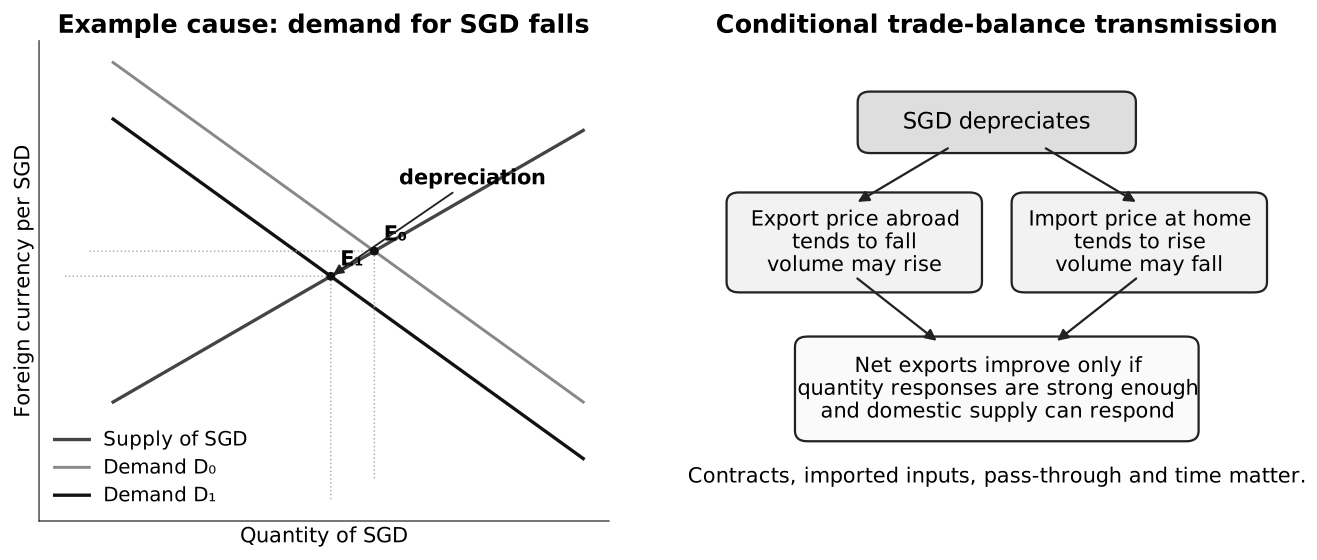
Caption: The currency-market panel uses foreign currency per SGD, so the lower equilibrium is a depreciation. The transmission panel then separates export and import price incentives from quantity responses. Net exports improve only if the combined revenue and expenditure changes are favourable; pass-through, contracts, elasticities, imported inputs, spare capacity and time all matter.
Price, quantity and total-value effects
| Step | Export side | Import side |
|---|---|---|
| Price per unit | depreciation tends to lower the foreign-currency export price | depreciation raises the domestic-currency import price |
| Quantity | foreign demand for exports may rise | domestic demand for imports may fall |
| Total value | export revenue depends on both export price and quantity | import expenditure depends on both import price and quantity |
This is why “exports rise and imports fall” is incomplete: the balance of trade concerns total export revenue and import expenditure, not physical quantities alone.
Marshall–Lerner condition
The Marshall–Lerner condition states that, other things equal, a depreciation improves the balance of trade when the sum of the absolute price elasticities of demand for exports and imports is greater than one. Formula derivation and calculation are not required by the syllabus.
The condition works more strongly when:
- foreign demand for exports and domestic demand for imports are price-elastic;
- close substitutes exist;
- firms have spare capacity and export supply can expand;
- imported inputs are not such a large part of export costs that depreciation erodes the competitive gain;
- contracts and consumer habits have time to adjust.
Enrichment: J-curve reasoning
The J-curve is useful supporting context from the teacher anchors; it is not named as a separate calculation or diagram requirement in the syllabus.
Immediately after depreciation, contracts and quantities may change slowly while each unit of imports costs more in domestic currency. Import expenditure can therefore rise and the trade balance initially worsen. Over time, export and import volumes respond, so the balance may improve if the Marshall–Lerner condition is satisfied.
An appreciation reverses the price incentives: it can reduce imported costs and inflation but tends to weaken net exports, subject to the same qualifications.
Supporting context: exchange-rate regimes
General regime comparison supports understanding of Singapore’s managed exchange-rate framework, but detailed institutional knowledge of every regime is not required.
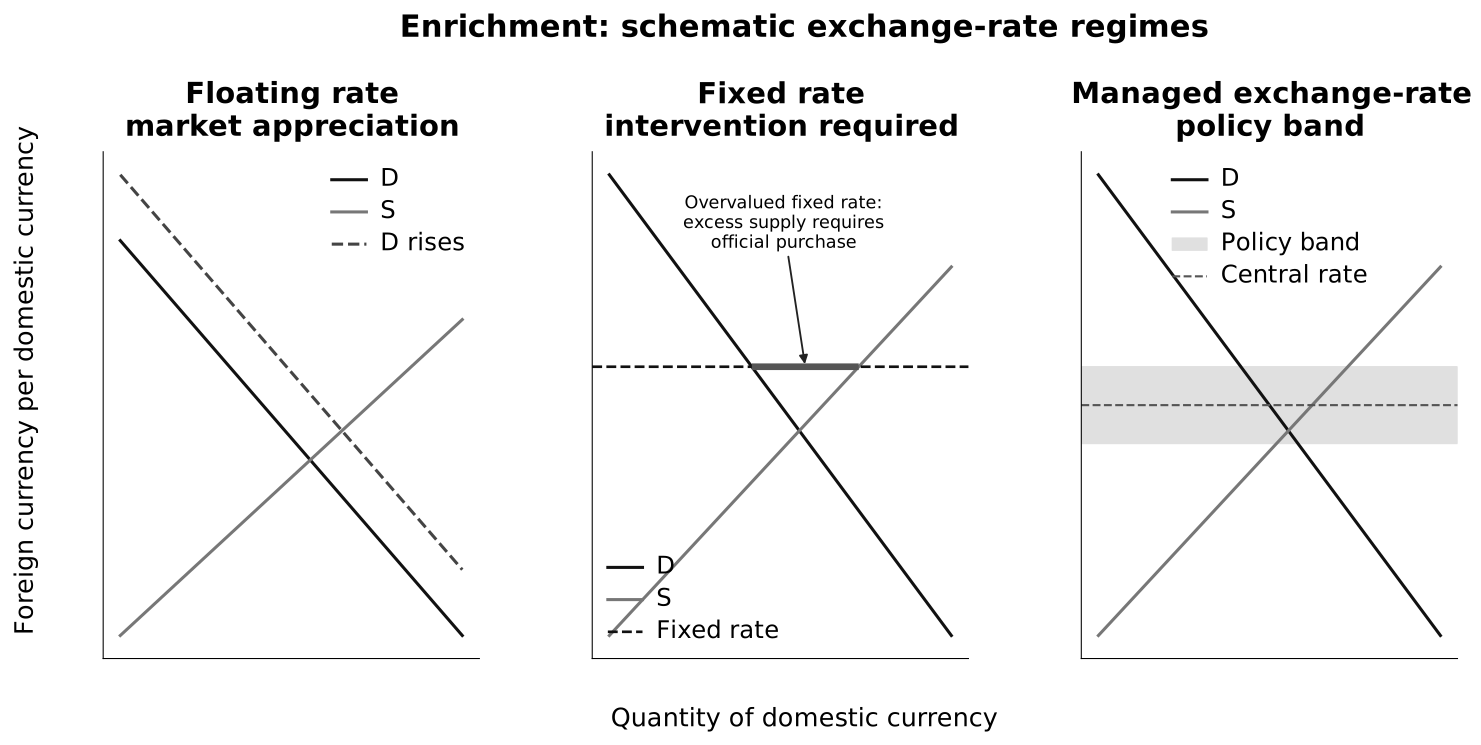
Caption: The first panel allows demand and supply to determine the rate; the second adds an official target maintained through intervention; the third permits market movement within a managed band. The shaded band is a policy range, not a claim that demand and supply cease to operate. Regime labels describe degrees and forms of management rather than three identical graphs.
- Floating exchange rate: determined primarily by currency demand and supply.
- Fixed exchange rate: the authority maintains a chosen parity through intervention and supporting policy.
- Managed float or band: market forces operate, but the authority restrains movements or guides the rate within a policy framework.
A more stable rate can reduce transaction uncertainty and imported-price volatility. However, intervention uses reserves or liquidity management and can constrain other policy objectives.
Short-term and long-term capital flows
The syllabus requires awareness of both.
Short-term capital flows
Short-term or portfolio flows respond to expected returns, relative interest rates, expected exchange-rate movements, risk and confidence. They can finance investment and deepen financial markets, but can reverse quickly and create exchange-rate or asset-price instability.
Foreign direct investment
Foreign direct investment (FDI) involves a lasting interest and influence in productive activity, such as establishing or acquiring production facilities.
Potential benefits to the host economy include:
- additions to capital and productive capacity;
- employment, skills and technology transfer;
- stronger exports and integration into production networks;
- tax revenue and competition.
Possible costs or qualifications include:
- profit remittances abroad;
- displacement of domestic firms;
- dependence on foreign decisions and mobile investment;
- environmental or labour-standard concerns;
- limited local linkages if inputs and skilled labour are largely imported.
FDI is generally less reversible than short-term portfolio capital, but it is not costless or automatically developmental.
Consequences of a persistently large deficit
Possible adverse effects include:
- lower AD, output and employment if the deficit reflects weak exports or import substitution away from domestic output;
- downward pressure on the exchange rate and higher imported inflation;
- weaker confidence if financing depends on volatile short-term inflows;
- rising external liabilities and future income outflows;
- evidence of declining competitiveness.
However, a deficit can be sustainable when it finances productive investment, the economy has credible institutions, and future export capacity or income is expected to rise.
Consequences of a persistently large surplus
Possible benefits include stronger AD and employment, reserve accumulation and evidence of competitiveness. But a persistently large surplus can also:
- create demand-pull inflation near capacity;
- place upward pressure on the exchange rate;
- expose the economy to foreign demand shocks;
- reflect weak domestic consumption or investment;
- provoke trade tension or protectionist retaliation.
Therefore “favourable” does not mean “the largest possible surplus”. Stability concerns the sustainability and economic basis of the external position.
Policy options
Expenditure switching
Depreciation or measures that improve relative competitiveness shift expenditure towards domestic output. Success depends on elasticities, supply capacity, imported inputs and retaliation.
Expenditure reducing
Contractionary fiscal or monetary policy lowers domestic income and import demand. It can improve the trade balance but may reduce growth and employment.
Supply-side measures
Productivity, innovation, skills and infrastructure can improve non-price and price competitiveness. These measures address structural weaknesses but involve time lags and fiscal or opportunity costs.
Protectionism
Tariffs or non-tariff measures may reduce imports temporarily, but can raise costs, invite retaliation, weaken competition and shift rather than solve the underlying competitiveness problem.
Evaluation checklist
Judge a deficit or surplus by:
- size relative to the economy;
- persistence rather than one-year volatility;
- cyclical or structural cause;
- composition of imports and exports;
- elasticity and productive-capacity conditions;
- financing source, maturity and reversibility;
- effects on growth, employment, inflation and distribution;
- policy side effects and trading-partner response.
Common pitfalls
- Confusing the balance of trade, current account and entire BOP.
- Treating a trade surplus as automatically desirable.
- Assuming depreciation automatically improves .
- Discussing quantity changes while ignoring prices and total expenditure.
- Treating short-term capital flows and FDI as identical.
- Saying a deficit is unsustainable without examining its cause and financing.
- Ignoring imported inputs and domestic supply constraints.
Return to Macroeconomic Objectives and Policies.