Paper 1 Practice: Elandra’s Price-Stability Dilemma — Answers
Indicative guidance
Credit accurate alternatives grounded in the extracts and supported by coherent analysis.
Questions: Elandra’s Price-Stability Dilemma.
Question 1(a)(i) [2]
Elandra’s inflation rate was approximately 5.8%.
Question 1(a)(ii) [2]
Real GDP grew by 0.7% while population grew by 1.4%. Using the growth-rate approximation, real GDP per capita fell by about . The exact calculation is . This suggests lower average real output per person, though it does not reveal distribution or household disposable income.
Question 1(b) [4]
Higher imported fuel and component prices raise unit production costs, shifting SRAS left and producing cost-push inflation: the GPL rises while real output falls. Weaker exports also shift AD left. Firms reduce derived demand for labour, creating demand-deficient unemployment. At the same time, the mismatch between displaced assembly workers and health-technology vacancies creates structural unemployment. The two sources should be distinguished.
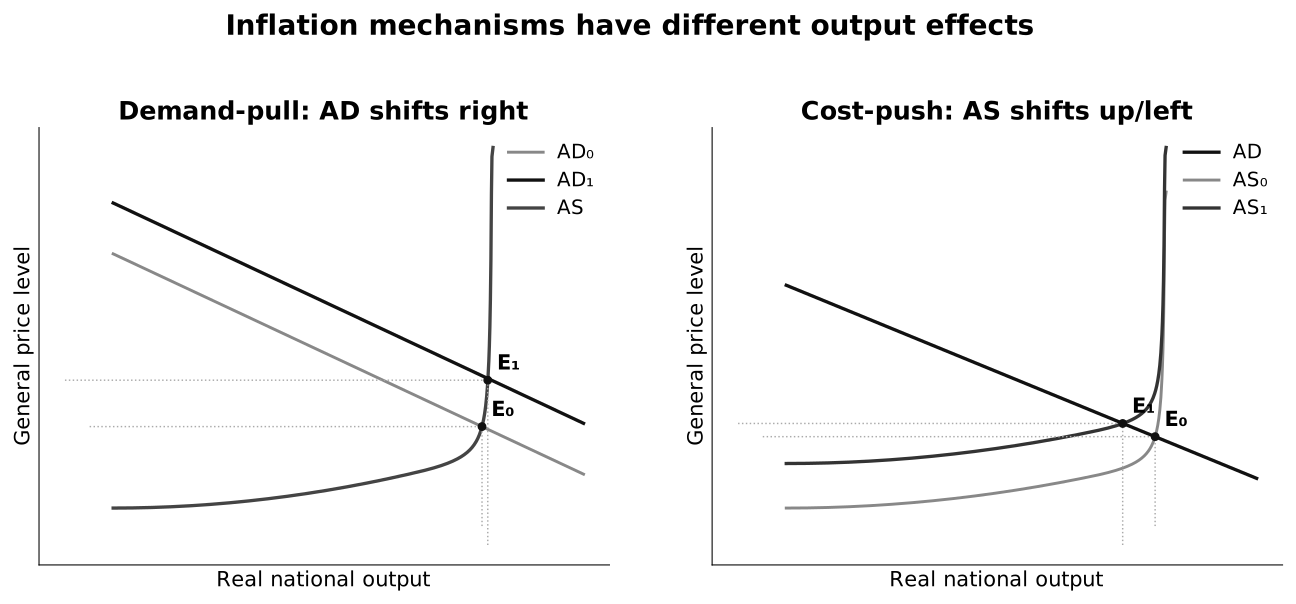
Caption: Elandra’s imported-cost shock is represented by a leftward AS shift, not a demand-pull movement. Weaker exports may additionally shift AD left.
Question 1(c) [4]
The balance of trade changed from a surplus of to a deficit of , a deterioration of E21 billion. These goods-and-services figures do not establish the current-account balance because primary- and secondary-income flows are not supplied. Weaker foreign demand reduced export revenue. Depreciation raised import prices, so import expenditure could rise even if import volume fell; demand for essential fuel and components may be price inelastic in the short run. The figures alone do not identify volume changes.
Question 1(d) [8]
Higher interest rates can reduce credit-financed consumption and investment, shifting AD left and easing demand pressure. Higher returns may support the currency; appreciation lowers domestic prices of imported fuel and components, directly reducing imported cost pressure. Credible action may restrain inflation expectations and wage-price persistence.
However, inflation originated mainly from supply costs while real growth is weak. Lower AD may reduce output and worsen demand-deficient unemployment without removing shipping disruption. Investment could fall, weakening future capacity. Exchange-rate pass-through, capital flows and import-demand elasticities are uncertain, and depreciation may reflect forces beyond domestic rates.
Moderate tightening is more defensible if expectations are becoming unanchored or currency weakness is amplifying costs. Aggressive tightening alone is poorly matched to the shock. Its effectiveness depends on exchange-rate responsiveness, indebtedness, spare capacity and the persistence of imported inflation.
The 7% exchange-rate-index fall makes an exchange-rate channel relevant, while variable-rate business borrowing increases the domestic output cost of higher rates. Falling shipping costs and lagged fuel contracts imply that part of the supply shock may unwind without equally aggressive demand restraint.
Question 1(e) [10]
Temporary targeted rebates protect lower-income households whose real wages and purchasing power have fallen. They improve equity but do not reduce the underlying cost and may sustain AD, adding price pressure. Broad subsidies would be fiscally expensive and weaken conservation incentives.
Maintenance can support weak demand and improve transport reliability if projects are ready, but the deficit and resource bottlenecks limit its scale. Retraining addresses structural unemployment; energy diversification and port automation can lower costs and increase resilience and LRAS. These measures take time, may fail through poor matching, and automation creates transitional displacement. Environmental quality must enter the living-standard judgement.
Elandra should combine calibrated monetary restraint with temporary means-tested support and credible supply measures. Retraining should be linked to actual vacancies, while energy projects should pass cost, security and emissions tests. The mix should prioritise price stability without intensifying the downturn. Average GDP alone is inadequate: real income per person, distribution, employment, health and environmental sustainability should determine success.
Relatively import-light, ready maintenance can support activity sooner than automation, while a universal rebate is poorly targeted. Because routine workers may be displaced by automation, retraining and transition support are complements to productivity policy rather than evidence against every automation project. This is an indicative route only; credit coherent alternatives that use the evidence and answer the precise question.
Question-by-question formative marking framework
Use this with the shared Economics formative marking framework.
| Part | Full-credit job | Acceptable alternatives and diagnostic ceiling |
|---|---|---|
| 1(a)(i), 2 | Calculate the percentage CPI increase using Year 1 as base and state the inflation interpretation. | Correct formula with rounding slip normally earns 1. |
| 1(a)(ii), 2 | Compare real-GDP and population growth to infer approximate real-GDP-per-capita growth. | Approximate or exact is valid. Claiming that every resident’s income fell is not. |
| 1(b), 4 | Explain imported cost pressure through SRAS and distinguish demand-deficient from structural unemployment. | A well-developed cost-push plus labour-demand route is sufficient; attributing all unemployment to one cause prevents full credit. |
| 1(c), 4 | Calculate the trade-balance deterioration and explain plausible export and import-value channels without inferring missing current-account components. | Price, volume and elasticity routes are valid. Calling the figures the current account prevents full credit. |
| 1(d), 8 | Explain interest-rate, AD, expectations and exchange-rate channels, then assess fit with a supply shock, output weakness, debt and transmission uncertainty. | Moderate or strong tightening can be defended conditionally. Assuming appreciation is automatic should normally remain below 6. |
| 1(e), 10 | Construct a policy mix that addresses inflation, cyclical and structural unemployment, distribution and productive capacity; evaluate timing, targeting and fiscal constraints. | Different mixes are valid. A one-policy answer or GDP-only living-standard criterion should normally remain below 8. |
Common misconceptions
- Real GDP per capita is an average and does not reveal distribution.
- A trade deficit is not identical to a current-account deficit.
- Cost-push inflation cannot necessarily be removed by contracting AD without output costs.
- Currency appreciation following higher interest rates is possible, not guaranteed.
Student self-check
Have I shown bases and units in the calculations, separated the unemployment mechanisms, avoided overclaiming from trade data, and judged the policy mix using distributional and non-material living-standard evidence?