Indicative essay-marking standard
Part (a): 10 marks
- Upper level: accurate, coherent and sufficiently developed explanation covering the full requirement; assumptions are made explicit; diagrams and context perform analytical work.
- Middle level: generally correct but incomplete, unevenly developed or weakly applied.
- Lower level: fragmented definitions, assertion, serious model error or failure to address a material part of the question.
Part (b): 15 marks
A strong response combines developed analysis with contextual evaluation. It compares arguments or policies using common criteria, identifies the conditions that change their relative importance, and reaches a supported judgement. Generic advantages/disadvantages or a bare “it depends” should not receive high evaluation credit.
These are formative descriptors derived from recurring corpus patterns, not official Cambridge or school-specific mark bands.
Paper 2 Practice: Macroeconomic Objectives and Policies — Outlines
Indicative rather than exhaustive
Reward valid alternatives with precise transmission, contextual evaluation and judgement.
Questions: Macroeconomic Objectives and Policies.
Question 1(a) [10]
- Nominal GDP can rise only because prices rise; real GDP removes domestic price change.
- Dividing real GDP by population gives average real domestic output per resident. It is a useful proxy for material living standards but is not the same as median household disposable income.
- Use consistent definitions and preferably real GNI when cross-border factor income is important.
- The mean omits distribution, household-specific inflation, unpaid output, leisure and environmental effects.
- For international rather than intertemporal comparison, PPP conversion is additionally relevant.
Question 1(b) [15]
Growth can raise employment, tax revenue, consumption possibilities and funding for health, education and environmental improvement. Potential growth can make gains sustainable with less inflation. Yet stagnant median income shows that benefits may accrue mainly to higher earners or capital owners. Pollution, congestion, insecurity and longer hours reduce non-material welfare.
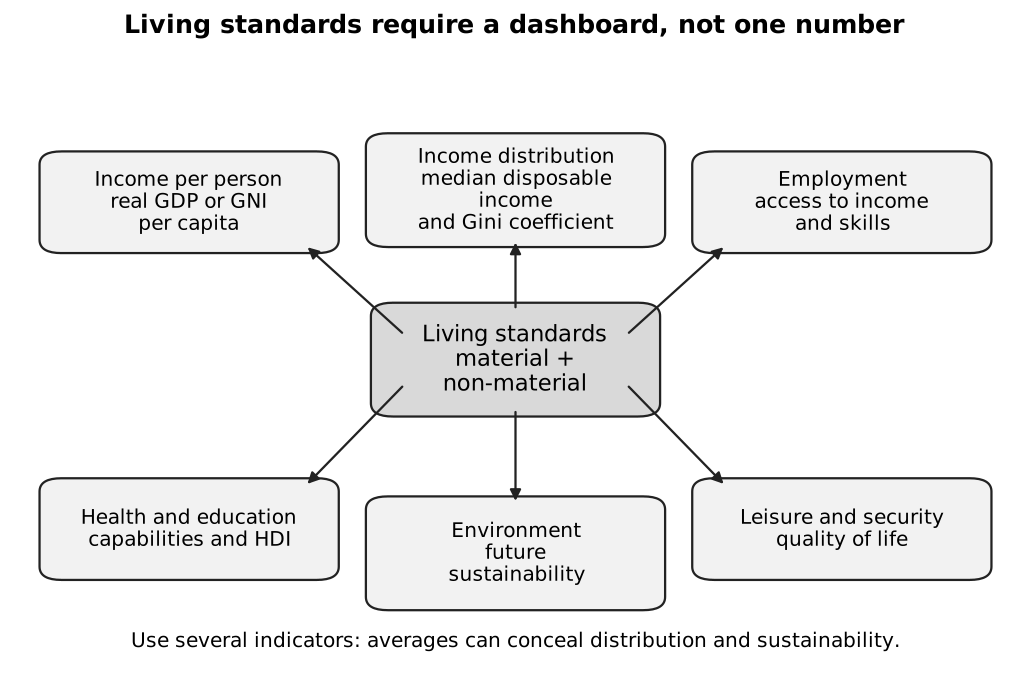
Caption: A defensible living-standard judgement combines real income per person with distribution, work, capabilities, security and environmental sustainability.
Outcomes depend on the source and composition of growth, ownership, tax-transfer policy, access to capabilities and environmental regulation. Continued growth improves most residents’ welfare only if it is inclusive and environmentally sustainable. Use median real disposable income, poverty, employment, health and environmental indicators alongside GDP.
Question 2(a) [10]
Contractionary fiscal policy reduces and/or raises taxes, lowering consumption and AD through disposable income and the multiplier. Tighter monetary policy raises borrowing costs, discouraging interest-sensitive consumption and investment. If it causes currency appreciation, net exports may fall while imported inputs become cheaper; both channels can reduce inflationary pressure, though the exchange-rate result is not guaranteed. A leftward AD shift reduces the inflationary gap and GPL pressure, with a likely output and employment cost. Effectiveness depends on MPC, confidence, interest sensitivity, exchange-rate response, lags and fiscal credibility.
Question 2(b) [15]
Cost-push inflation requires diagnosis. Strong demand contraction can lower inflation but worsens unemployment and does not directly restore supply. Temporary targeted cost relief may prevent firm closures but burdens the budget and can blunt adjustment. Currency appreciation lowers imported costs but weakens export competitiveness.
Supply policies—energy diversification, logistics, competition, retraining and productivity investment—can shift SRAS/LRAS right and ease the conflict. They face long lags, uncertainty and distributional effects. Income support may protect vulnerable households without pretending to cure inflation.
The best package depends on whether expectations are unanchored, the shock’s duration, fiscal space and labour mismatch. Use limited demand restraint for persistence, targeted temporary protection, and credible supply measures. A single aggressive contraction is unlikely to minimise both inflation and unemployment.
Question-specific formative marking framework
Use the working ranges in the shared Economics formative marking framework.
| Part | Requirements for the strongest working range | Diagnostic ceiling and alternatives |
|---|---|---|
| 1(a), 10 | Distinguish nominal from real measures, explain the price and population adjustments, state what per-capita output captures and recognise remaining distribution/quality limitations. | Simply asserting “real is better” should normally remain below 6. PPP or median-income discussion can extend but not replace the required comparison over time. |
| 1(b), 15 | Analyse routes from growth to material welfare and countervailing distributional, environmental, leisure and sustainability effects; judge whether most residents benefit. | GDP-only or unqualified anti-growth answers should normally remain below 12. The decisive criterion must relate to residents, not aggregate output alone. |
| 2(a), 10 | Explain contractionary fiscal and monetary transmission to AD and demand-pull inflation, including output/employment costs and conditional exchange-rate effects. | Policy lists without transmission should normally remain below 7. Supply-side policy answers do not address the specified demand-pull task directly. |
| 2(b), 15 | Diagnose cost-push inflation with rising unemployment, compare limited demand restraint, targeted relief and supply policies, and evaluate timing, persistence, expectations and fiscal space. | A single aggressive contraction without the policy conflict should normally remain below 12. Different mixes are valid under stated shock conditions. |
Common errors and self-check
Do not equate nominal GDP growth with real living-standard improvement, treat averages as distribution, or claim that contractionary policy directly repairs a supply disruption. Check that every policy chain reaches inflation, output, employment and the stated living-standard objective.