Supply-Side Policy and Policy Conflicts
Purpose of supply-side policy
Supply-side policies improve the quantity, quality, mobility or allocation of factors of production. Greater factor quantity mainly expands productive capacity; better quality, technology, mobility or allocation may also raise productivity and lower unit costs. The exact channel depends on the measure.
The general transmission chain is:
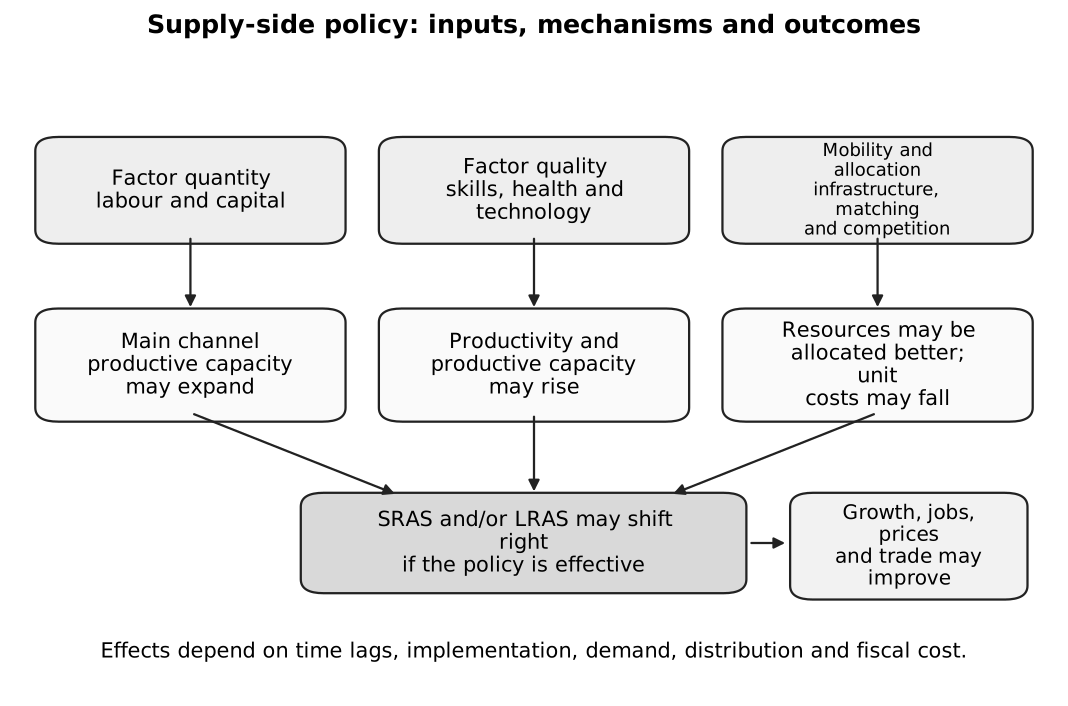
Caption: Read each column separately. Increasing factor quantity mainly expands capacity. Improving factor quality can raise productivity as well as capacity. Better mobility and allocation can reduce mismatches and may lower unit costs. These are possible—not automatic—channels; successful changes may shift SRAS, LRAS or both and then affect growth, inflation, employment and trade.
Some supply measures also raise AD while being implemented. Infrastructure construction, for example, raises immediately but increases capacity only later if the project is productive. Keep the short-run demand effect separate from the intended supply effect.
Separate the two time horizons
| During implementation | After a successful supply response |
|---|---|
| public construction or training expenditure may raise and AD | infrastructure, skills or innovation may raise productivity and capacity |
| resource use may intensify and create short-run inflation near capacity | lower unit costs can ease inflationary pressure |
| imports of machinery may initially worsen the balance of trade | stronger price or non-price competitiveness may later improve exports |
| workers or firms may face transition costs | structural unemployment may fall if new skills match actual vacancies |
The long-run column is conditional: expenditure creates potential growth only when the project is additional, well chosen, completed and used effectively.
Interventionist supply-side policies
Education, training and healthcare
Better education and employer-linked training can raise labour quality and occupational mobility. Healthcare can improve participation and reduce absence.
Limitations include long lags, mismatch between training and vacancies, unequal access, migration of trained workers and difficulty forecasting future skill demand.
Infrastructure
Transport, digital, energy and logistics infrastructure can reduce business costs, connect workers to jobs and encourage private investment. Benefits depend on project selection, usage and complementary private activity. Construction has an opportunity cost and may crowd out resources near capacity.
Research, development and innovation support
Grants, tax credits and public research can address spillovers and financing gaps. Success depends on firms’ capacity to commercialise knowledge and whether support creates additional innovation rather than subsidising activity that would have occurred anyway.
Regional, housing and mobility measures
Transport links, affordable housing, relocation assistance and vacancy information can improve geographical and occupational mobility. Physical mobility alone is insufficient when skills do not match available jobs.
Market-oriented supply-side policies
Competition and entry reform
Lower barriers to entry and stronger competition can reduce complacency, improve resource allocation and stimulate innovation. Excessive fragmentation or unstable regulation can, however, reduce scale economies and long-term investment.
Tax and incentive reform
Lower marginal tax rates may strengthen incentives to work, save, invest or take entrepreneurial risk. The response is uncertain and depends on non-tax constraints, income effects, expectations and the credibility of the reform. Tax reductions also have fiscal and distributional costs.
Labour-market flexibility
Flexible wages, contracts and hiring can improve adjustment to changing demand. But weaker protection, insecurity or low training incentives can reduce worker welfare and long-run human-capital formation.
Trade openness and foreign investment
Greater openness can increase competition, specialisation, technology transfer and access to capital. It also exposes workers and firms to adjustment costs and external shocks. Complementary retraining and social support may be needed for inclusive gains.
Effects on macroeconomic objectives
Economic growth
More or better factors and higher productivity expand potential output. If expected demand is sufficient, firms invest and use the additional capacity, supporting actual growth as well.
Employment
Training, mobility and business formation can reduce structural unemployment. Yet labour-saving technology may displace particular workers in the short run. Whether total employment rises depends on new demand, retraining and the creation of complementary tasks.
Price stability
Higher productivity can reduce unit costs and shift AS right, easing cost-push and demand-pull pressure. Supply policy is not an instant anti-inflation tool because implementation and behavioural responses take time.
Balance of trade
Improved price and non-price competitiveness can raise export revenue and reduce import dependence. However, growth may also increase imports, and imported capital goods may initially worsen the trade balance.
Living standards and distribution
Higher productivity creates scope for higher real wages, profits, tax revenue and public services. Gains may be unequal if policies mainly reward owners of capital or already-skilled workers. Access to education, transfers and transition support influences inclusiveness.
Growth, employment and inflation conflicts
Core AD-AS analysis
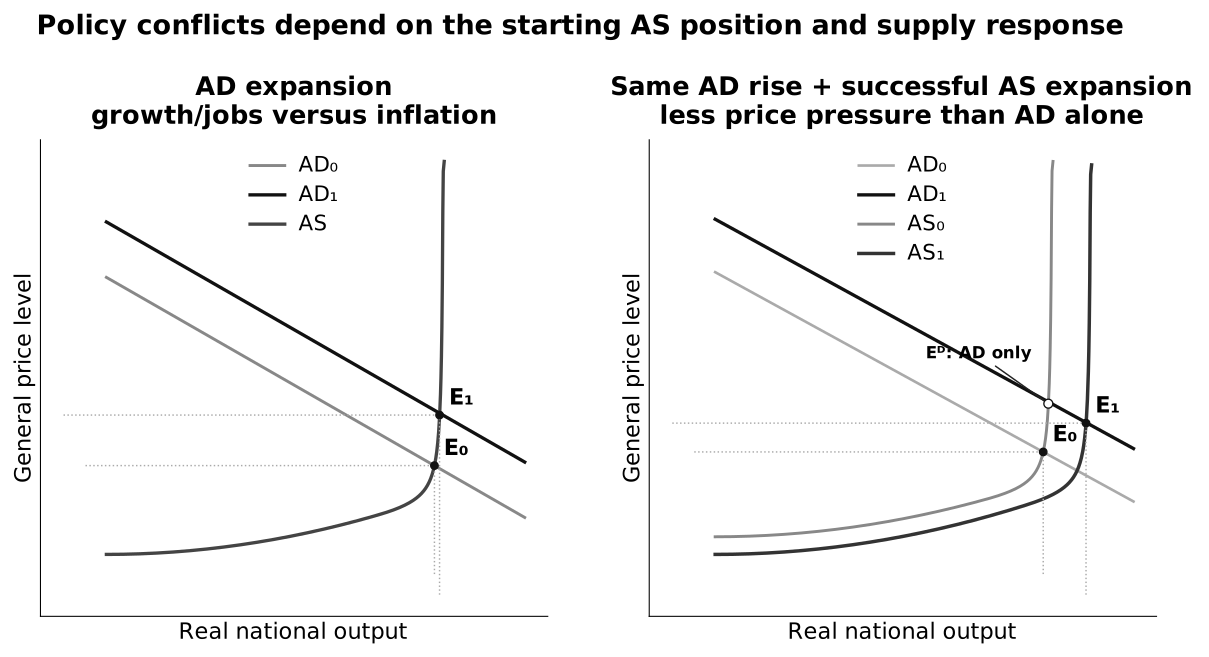
Caption: The left panel isolates a rightward AD shift with AS unchanged, so output and GPL rise. The right panel starts from the same and combines that same AD expansion with a successful outward AS shift. The open point is the demand-only counterfactual; has less GPL pressure than because supply responds, although its GPL can still exceed the original . The conflict is eased, not necessarily eliminated.
The conflict is conditional:
- with substantial spare capacity, stronger AD mainly raises output and employment;
- near full capacity, the same AD increase raises GPL more strongly;
- if unemployment is structural, more AD may create inflation before the mismatch is resolved;
- if supply policy raises productivity, capacity and output can increase while unit cost pressure falls.
Enrichment: short-run Phillips-curve framing
The syllabus requires analysis of conflicts between macroeconomic objectives but does not name the Phillips curve as a required diagram. The curve is retained as supporting enrichment for the short-run demand-side inflation-unemployment trade-off.
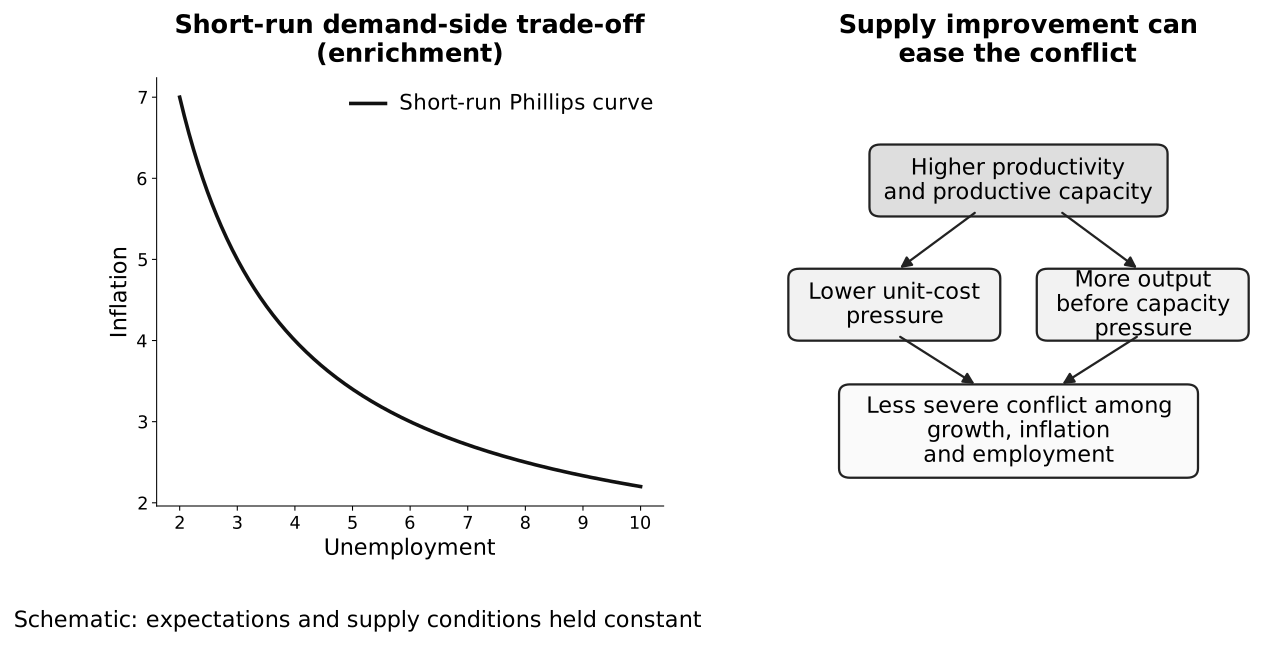
Caption: The downward-sloping curve is an enrichment model of a short-run demand-side inflation–unemployment association under fixed expectations and supply conditions. The right-hand causal boxes show how successful productivity and capacity improvement can reduce both cost pressure and structural constraints. It is not a permanent menu of choices or a compulsory syllabus diagram.
Match the cause, instrument and objective
| Diagnosed constraint | Better-aligned policy direction | Why a mismatched response can fail |
|---|---|---|
| weak AD with spare capacity | temporary demand support | training alone does not create enough current vacancies |
| structural skills mismatch | employer-linked training and matching | more AD can create inflation before employability improves |
| imported cost pressure | exchange-rate or targeted cost response, plus diversification | broad demand contraction reduces output without removing the external cause |
| low productive capacity | investment, infrastructure, skills, innovation and competition | repeated demand expansion reaches bottlenecks |
| non-inclusive growth | access to capabilities, employment and targeted redistribution | aggregate growth alone can leave distribution and opportunity unchanged |
Other policy conflicts
Growth versus balance of trade
Growth raises income and often imports. The trade balance worsens more when the marginal propensity to import is high and domestic substitutes are weak. Export-led or productivity-driven growth may offset this effect.
Price stability versus growth under cost-push inflation
Contractionary demand policy lowers inflationary pressure but further reduces output. Targeted cost relief or supply reform may be better aligned with the cause, though slower or fiscally costly.
Growth versus equity
Incentive-focused reforms may raise investment but widen post-tax income inequality. Education, access to healthcare and targeted transfers can make growth more inclusive, though financing and design matter.
Growth versus environmental sustainability
Higher production can increase emissions and resource use. Clean technology, appropriate pricing of environmental costs and public infrastructure can change the composition and resource intensity of growth rather than treating all growth as identical.
Fiscal support versus sustainability
Public investment may raise both AD and capacity, but persistent poorly targeted deficits raise debt-service and opportunity costs. The relevant question is whether the long-run social return and revenue capacity justify the financing burden.
Currency appreciation versus external demand
Appreciation can reduce imported inflation but weaken export competitiveness and net exports. The effect depends on elasticities, imported-input savings and firms’ non-price competitiveness.
Choosing a policy package
The government’s priority depends on the state and structure of the economy and its level of development. A useful decision sequence is:
- identify whether the problem is mainly cyclical, structural or both;
- identify the binding constraint—demand, skills, infrastructure, finance, competition or external conditions;
- choose short-run stabilisation and long-run capacity measures separately;
- check administrative capacity and fiscal sustainability;
- protect groups bearing transition costs where this improves both equity and political durability;
- state the time horizon for success.
Example: recession with a skills mismatch
Temporary fiscal or monetary support can prevent a deeper collapse in employment. Employer-linked retraining and matching services address structural unemployment. Productive infrastructure can support AD during construction and capacity later. The package works only if demand support is withdrawn as spare capacity closes, training matches actual vacancies and financing remains sustainable.
Example: imported cost-push inflation
Appreciation may reduce imported prices quickly, while energy diversification and productivity measures address vulnerability over time. Strong contractionary demand policy may reduce inflation but worsen output unnecessarily if domestic demand is already weak.
Evaluation checklist
- Is the measure genuinely supply-side, or only a demand stimulus?
- Which factor quantity, quality or mobility changes?
- Does it reduce unit cost, expand capacity, or both?
- What is the time lag and probability of implementation success?
- Who pays, and who gains?
- Are there government-failure risks or opportunity costs?
- Does current demand exist to use the new capacity?
- Are complementary policies needed?
Common pitfalls
- Calling every tax cut supply-side.
- Claiming supply-side policy shifts AD only.
- Assuming increased capacity automatically creates current demand.
- Assuming education immediately eliminates structural unemployment.
- Listing policy conflicts without explaining the causal chain and conditions.
- Treating interventionist and market-oriented policies as universally opposed rather than potentially complementary.
- Ignoring distribution, environmental effects and implementation capacity.
Return to Macroeconomic Objectives and Policies.