Policy Evaluation and Government Failure
Start with diagnosis, not the instrument
A policy is well targeted only if it changes the mechanism causing the inefficient or inequitable outcome.
The correct comparison is:
“No intervention” is the counterfactual against which the policy’s incremental effects are measured, not an assumption that the unregulated outcome is desirable. An intervention need not remove every failure to be worthwhile; it succeeds if its expected improvement exceeds its full opportunity cost and compares favourably with feasible alternatives.
- Diagnose the marginal divergence, missing market, information problem, mobility barrier, market power or access problem.
- State the intended efficiency or equity outcome.
- Explain how the instrument changes incentives, constraints or information.
- Predict responses by consumers, producers and government agencies.
- Compare the resulting social benefits with all opportunity costs.
Exam reasoning chain
policy → transmission mechanism → behavioural response → quantity, quality or access → efficiency/equity effect → limitation → conditional judgement
Syllabus policy menu
| Instrument | Main mechanism | Main limitation |
|---|---|---|
| Tax | Makes the decision-maker bear more of a marginal social cost | Needs MEC and elasticity estimates; may be regressive or evaded |
| Subsidy | Raises effective private benefit or lowers effective private cost | Fiscal opportunity cost, fraud and possible overprovision |
| Quota or rule | Fixes a quantity, quality or behaviour constraint | Rigid; monitoring and compliance costs |
| Tradable permits | Sets an overall cap and permits low-cost trading | Allocation, monitoring and permit-price volatility |
| Direct provision | Government finances and arranges baseline access | Fiscal cost, information gaps and possible X-inefficiency |
| Joint provision | Public provision supplements private providers | Coordination, duplication, targeting and capacity decisions |
| Public education or nudge | Changes knowledge, attention or choice architecture | Effects may be weak, temporary or unequal across groups |
| Competition or price regulation | Constrains abuse of market power | Market-definition, investment and scale trade-offs |
Other mechanism-specific responses include disclosure and screening for information problems and education, training, transport or housing support for factor immobility.
Distinguish an instrument from its target. A tax creates a financial wedge, a quota imposes a quantity constraint, disclosure changes information, and direct provision changes who finances and arranges supply. The same instrument can be well targeted for one diagnosis and poorly targeted for another.
Behavioural policy and cognitive biases
The syllabus requires awareness of three biases that government may use when designing nudges:
- Salience bias: vivid or prominent information receives excessive attention. Government can make relevant health, safety or financial information easier to notice and compare.
- Loss aversion: people tend to feel a loss more strongly than an equal gain. A message may truthfully emphasise an avoidable loss rather than an equivalent gain.
- Sunk-cost fallacy: irrecoverable past costs improperly affect present choices. A nudge may remind participants of time or effort already invested to encourage completion of a beneficial programme. This deliberately leverages the bias and must not use false or deceptive claims.
For rational appraisal, a sunk cost must be ignored because it cannot be recovered under any current option. Only future marginal benefits and future marginal costs should determine whether an activity continues. A policy that draws attention to past effort may influence completion, but it should not trap people in a programme whose remaining costs exceed its remaining benefits.
Nudges preserve formal choice, but their effectiveness is context-dependent. Evaluation should consider transparency, manipulation concerns, distributional effects and whether a stronger price or regulatory instrument is needed. When government evaluates its own policy, it should not commit the sunk-cost fallacy: only future costs and benefits are relevant to whether a programme should continue.
Government failure
Government failure occurs when intervention reduces net social welfare relative to the relevant unregulated counterfactual. It does not mean that every imperfect or incomplete policy has failed; the test is comparative.
Do not count every payment as a social cost. Tax revenue received by government and a subsidy received by a household are primarily transfers between parties. Welfare analysis instead considers behavioural gains or losses, administrative and compliance resources, distortionary financing effects, external effects and the opportunity cost of public funds. Distributional evaluation separately asks who pays and who benefits.
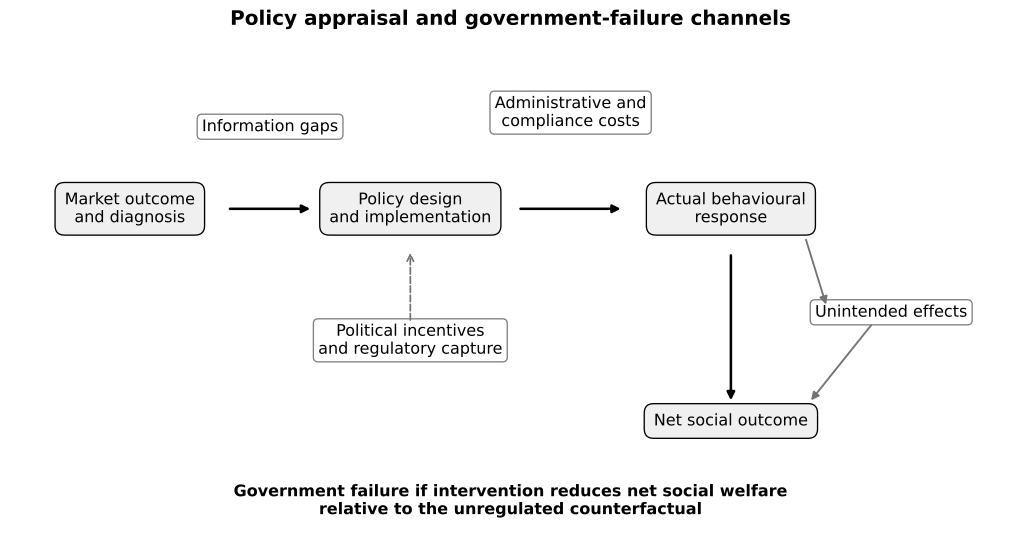
Caption: Begin with the unregulated outcome and diagnose its mechanism. Government chooses and implements an instrument, but actual households and firms may respond differently from the prediction. Information gaps, administrative cost, political incentives and unintended responses alter the final net social outcome. Government failure occurs only if intervention leaves society worse off than the relevant unregulated counterfactual.
Information gaps
Government may not know the true MEC, MEB, elasticities, preferences, risk types, compliance costs or future technology. An intervention can therefore be too strong, too weak or aimed at the wrong margin.
For example, a corrective tax above MEC at the efficient quantity can push output below the social optimum, whereas a tax below MEC leaves part of the over-allocation. Uncertainty is not automatically an argument for doing nothing, but it strengthens the case for monitoring, adjustment and reversible design.
Administrative, compliance and opportunity costs
Monitoring, enforcement, eligibility checks and appeals use scarce labour and capital. Firms and households also spend resources complying. Public expenditure displaces other possible uses or requires taxation.
Distorted incentives and unintended responses
Taxes may encourage evasion; subsidies may invite false claims; price ceilings may create shortages; insurance rules may change risk-taking; regulation may deter entry or innovation. Incidence may also differ from the group legally charged.
Political incentives and regulatory capture
Concentrated interest groups may lobby for visible benefits while dispersed taxpayers bear costs. A regulator may become too aligned with the industry it oversees, weakening enforcement or protecting incumbents.
Time lags and inflexibility
Evidence gathering, legislation and capacity building take time. A rule suited to earlier conditions may persist after technology, prices or behaviour changes.
Evaluation dimensions
A strong comparison considers:
- effectiveness: does the policy substantially reduce the failure or improve access?
- precision: does it target the marginal divergence or intended group?
- responsiveness: how elastic are behavioural responses?
- feasibility: can behaviour, emissions, eligibility or quality be monitored?
- cost: fiscal, administrative, compliance and opportunity costs;
- equity: incidence across income groups, workers, consumers, firms and regions;
- time: speed, durability and ability to adapt;
- uncertainty: imperfect data, irreversibility and unintended consequences.
Do not mechanically monetise values for which credible monetary estimates do not exist. State the uncertainty and test whether the conclusion survives plausible alternative assumptions.
Policy packages
One failure may have several causes. Congestion pricing can be combined with public transport; carbon pricing with innovation support; disclosure with safety standards; retraining with job matching and transport.
Packages may address several margins and improve political acceptability, but also increase administrative complexity, fiscal cost and the risk that policies work against one another.
Conditional judgement
The intervention is more likely to improve welfare when the original failure is substantial, the instrument closely targets its mechanism, behaviour is responsive, and monitoring is feasible. When information and enforcement are weak, a simpler, adaptive or mixed policy may achieve a larger net benefit.
A good conclusion states which condition is decisive in the context rather than ending with an unexplained “it depends”.
Common pitfalls
- Listing generic government-failure points without linking them to the policy.
- Comparing policy with perfection instead of the unregulated outcome.
- Treating tax revenue as a free social benefit or subsidy spending as automatically a welfare loss.
- Confusing direct provision with government production only; contracted production is possible.
- Recommending multiple policies without explaining their interaction.
- Evaluating nudges as if information and external-cost problems were identical.
Return to Microeconomic Objectives and Policies.