Paper 1 Practice: Solmere’s Home-Efficiency Programme — Answers
Indicative guidance
Credit any accurate route using the case evidence. Longer responses require analysis, evaluation and a supported policy judgement.
Question 1(a)(i) [2]
The estimated private net benefit is -$180 per home: a private net cost of $180.
Question 1(a)(ii) [2]
The estimated social net benefit is $80 per home.
Question 1(b) [4]
The household considers its marginal private benefit from energy savings, while the reduction in pollution benefits third parties. Thus and exceeds . Market demand based on private benefit understates social benefit. The market equilibrium occurs where , giving a quantity below the social optimum where (assuming no external cost and hence ). Beneficial units between the market and social quantities are forgone, creating deadweight welfare loss.
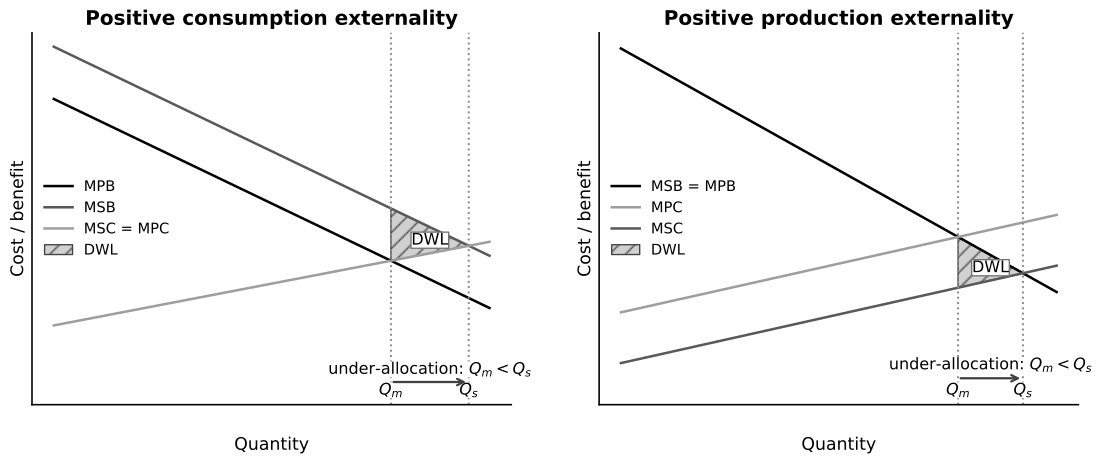
Caption: For a positive consumption externality, market demand reflects MPB below MSB, so the unregulated quantity is below the socially efficient quantity.
Question 1(c) [4]
Warnings are non-rival because one resident’s access does not significantly reduce the warning available to others. They are non-excludable because non-payers are difficult to prevent from viewing or receiving public data. People can free-ride, understating demand revealed through voluntary payment. A private provider may therefore be unable to collect enough revenue even when total social benefit exceeds cost, causing underprovision or non-provision.
Question 1(d) [8]
In principle, a per-unit subsidy equal to marginal external benefit at the social optimum can lower the effective private cost or raise private benefit, increasing consumption toward the quantity where . Table 1 shows that a $260 payment would turn the representative basic-sealing household’s private calculation from -$180 to +$80. This aligns that household’s private net benefit with the table’s estimated social net benefit, but it does not by itself prove that $260 equals marginal external benefit at the market-wide social optimum.
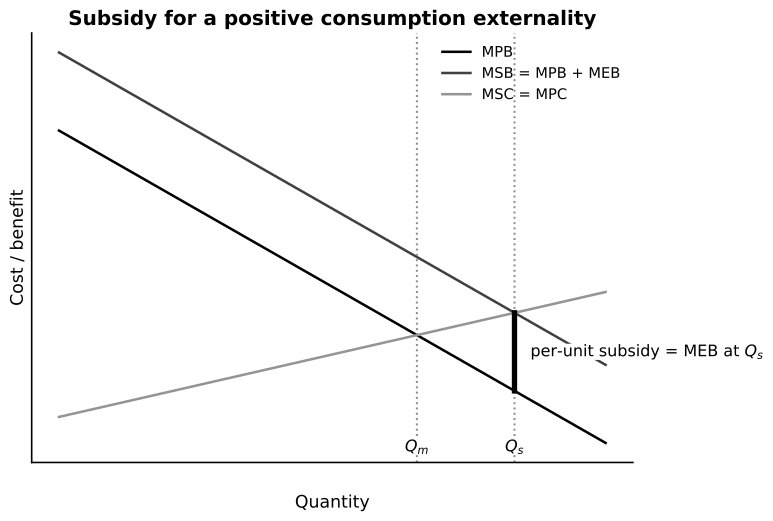
Caption: A correctly calibrated subsidy can close the benefit gap at the social quantity and expand consumption toward the social optimum.
The table reports an estimated present-value benefit per participating home, not a complete marginal-benefit schedule. External benefit may vary across homes and the government cannot observe savings perfectly. A uniform $260 may over-subsidise some homes and under-subsidise others. Some payments go to households that would participate anyway, raising fiscal opportunity cost. Supply is constrained by skilled labour, so the short-run response may be higher contractor prices rather than many extra retrofits. Landlord-tenant incentives, misinformation and credit constraints remain.
The subsidy is useful but not sufficient. It should be limited to verified work and adjusted using evidence, with audits and measures addressing upfront finance or split incentives.
The capacity estimates—18,000 basic projects but only 4,000 deep retrofits—support prioritising the less skill-intensive option in the short run. The earlier information campaign does not provide a clean causal estimate because its groups were not randomly assigned.
Question 1(e) [10]
Subsidies target the positive externality and preserve household choice, but require benefit estimates and public funds. Information audits and certification address mistaken beliefs and misleading claims; they work poorly where the main obstacle is finance or landlord incentives. Low-income grants improve equity and may relieve credit constraints but means testing creates boundaries and administration. Direct provision can target inefficient homes and assure minimum quality, yet risks delay, high cost and weak preference matching.
Policy interactions matter. Certification improves the evidence used for a subsidy; targeted grants can make socially beneficial basic work affordable; direct provision can be reserved for households unable to contract effectively. The limited skilled workforce and Table 1 favour initially scaling basic sealing rather than subsidising every deep retrofit: the basic option has positive estimated social net benefit and uses fewer scarce specialists.
Solmere should combine certified audits with a verified basic-retrofit subsidy, adding larger grants or direct provision for low-income and hard-to-serve households. It should pilot, measure realised savings and revise subsidy values. The final mix depends on administrative capacity, distributional objectives and whether labour supply can expand.
Because the budget is fixed, universal subsidy payments have an opportunity cost in inspections, warning provision and targeted grants. A staged programme permits realised savings to be measured before expansion, though weather and behaviour make evaluation imperfect.
Return to the question paper.
Question-by-question formative marking framework
Use this with the shared Economics formative marking framework.
| Part | Full-credit job | Acceptable alternatives and diagnostic ceiling |
|---|---|---|
| 1(a)(i), 2 | Calculate private net benefit using private energy saving minus installation cost, with sign and unit. | An unsigned 180 should not receive the interpretation mark. |
| 1(a)(ii), 2 | Add the external environmental benefit and calculate social net benefit, with sign and unit. | An equivalent benefit-cost layout is valid. |
| 1(b), 4 | Show that decision-makers consider private rather than full social benefit, so market quantity is below the social optimum. | Information or credit constraints may supplement but not replace the external-benefit mechanism requested. |
| 1(c), 4 | Explain non-rivalry and non-excludability using the warning network and connect them to free riding or underprovision. | Imperfect rather than absolute non-excludability may be recognised. Defining “publicly provided” as a public good is insufficient. |
| 1(d), 8 | Explain the corrective subsidy benchmark, then test whether the per-home estimate is marginal, accurate, additional and administratively feasible. | A qualified subsidy recommendation is valid. Treating S$260 as proven market-wide MEB should normally remain below 6. |
| 1(e), 10 | Match subsidies, information/certification and direct provision or targeted grants to distinct failures and constraints; compare incidence, capacity and government failure. | A policy package or single instrument is defensible. Listing policies without matching instruments to causes should normally remain below 8. |
Common misconceptions
- An external benefit is received by third parties, not simply by the buyer in the future.
- A public good is defined by non-rivalry and non-excludability, not by government production.
- An average estimated benefit is not automatically marginal external benefit at the social optimum.
- A positive estimated social net benefit for one representative home does not establish a complete market demand or benefit schedule.
Student self-check
Have I separated private and external components, used the two public-good characteristics precisely, tested the subsidy estimate rather than accepting it mechanically, and matched each policy to a diagnosed failure?