Indicative essay-marking standard
Part (a): 10 marks
- Upper level: accurate, coherent and sufficiently developed explanation covering the full requirement; assumptions are made explicit; diagrams and context perform analytical work.
- Middle level: generally correct but incomplete, unevenly developed or weakly applied.
- Lower level: fragmented definitions, assertion, serious model error or failure to address a material part of the question.
Part (b): 15 marks
A strong response combines developed analysis with contextual evaluation. It compares arguments or policies using common criteria, identifies the conditions that change their relative importance, and reaches a supported judgement. Generic advantages/disadvantages or a bare “it depends” should not receive high evaluation credit.
These are formative descriptors derived from recurring corpus patterns, not official Cambridge or school-specific mark bands.
Paper 2 Practice: Microeconomic Objectives and Policies — Outlines
Indicative rather than exhaustive
Reward coherent alternatives that use a clear criterion and correct counterfactual.
Question 1(a) [10]
- Truck users consider marginal private cost, while noise and congestion impose marginal external cost on third parties.
- , so MSC lies above MPC when external cost is positive.
- Market equilibrium at gives ; the social optimum is where , giving lower if no external benefit is present.
- Units from to have social marginal cost above social marginal benefit, creating deadweight loss.
- The analysis requires a delivery quantity, not merely the existence of noise.
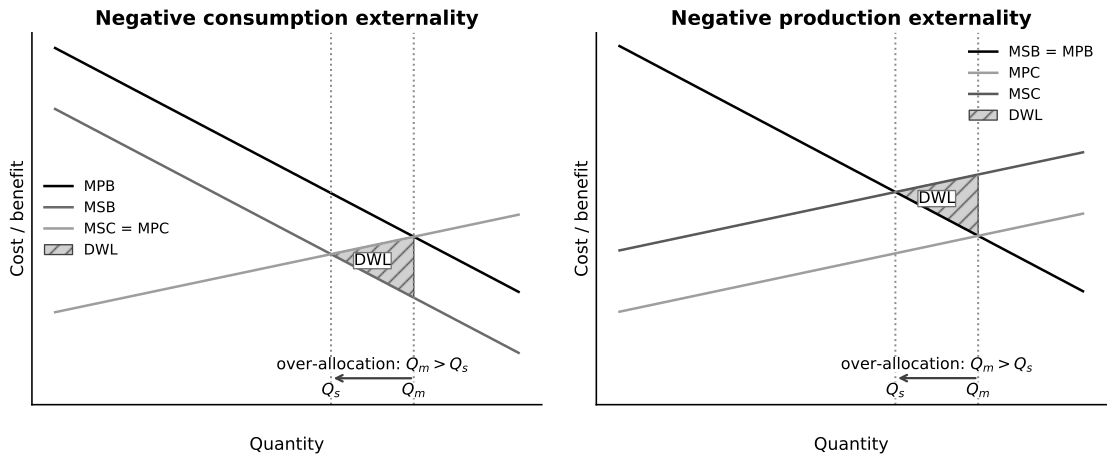
Caption: Adding marginal external cost places MSC above MPC and reveals overproduction relative to the social optimum.
Question 1(b) [15]
A corrective tax equal to marginal external cost at can internalise the external cost, raising the decision-maker’s marginal cost and reducing deliveries toward the optimum. It gives firms flexibility and raises revenue. Yet noise varies by route, time, vehicle and location, so a uniform tax is poorly targeted. MEC and responsiveness are uncertain; essential deliveries may have inelastic demand; diversion may shift traffic elsewhere.
Alternatives include time/location road charges, noise standards, low-noise technology subsidies, zoning or caps. Standards offer certainty but less flexibility; tradable permits require measurable emissions or access rights; infrastructure may address congestion directly but is costly. Government failure includes monitoring cost, lobbying and unintended distributional effects.
The best approach is a differentiated charge where measurement is feasible, paired with enforceable noise standards or technology support. A simple per-delivery tax is best only if damages are reasonably similar and administrative simplicity outweighs targeting gains.
Question 2(a) [10]
- In a competitive labour-market model, a statutory minimum wage above the equilibrium wage is binding.
- Quantity of labour supplied rises while quantity demanded falls, creating excess labour supply under the competitive benchmark.
- Workers retaining jobs receive higher wages; displaced or excluded workers may lose income.
- Firms face higher labour cost and may raise prices, accept lower profit, substitute capital, improve productivity or reduce employment.
- Effects depend on labour-demand and supply elasticities, compliance, market power and time.
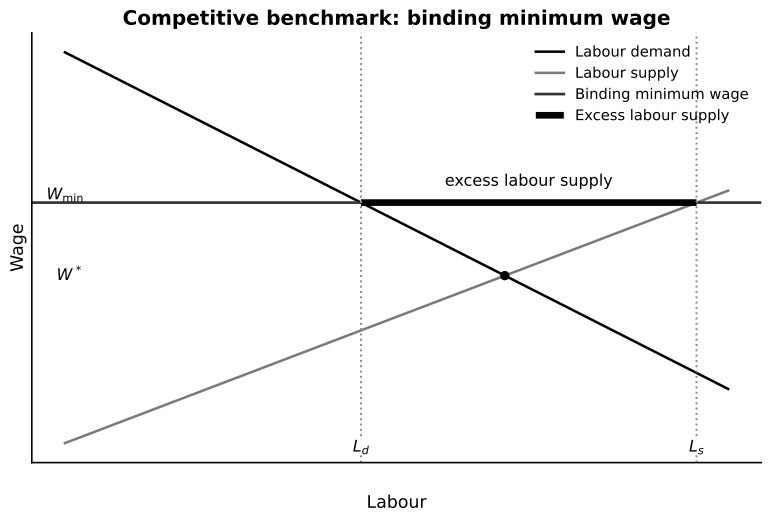
Caption: In the competitive benchmark, a binding wage floor raises pay for employed workers but creates excess labour supply and uncertain distributional effects.
Question 2(b) [15]
A minimum wage directly raises low hourly pay but misses non-workers and may reduce employment. Progressive tax and transfers can target disposable income broadly but may weaken incentives, create avoidance and impose fiscal opportunity cost. Education and training can raise productivity and earnings more sustainably, yet involve long lags and uncertain access or labour demand.
The Gini coefficient and median income should be used with poverty, employment and mobility evidence. Equity judgements also depend on who finances policy and whether benefits reach intended groups. Policies may complement one another: a cautious wage floor protects pay, tax credits support incomes and targeted education addresses structural causes.
Estara should use a package calibrated to labour-market responsiveness and administrative capacity. Immediate redistribution is appropriate for current hardship, while education supports longer-run earning capacity. The decisive test is distributional improvement after employment, incentive, fiscal and implementation effects, not whether one headline inequality indicator falls.
Return to the essay questions.
Question-specific formative marking framework
Use the working ranges in the shared Economics formative marking framework.
| Part | Requirements for the strongest working range | Diagnostic ceiling and alternatives |
|---|---|---|
| 1(a), 10 | Identify marginal external cost from deliveries, derive , explain overproduction relative to the social optimum and connect the gap to deadweight welfare loss. | A pollution/noise description without marginal analysis should normally remain below 8. Consumption- or production-externality diagrams are valid if labelled consistently. |
| 1(b), 15 | Explain a corrective tax and evaluate calibration, incidence, elasticity, monitoring, route/time heterogeneity and alternatives; recommend a policy or package. | “Tax equals external cost” without measurement and behavioural conditions should normally remain below 12. Standards, pricing, technology or zoning may be valid alternatives. |
| 2(a), 10 | Explain the competitive binding-wage-floor benchmark across workers, firms and consumers, then qualify it where labour-market power or productivity responses matter. | Automatic unemployment claims without model assumptions should normally remain below 8. A monopsony qualification can strengthen but should not replace the benchmark. |
| 2(b), 15 | Compare wage floors, progressive taxes/transfers and education using distribution, employment, incentives, fiscal cost, timing and mobility; judge a coherent package. | A falling Gini coefficient alone is not sufficient proof of improved welfare. Different equity weights and policy mixes are valid when supported. |
Common errors and self-check
Do not label every social cost an externality, treat a tax payment as deadweight loss, or assume a wage floor has identical effects in every labour market. Match each policy to a diagnosed cause and judge distribution and efficiency after behavioural responses.