Public Goods and Information Failure
Public goods and missing markets
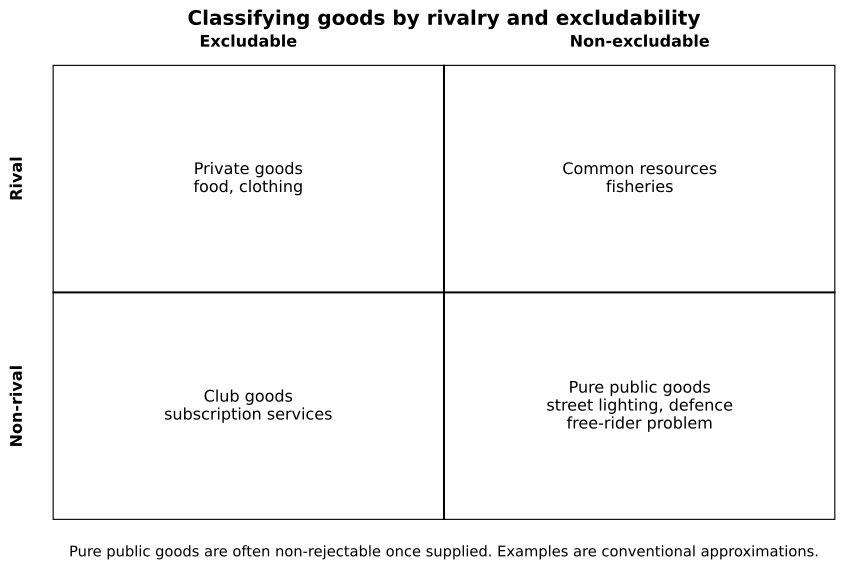
Caption: The two axes ask separate questions. Rivalry asks whether one person’s use leaves less or lower-quality service for others. Excludability asks whether non-payers can feasibly be prevented from benefiting. A pure public good occupies the non-rival, non-excludable cell; government provision does not by itself make a good public.
A pure public good is:
- non-rival: one person’s use does not reduce availability to another, while the good is uncongested;
- non-excludable: preventing non-payers from benefiting is infeasible or prohibitively costly;
- often non-rejectable: once the good is supplied in the relevant area, people cannot readily refuse its effects.
Non-rivalry does not mean unlimited capacity. The marginal cost of an additional user may be close to zero only after the service exists and while congestion is absent.
For example, national defence can protect one more resident without reducing protection for others, while an uncongested broadcast can reach one more viewer at negligible marginal transmission cost. By contrast, a public hospital bed is rival when using it prevents another patient from using the same bed, even if government supplies it.
From free-riding to non-provision
Because exclusion is difficult, each person has an incentive to understate willingness to pay and wait for others to finance the good. A private firm cannot reliably convert social willingness to pay into revenue. An effective market demand may therefore fail to emerge and the good may not be provided, even when its total social benefit exceeds total social cost.
This is the free-rider problem. A free rider benefits without contributing directly because exclusion is infeasible. The problem is strategic rather than proof that people place no value on the good: many individuals may value street lighting or national defence, yet each prefers that others pay.
The socially efficient quantity would require vertically summing individuals’ marginal willingness to pay, but true preferences are difficult for government to observe.
Vertical summation is used because all users consume the same unit of a non-rival public good at the same time. At a given quantity or quality of public-good provision, society’s marginal benefit is the sum of each person’s marginal willingness to pay for that shared unit. This differs from the horizontal summation of market demand for rival private goods, where different consumers buy different units.
Non-rejectability and provision risk
Non-rejectability matters after government provision: recipients may be unable to opt out even when they value the service less than its cost. This strengthens the case for careful estimation because government may overprovide, underprovide or supply an unsuitable form of the good.
Direct provision
Government may finance provision through taxation and produce the service through a public agency or contract a private supplier. Charging no direct user price avoids making access depend on individual payment, but provision still carries an opportunity cost and may face information, quality and X-inefficiency problems.
Helpful classification enrichment
A common resource is rival but non-excludable and is vulnerable to overuse. A club good is excludable but largely non-rival until congestion. These categories are useful for choosing policy, but they are not pure public goods.
Inaccurate or insufficient information
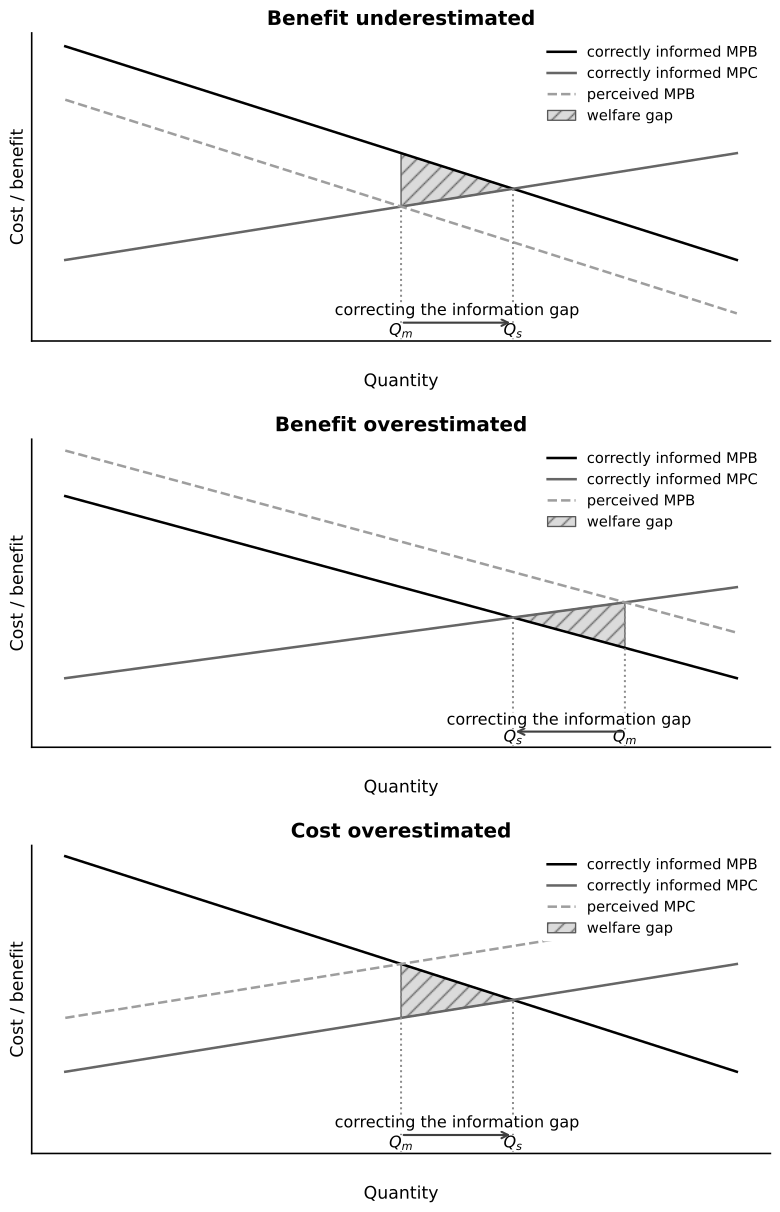
Caption: Each panel compares the curve perceived by the decision-maker with the correctly informed private curve. The chosen quantity occurs where the perceived marginal benefit equals the perceived marginal cost. In the panels shown, underestimating benefit or overestimating cost causes , whereas overestimating benefit causes . The hatched welfare gap should be explained using the correctly informed curves.
Here, means the quantity chosen with mistaken or incomplete information, while is the correctly informed benchmark under the stated no-externality assumptions. The label does not imply that government always knows the correct value with certainty.
Consumers or producers may lack accurate information about quality, future consequences, probability or cost. The market exists, but the privately chosen quantity is based on a misperceived curve.
The distinction from an externality is crucial. If a smoker underestimates harm to the smoker, the problem is inaccurate private information. If second-hand smoke harms non-smokers without compensation, the problem is an externality. One activity may involve both failures, but each requires a separate causal explanation.
- Underestimating the benefit of preventive healthcare may cause underconsumption.
- Underestimating addiction risk may cause overconsumption of a harmful good.
- Overestimating a product’s quality may also cause overconsumption.
Responses include disclosure, standardised labels, public education, certification, quality and safety rules, taxes, subsidies, default settings and direct provision.
Information alone may be insufficient when people cannot interpret it or when cognitive biases persist. Salient warnings can attract attention, loss-framed messages can exploit loss aversion, and choice architecture can change defaults while preserving choice. Such nudges should be transparent and evaluated empirically.
Enrichment: merit and demerit goods
A merit good is judged to be underconsumed; a demerit good is judged to be overconsumed. The label is not itself a causal explanation. The underlying reason may be information failure, an externality, a behavioural bias or a normative judgement.
Asymmetric information
Asymmetric information exists when one party to a transaction has relevant information that the other does not.
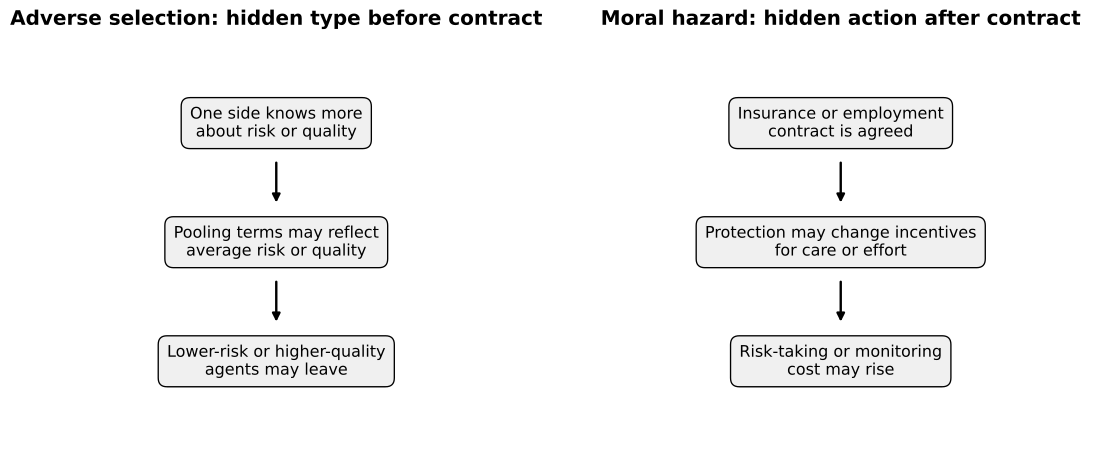
Caption: Adverse selection begins with a hidden characteristic before agreement: average pricing can drive lower-risk or higher-quality participants away, worsening the remaining pool. Moral hazard begins after protection or a contract is agreed: an action is difficult to observe, and the protected party may take more risk or exert less care because part of the consequence is shifted to someone else.
Diagram scope
Diagrammatic analysis of asymmetric information, adverse selection and moral hazard is not required by the syllabus. The figure is a conceptual timeline, not a demand-and-supply model to reproduce in an essay.
Adverse selection: hidden type before agreement
Insurance applicants may know more about their risk than insurers; used-car sellers may know more about quality than buyers. If the uninformed party offers terms based on average risk or quality, lower-risk or higher-quality participants may withdraw. The remaining pool becomes worse, so premiums rise or prices fall and trade may unravel.
The key is selection before agreement, not simply dishonesty. Even when nobody lies, high-risk applicants are more willing to buy insurance at an average premium, while low-risk applicants may judge it too expensive. Their different participation decisions change the composition of the market.
Responses include signalling, screening, warranties, certification, mandatory disclosure, risk pooling and compulsory participation. These mechanisms involve administrative cost and may exclude some beneficial trades.
Moral hazard: hidden action after agreement
Once insurance or another contract reduces the private cost of risky behaviour, the insured party may take less care. Similarly, workers may reduce effort when monitoring is difficult.
The key is a change in incentives or hidden conduct after agreement. Insurance does not force reckless behaviour, and moral hazard does not mean the insured person is immoral. It means the contract changes the share of consequences borne privately, while the action is costly to observe or verify.
Responses include deductibles, co-payments, no-claims bonuses, monitoring and performance pay. Stronger incentives may reduce risk protection, equity, trust or teamwork.
Distinguishing nearby failures
| Observation | Most direct diagnosis |
|---|---|
| Unpriced effect on uninvolved third parties | Externality |
| Incorrect or incomplete knowledge affects a choice | Information failure |
| One contracting party has a hidden type or action | Asymmetric information |
| A non-rival service cannot feasibly exclude non-payers | Public-good problem |
| A person knows the facts but predictably misprocesses them | Behavioural bias; possibly alongside information failure |
Common pitfalls
- Defining a public good as “free” or “provided by government”.
- Ignoring non-rejectability.
- Claiming non-rivalry means the good has no production cost.
- Treating every merit good as a public good.
- Reversing adverse selection and moral hazard.
- Assuming disclosure always overcomes limited attention or bounded rationality.
Return to Microeconomic Objectives and Policies.