Paper 1 Practice: Lunara’s Meal-Delivery Market — Answers
Indicative marking guidance
Credit other economically valid reasoning grounded in the extracts. Longer responses should be judged holistically for analysis, application, evaluation and a supported conclusion; the points below are not a compulsory script.
Question 1(a)(i) [2]
Equilibrium occurs where quantity demanded equals quantity supplied: L$6 per bundle and 80,000 bundles per week.
- correct price: 1 mark;
- correct quantity with unit: 1 mark.
Question 1(a)(ii) [2]
At L$5, quantity demanded is 95,000 and quantity supplied is 65,000:
The market shortage, or excess demand, is 30,000 bundles per week. Award 1 mark for selecting the correct quantities and 1 mark for the correct subtraction and unit.
Question 1(b) [4]
Delivered meals are plausibly normal goods, so higher household income increases demand. Improved app reliability raises the non-price attractiveness of ordering and also increases demand. Hence, at each possible price, consumers are willing and able to buy more, shifting the demand curve right.
With supply held constant as required by “other things being equal”, excess demand exists at the old equilibrium. The price rises, causing an extension of supply and a contraction of quantity demanded along the new demand curve until a new equilibrium is reached. Equilibrium price and quantity both rise.
Indicative allocation: two applied demand determinants (up to 2); rightward demand shift (1); adjustment to higher equilibrium price and quantity (1).
Question 1(c) [4]
Using midpoint percentages:
Demand is price elastic over this observed range because . Weekly sales revenue rose from
to
This revenue increase does not establish that profit rose because costs and the commission arrangement also matter.
Indicative allocation: valid midpoint method (1); PED approximately or magnitude with elastic interpretation (1); both revenue values or correct change of L$45,000 (1); correct revenue conclusion (1).
Question 1(d) [8]
Analysis
A specific tax raises the private marginal cost of using a disposable container. This shifts the supply curve for meal bundles using such containers upward/left. The price paid by consumers rises, the price retained by producers after tax falls, and equilibrium quantity decreases. Firms and consumers also gain incentives to reduce packaging, switch to reusable systems or change ordering habits.
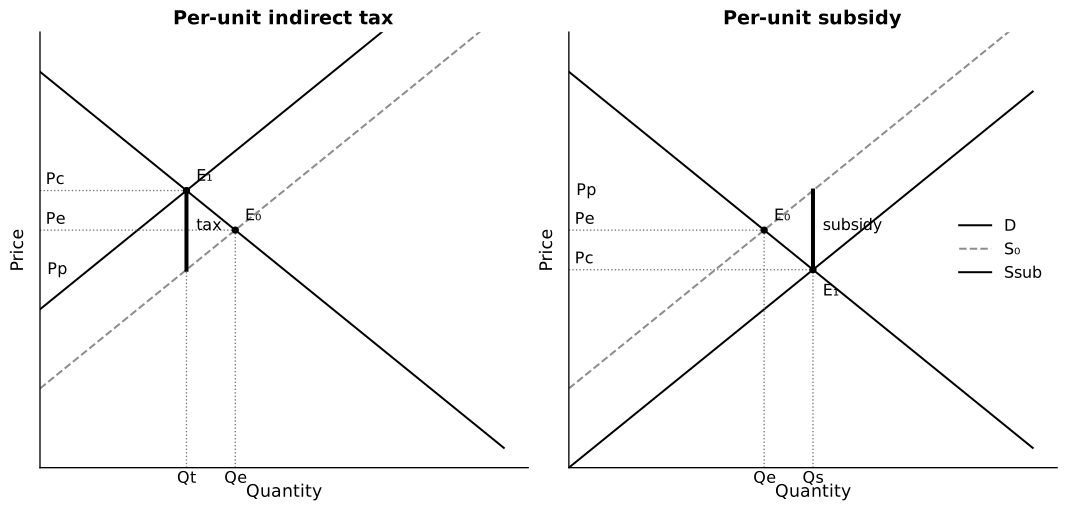
Caption: A specific tax creates a vertical wedge between the consumer price and the producer price net of tax. The resulting fall in equilibrium quantity reduces container use if each bundle would otherwise use one disposable container.
Evaluation and supported judgement
Effectiveness depends on PED, PES, the tax rate and the availability of substitutes. In the short run, dependent consumers and restaurants without washing equipment may respond weakly, so container use falls little even if prices rise. Responsiveness may increase over time as habits and equipment change. A per-container tax is more closely targeted at the external cost than a general tax on meals, but classification, monitoring and enforcement impose administrative costs. Reusable systems may themselves use water, energy and transport, so policy should compare net environmental costs rather than assume every reusable option is superior.
The 62% return rate in the voluntary trial shows that reuse is feasible but incomplete; it does not establish how a compulsory city-wide system would perform. Variation in clean-up cost by material and neighbourhood also means that one uniform charge may not equal marginal external cost in every use.
The tax is likely to reduce waste if it is large enough to alter marginal decisions and reusable alternatives are practical. Earmarking revenue for collection may manage remaining waste, but does not by itself prove that the tax rate is efficient. Full credit may be given to a different conclusion supported by elasticities, time period, substitution possibilities and administrative feasibility.
Indicative level guidance: a one-sided explanation should not normally reach the top band; a top response develops the mechanism, applies the evidence, evaluates conditions and reaches a qualified judgement.
Question 1(e) [10]
Case for a maximum price
A binding maximum price below equilibrium lowers the legal price and makes each successfully purchased bundle more affordable. This may protect households with caring or health needs. If platforms possess market power, a carefully designed control could also restrain excessive mark-ups, although the competitive demand-and-supply model alone does not establish market power.
Shortage and allocation problems
At the controlled price, quantity demanded exceeds quantity supplied. Couriers may reject orders and restaurants may reduce availability. The number of legal transactions is therefore normally constrained by quantity supplied. Waiting, rationing, reduced quality, hidden fees or illegal premiums can replace allocation by price, so the households with greatest need may still fail to obtain meals.
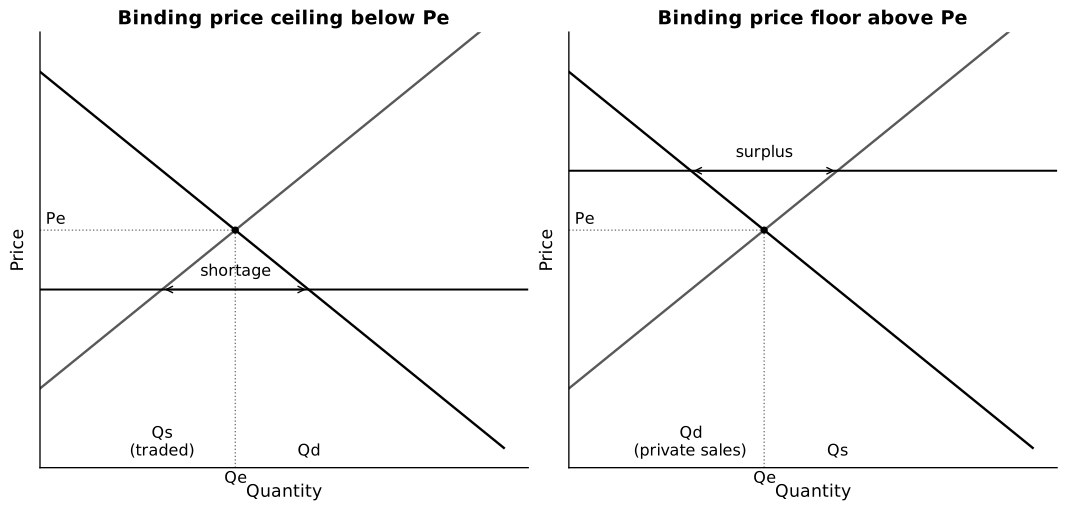
Caption: A binding ceiling creates excess demand equal to quantity demanded minus quantity supplied at the controlled price. This shortage is not itself the quantity traded; legal trades are normally limited by the smaller quantity supplied.
Alternatives and judgement
Targeted vouchers improve purchasing power for vulnerable households without directly suppressing the market price, but may raise demand and price when supply is inelastic. A capacity subsidy can shift supply right but has fiscal and opportunity costs and may subsidise activity that would have occurred anyway. Peak pricing can attract couriers when demand is high but weakens affordability.
The proposed control would also require rules covering delivery fees and service charges; otherwise firms could partly evade the ceiling by changing the price label. Eligibility costs weaken the voucher alternative, while the 78% platform share is not sufficient evidence by itself that a ceiling is an appropriate response to market power.
Lunara should not use a broad permanent ceiling unless it can secure adequate capacity and a fair non-price allocation mechanism. Targeted vouchers combined with supply expansion are more likely to preserve access. A temporary ceiling may be defensible in an emergency if essential users are prioritised. Credit alternative judgements that weigh affordability against availability and use relevant evidence.
Indicative level guidance: top responses analyse both intended and unintended consequences, compare at least one feasible alternative, apply the case evidence and make a reasoned conditional judgement.
Return to the question paper.
Question-by-question formative marking framework
Use this with the shared Economics formative marking framework.
| Part | Full-credit job | Acceptable alternatives and diagnostic ceiling |
|---|---|---|
| 1(a)(i), 2 | Identify the equilibrium price and quantity from equality of demand and supply, with units. | Method plus correct pair earns full credit; one correct value normally earns 1. |
| 1(a)(ii), 2 | Calculate excess demand at L$5 as quantity demanded minus quantity supplied, with unit. | “Shortage of 30,000 bundles” is required; calling it quantity traded should lose the interpretation mark. |
| 1(b), 4 | Explain two demand shifts and the resulting rise in equilibrium price and quantity under the stated ceteris-paribus condition. | A correctly explained combined rightward demand shift is sufficient. Treating income or reliability as movement along demand prevents full credit. |
| 1(c), 4 | Use the midpoint method, interpret elastic demand and reconcile the result with the observed revenue change. | Minor rounding is acceptable. A correct coefficient without revenue reasoning should normally remain at 2 or below. |
| 1(d), 8 | Trace the tax incentive, waste response and incidence, then assess elasticity, substitution, tax calibration, administration and heterogeneous external cost. | A supported pro-tax or sceptical conclusion is valid. Generic “taxes reduce demand” without case evidence should normally remain below 6. |
| 1(e), 10 | Explain a binding ceiling’s shortage and allocation effects, compare it with vouchers/capacity measures and judge affordability, access and enforcement together. | A temporary or targeted ceiling can be defended. An answer that equates a lower legal price with improved access should normally remain below 8. |
Common misconceptions
- A demand shift is not the same as an increase in quantity demanded caused by a lower price.
- Revenue and profit are different; higher revenue can coexist with lower contribution or profit.
- A shortage is excess quantity demanded at the controlled price, not necessarily the amount actually traded.
- Tax revenue is not proof that the tax rate equals marginal external cost.
Student self-check
Have I kept movements and shifts distinct, shown units and midpoint denominators, linked the tax to marginal decisions, and evaluated the price ceiling against both affordability and actual access?