Paper 2 Practice: Price Mechanism and Applications — Outlines
Indicative rather than exhaustive
These are analytical plans, not scripts. Credit coherent alternatives using correct Economics and a supported judgement. A response need not reproduce every bullet to earn high marks.
Question 1(a) [10]
- Define PED, YED and XED as proportionate responsiveness measures and interpret their signs and magnitudes.
- PED predicts the proportionate response of journeys to a fare change, ceteris paribus. If demand is elastic, a fare reduction raises sales revenue; if demand is inelastic, it reduces sales revenue.
- Commuters may have fewer close substitutes and more habitual travel than leisure passengers, but this is a testable hypothesis rather than a certainty.
- Positive YED identifies rail travel as a normal good for the relevant group; its magnitude estimates the demand shift caused by an income change. Negative YED would indicate an inferior service.
- Coach travel is a substitute if XED is positive. A coach-fare rise then increases demand for rail travel; a negative value would indicate complementarity.
- Estimates are conditional on the route, customer group, price range and time period. The operator must distinguish a movement along demand caused by its own fare from shifts caused by income or the price of coach travel.
- Revenue is not profit: capacity, staffing and energy costs also matter.
For 10 marks, reward connected explanation and application, not a list of definitions. A valid response may develop fewer points in greater depth.
Question 1(b) [15]
PED is useful because it predicts passenger and revenue responses and may support different fares across market segments. However, estimates vary by route, time, fare range, journey purpose and adjustment period. Segments must be identifiable and resale between them prevented. Capacity constraints matter: stimulating price-elastic demand at peak time may worsen crowding and require costly expansion. Objectives may include profit, ridership, congestion relief, equity or public-service obligations. Competitor reactions, regulation, marginal costs, network effects and customer goodwill also affect the decision.
A justified judgement is that PED is important but insufficient. It should inform route- and time-specific fares alongside marginal capacity cost, the operator’s objective and distributional effects. Greater weight belongs to PED where estimates are reliable and capacity is flexible; less where regulation or severe peak constraints dominate. Credit alternative conclusions supported by coherent conditions.
Question 2(a) [10]
- Establish the competitive equilibrium rent and quantity.
- A maximum rent below equilibrium is binding. It lowers the legal rent, increases quantity demanded and reduces quantity supplied, creating excess demand.
- The shortage is quantity demanded minus quantity supplied at the controlled rent; legal transactions are normally constrained by quantity supplied.
- Some incumbent tenants gain from lower rent, while unsuccessful applicants face search, waiting or administrative rationing.
- Landlords may reduce maintenance, convert units, screen tenants more strictly or demand hidden payments. These effects may grow over time if long-run supply is more price elastic.
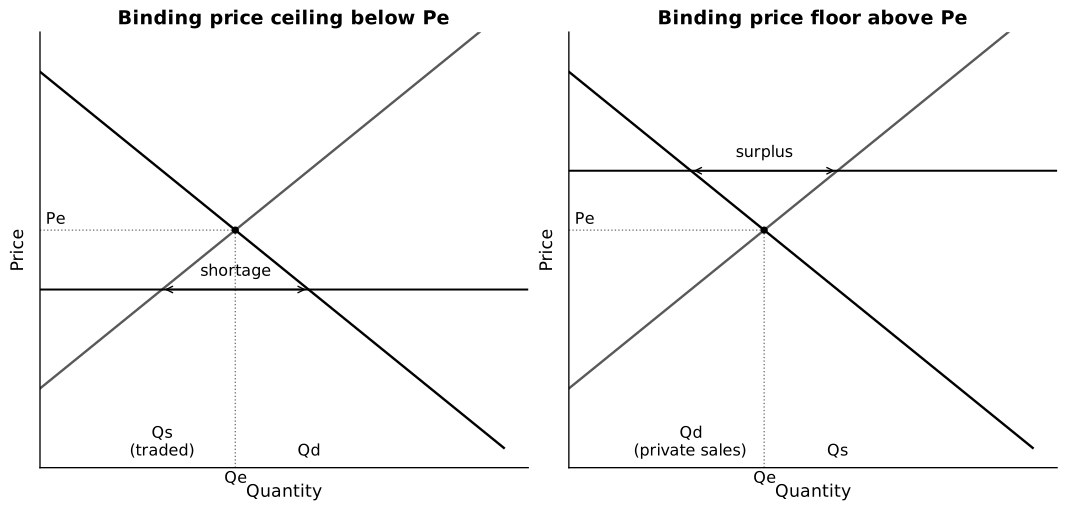
Caption: The binding ceiling produces excess demand measured at the controlled rent, while the quantity actually rented is normally constrained by the smaller quantity supplied.
For 10 marks, reward a well-labelled diagram integrated into a causal explanation. The diagram alone is insufficient.
Question 2(b) [15]
A maximum rent directly lowers the legal rent for successful tenants but does not remove housing scarcity and may contract supply. A provider subsidy shifts supply right, lowering rent and increasing quantity, but costs public funds; its incidence depends on elasticities and some benefit may accrue to landlords. Releasing suitable serviced land or reducing avoidable planning delays can increase supply more durably, but faces infrastructure needs, external costs and long time lags. Targeted tenant support improves affordability for selected households but can bid up rent when supply is inelastic.
The best package depends on whether the main problem is temporary hardship, structural land scarcity, construction cost or market power. Norvia should normally combine targeted short-run assistance with credible supply expansion. A narrowly designed temporary ceiling may protect existing vulnerable tenants during transition, but a broad permanent ceiling is unlikely to maximise access unless supply and allocation problems are addressed. Credit other policies and conclusions where their mechanisms, trade-offs and contextual conditions are explained.
Return to the essay questions.
Indicative essay-marking standard
Part (a): 10 marks
- Upper level: accurate, coherent and sufficiently developed explanation covering the full requirement; assumptions are made explicit; diagrams and context perform analytical work.
- Middle level: generally correct but incomplete, unevenly developed or weakly applied.
- Lower level: fragmented definitions, assertion, serious model error or failure to address a material part of the question.
Part (b): 15 marks
A strong response combines developed analysis with contextual evaluation. It compares arguments or policies using common criteria, identifies the conditions that change their relative importance, and reaches a supported judgement. Generic advantages/disadvantages or a bare “it depends” should not receive high evaluation credit.
These are formative descriptors derived from recurring corpus patterns, not official Cambridge or school-specific mark bands.
Question-specific formative marking framework
Use the working ranges in the shared Economics formative marking framework.
| Part | Requirements for the strongest working range | Diagnostic ceiling and alternatives |
|---|---|---|
| 1(a), 10 | Define PED, YED and XED; interpret sign and magnitude; trace effects on segment demand and revenue; and distinguish own-fare movements from demand shifts. | Merely listing formulae should normally remain at 4 or below. Calculated examples or diagrammatic routes are valid but not compulsory. |
| 1(b), 15 | Evaluate elasticity estimates alongside cost, capacity, objectives, segmentation, resale, rivals, regulation and time period, then judge when differentiated fares are defensible. | An elasticity-only answer cannot reach the strongest range. Profit, ridership, equity or congestion objectives may support different conclusions. |
| 2(a), 10 | Explain a binding ceiling’s price, demand, supply, shortage, quantity traded and non-price allocation effects. | A diagram with no allocation mechanism should normally remain at 7 or below. Credit black-market, quality or search-cost analysis when causally developed. |
| 2(b), 15 | Compare rent control, provider subsidy and land/supply measures using access, affordability, incidence, timing, fiscal cost and supply responsiveness; recommend a coherent package. | A lower controlled rent is not sufficient evidence of better access. Any ranking is valid when the constraints and affected groups are compared. |
Common errors and self-check
Do not confuse PED with a demand shift, revenue with profit, or a legal controlled price with the price and quantity every household actually obtains. Check that each essay answers the operator’s or government’s objective and compares policies using the same criteria.