Inflation, Deflation and Price Stability
Core distinctions
- Inflation: a sustained rise in the general price level (GPL).
- Disinflation: the GPL continues to rise, but at a slower rate.
- Deflation: a sustained fall in the GPL, corresponding to a negative inflation rate.
- Price stability: low and sufficiently stable inflation, avoiding both high inflation and harmful deflation.
A one-off increase in the price of one product is not inflation unless it contributes to a continuing increase in the general price level.
A numerical price-index path
| Year | CPI | Inflation rate from previous year | Interpretation |
|---|---|---|---|
| 0 | 100.00 | — | base observation |
| 1 | 106.00 | inflation: GPL rises | |
| 2 | 109.18 | disinflation: GPL still rises, but more slowly | |
| 3 | 108.09 | deflation: GPL falls |
The fall in the inflation rate from to does not reverse the earlier price increase. It only reduces the slope of the price-level path.
CPI and inflation measurement
The Consumer Price Index measures the price of a representative basket of consumer goods and services relative to a base year. Expenditure weights reflect the relative importance of basket categories.
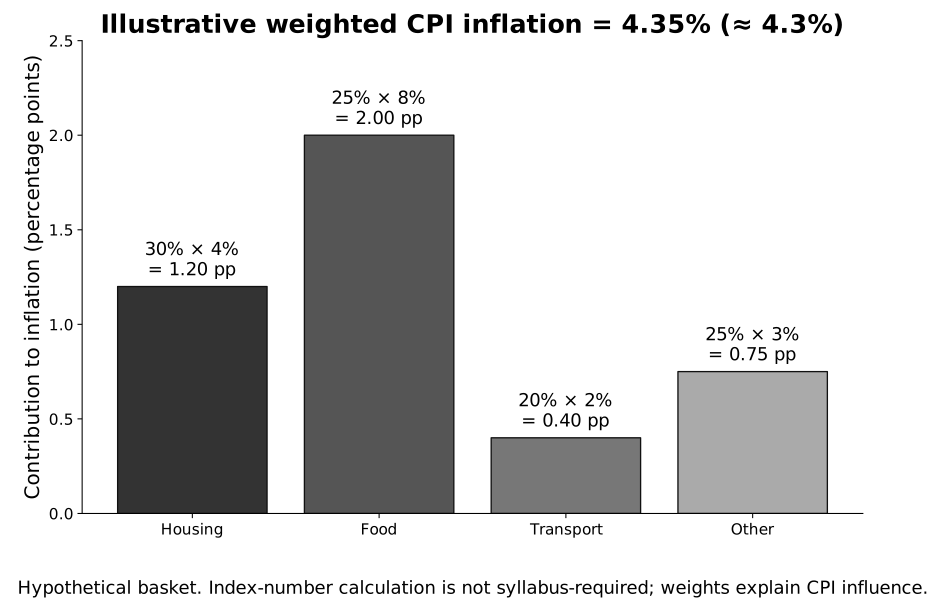
Caption: Each bar is a category’s percentage-point contribution: expenditure weight multiplied by its price change. Adding the four contributions gives the illustrative overall inflation rate. The chart explains weighting, not the construction of an actual national basket, and a large price rise can have a small CPI effect when its expenditure weight is small.
If inflation falls from to , prices are still rising. CPI may not represent every household because baskets differ, and measurement must address substitution, quality changes, new products and changing outlets.
Demand-pull inflation
Demand-pull inflation occurs when AD grows faster than the economy’s ability to produce, especially near full capacity.
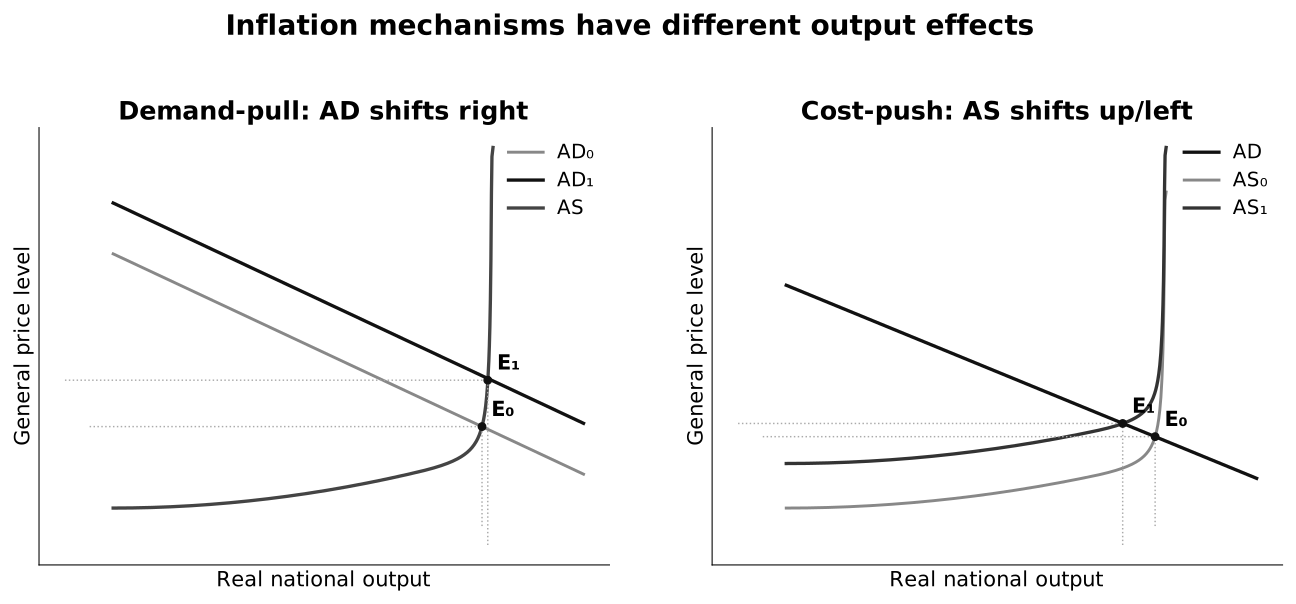
Caption: In the demand-pull panel, AD shifts right while AS is unchanged; output and GPL rise, with stronger price pressure near capacity. In the cost-push panel, AS shifts upward or left while AD is unchanged; GPL rises but output falls. The different output directions are why policy must begin with the cause of inflation.
Possible triggers include expansionary fiscal or monetary policy, rising confidence, stronger foreign demand or a depreciation that raises net exports.
Cost-push inflation
Cost-push inflation occurs when unit production costs rise and AS contracts. Possible causes include:
- higher wages not matched by productivity;
- higher energy, commodity or imported input prices;
- indirect taxes or regulatory costs;
- currency depreciation that raises import prices;
- supply-chain disruption or reduced productive capacity.
The result is stagflationary: the GPL rises while real output and employment fall. A wage-price process can make inflation persistent if workers seek compensation for expected inflation and firms pass higher costs into prices.
Imported inflation is particularly important in an open, import-dependent economy. Appreciation can lower domestic-currency import prices, but may weaken net exports.
Consequences of inflation
The severity depends on the rate, volatility, anticipation and the extent to which contracts are indexed.
Consumers and households
- real purchasing power falls when nominal income rises more slowly than prices;
- fixed-income households may be especially vulnerable;
- unanticipated inflation redistributes from fixed-rate lenders to borrowers because repayment has lower real value;
- high uncertainty makes saving and long-term planning harder.
Firms
- menu and repricing costs rise;
- relative-price signals become noisier;
- uncertainty can discourage investment;
- domestic firms may lose international price competitiveness if domestic inflation exceeds trading partners’ inflation, other things equal.
Government and the economy
- nominal tax receipts may rise, but expenditure and debt-servicing pressures can also increase;
- strong demand-pull inflation may accompany temporary growth and employment gains;
- persistent inflation can weaken confidence, exchange-rate stability and living standards.
Moderate, predictable inflation is less disruptive than high, volatile and unexpected inflation. Do not claim that every household or borrower is harmed in the same way.
Anticipated and unanticipated inflation
When inflation is anticipated, workers, lenders and firms may adjust wages, interest rates and contracts. Adjustment is rarely complete or costless, but redistribution is smaller than when inflation surprises agents. With unexpected inflation, a fixed nominal repayment transfers real purchasing power from lender to borrower because the money repaid buys less than expected. The relevant comparison is between nominal changes and the price-level change, not nominal income alone.
Deflation: causes are decisive
Deflation may result from:
- falling AD, which lowers both GPL and real output; or
- rising AS or productivity, which lowers GPL while real output rises.
These cases must not be evaluated identically.
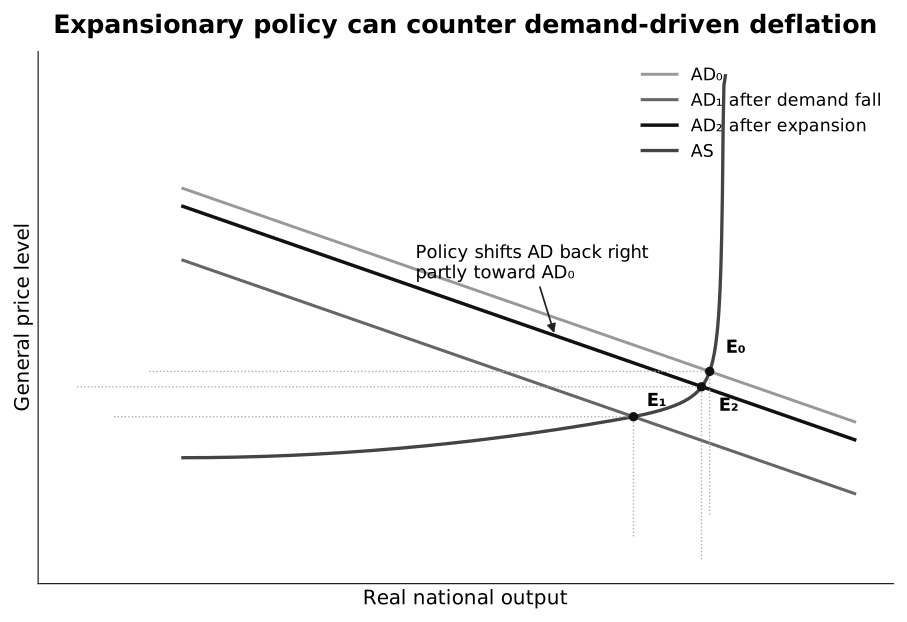
Caption: This diagram shows demand-driven deflation only. AD first shifts left from to , lowering both the GPL and real output; expansionary policy then shifts AD partly back right to . The new equilibrium does not necessarily return fully to . Productivity-driven deflation is a different case: an outward AS shift can lower the GPL while raising output, but that separate mechanism is not drawn here.
Harmful demand-driven deflation can form a reinforcing chain:
It also raises the real burden of nominal debt, which can force indebted households and firms to reduce expenditure further. Falling revenue and sticky nominal wages can squeeze profits, reduce investment and raise unemployment.
By contrast, productivity-driven deflation increases real purchasing power and output. Its benefits still depend on distribution, expectations and whether indebted agents face stress.
Policies against demand-pull inflation
Contractionary fiscal policy lowers or raises taxes, while tighter interest-rate or exchange-rate policy restrains private spending or imported inflation. Effectiveness depends on:
- the starting AS range;
- the multiplier and import leakages;
- interest sensitivity and confidence;
- time lags and policy credibility;
- fiscal and distributional consequences.
Demand restraint may lower inflation but sacrifice output and employment. The sacrifice is smaller when inflation mainly reflects excessive AD and expectations respond credibly.
Policies against cost-push inflation
Contractionary demand policy can reduce inflationary pressure, but it worsens the fall in output. More targeted responses may include:
- measures that reduce supply bottlenecks or unit costs;
- productivity-enhancing supply-side policy;
- temporary, well-targeted support that avoids sustaining inefficient input use;
- exchange-rate appreciation in an import-dependent economy.
Supply measures may take time. Exchange-rate appreciation can reduce imported inflation but weaken export competitiveness, and cost relief may burden the budget.
Policies against harmful deflation
When weak AD is the cause, expansionary fiscal or monetary policy can restore spending. Direct government expenditure may be more reliable when confidence is very weak, while lower interest rates may have limited effect if households deleverage or firms expect poor demand. Measures that support bank lending and credible expectations can strengthen transmission.
Singapore exchange-rate context
Singapore gives substantial weight to the exchange rate because trade and imported inputs are large relative to GDP. A policy-induced appreciation can:
- reduce the domestic-currency price of imported consumer goods and inputs;
- lower cost-push pressure and restrain inflation expectations;
- make exports dearer to foreigners and imports cheaper relative to domestic goods, tending to reduce .
The final effect depends on pass-through, contracts, market structure and demand elasticities. See Fiscal and Monetary Policy.
Common pitfalls
- Calling a slower increase in CPI deflation.
- Treating a single price increase as inflation.
- Explaining cost-push inflation with a rightward AD shift.
- Assuming all inflation harms borrowers.
- Claiming all deflation is harmful without identifying its cause.
- Recommending demand contraction for cost-push inflation without discussing the output cost.
- Assuming appreciation eliminates imported inflation completely.
Exam-ready judgement
Begin with the source of price instability. Then compare the likely inflation effect with output, employment, distribution and external effects. The most appropriate policy may be a package: immediate stabilisation for demand, targeted relief for a temporary supply disruption, and longer-run productivity measures where the cost problem is persistent.
Return to Macroeconomic Objectives and Policies.